How Arvo works
Arvo turns a denial letter into an appeal you can sign and send. You send a photo of the letter; Arvo reads it, works out your real appeal deadline, asks a few questions only you can answer, and drafts a letter that cites the rules your plan is bound by. You review it, sign it, and send it yourself, or tap “Fax it now” where fax sending is switched on.
The follow-up questions are the point. The facts that win a first-level appeal usually aren't on the denial letter. The plan says “conservative therapy was not documented”, and only you know you did physical therapy twice a week since December. Without asking, all a drafting step can do is write around the gap.
You can use Arvo on the web, from the appeal page, or, during the pilot, through the Arvo Telegram bot. There is no app to install.
What you can send
A phone photo of the letter is enough. Not the clean scan a demo would use: the sideways one, at night, with a thumb in the corner. Arvo prepares every file before a model sees it.
| iPhone photo (HEIC) | Converted to JPEG first. This one conversion fixes the most common failure in the whole pipeline. |
|---|---|
| JPEG, PNG, WebP, GIF, AVIF | Passed through the same preparation. |
| PDF from a payer portal | Read as a document rather than turned into an image, so small print stays small print. |
| Sideways photo | Rotated upright first. Rotated input measurably degrades what a model can read. |
| 12-megapixel camera photo | Downscaled to a 2,576-pixel long edge, the most detail the model uses. Nothing it could read is lost. |
If the document isn't a denial, or is too blurry to read, Arvo stops there: no questions, no letter, no PDF. It would rather ask you to send it again than draft an appeal from a document it couldn't read.
What Arvo reads
Arvo reads the letter with Anthropic’s Claude and pulls out the facts an appeal depends on, then shows them back to you to check and correct. When it is unsure of a field, it says so instead of guessing. Unsure fields are labelled unsure; they are never quietly filled in.
| Payer | Northgate Mutual Health |
|---|---|
| Patient | M. Alvarez |
| Claim number | 2026-CLM-77401 |
| Service | MRI, lumbar spine (CPT 72148) |
| Denial code | CO-50, not medically necessary |
| Amount billed | $2,410.00 |
| Plan type | Low confidence, please confirm: not stated on the notice |
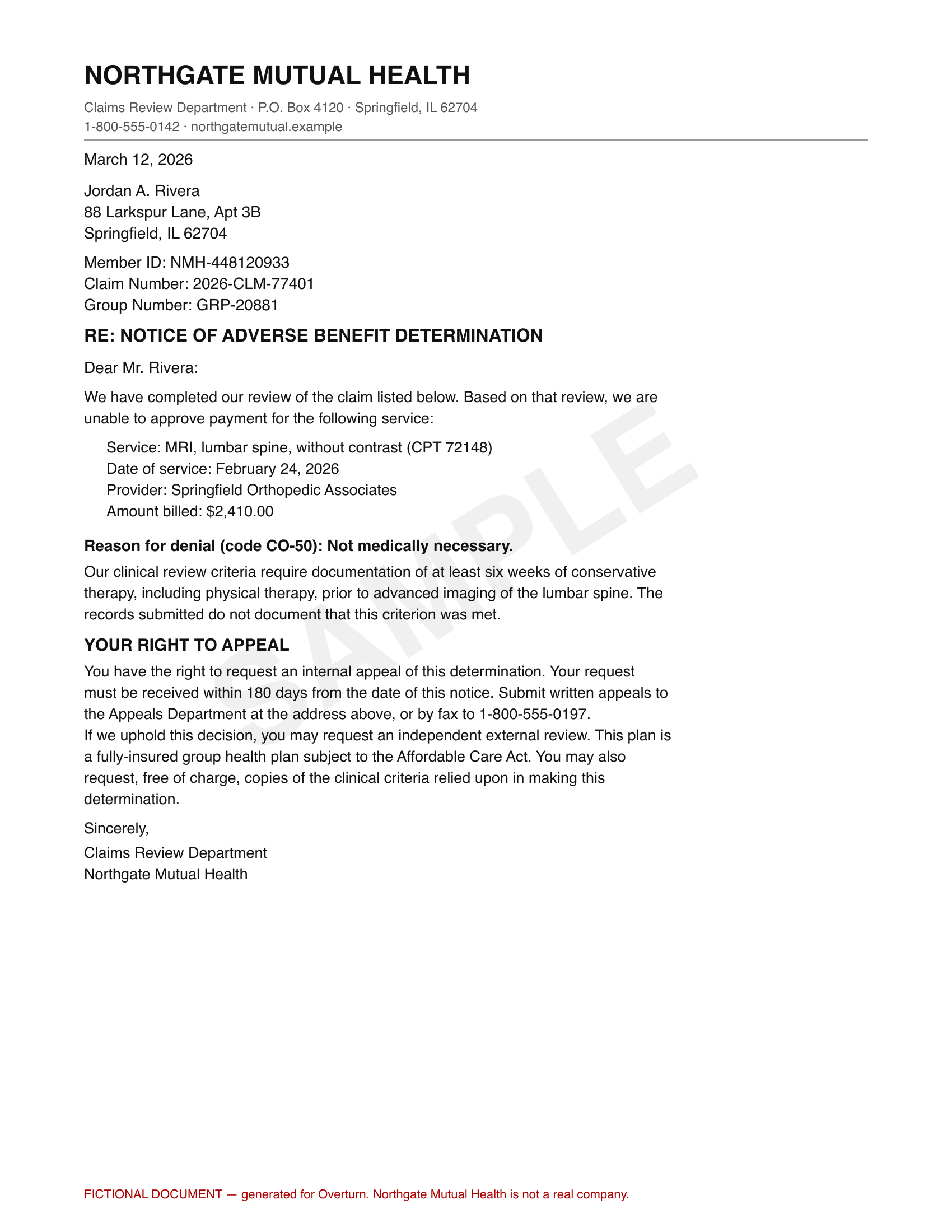
Your deadline
Every appeal right expires, and the date is almost never stated plainly. It is usually a number of days from a date printed somewhere else on the page. Arvo works it out with plain arithmetic, not a model: it reads “180 days”, “60 business days”, “6 months” or an explicit date, anchors it to the date on your notice, and gives you a calendar date and the days you have left.
When a letter states no deadline, Arvo falls back to the minimum the rules give your kind of plan: 180 days for plans governed by the ACA or ERISA, and 60 days for Medicare Advantage and Medicaid managed care. That fallback is always labelled as inferred, never presented as something your letter said, and never written into the appeal itself.
The questions
Arvo asks between none and four questions, each traced to the reason your claim was denied, each with the reason it matters attached. For a denial that cites a conservative-therapy threshold, the first question is whether you tried anything else before the treatment was ordered, because naming what you already tried is the single strongest thing you can add.
Every question can be skipped, and so can all of them at once. The letter is never held back for want of an answer: skip everything and you still get a complete draft.
The letter
Arvo drafts a first-person appeal in your voice, at a reading level a person actually uses, addressed to the appeals department named on your notice, with your claim number and deadline in it. It identifies which rules apply to your plan and writes to that standard:
- ERISA claims procedure rules, for most employer plans
- ACA internal and external review, for individual and marketplace plans
- Medicare Advantage appeals (42 CFR Part 422)
- Medicaid managed care appeals
It cites only well-established rules that apply generally. It is instructed never to invent a statute, case or policy number, and never to sharpen what you said: “a few weeks of PT” does not become “eight weeks of documented physical therapy”. Drafted letters are checked by a test suite that fails if a citation falls outside the allowed set, or if a date, amount or claim number appears that wasn’t on your notice.
The result is a PDF you can read, correct and download. It is a draft for you to review; it is not legal advice.
Signing
A draft becomes a letter when you sign it. You read a short statement (you have read the letter, the facts are true to your knowledge, you are the member or their guardian, you are signing it yourself, and Arvo is not your lawyer, representative or agent) and type your full name. That name is your signature.
Arvo then builds one packet: a cover sheet addressed to your plan’s appeals department, your signed letter with a real list of enclosures, and your denial letter re-rendered so it reads clearly by fax. A letter from your doctor goes in only as a signed original you upload yourself, never as a draft. Alongside it comes a one-page guide: where to send it, how (fax, certified mail or the plan’s portal), by when, and what to expect back.
Sending
Nothing goes to any insurer on Arvo’s initiative. You send the signed packet yourself, or, where fax sending is switched on, you tap “Fax it now” and Arvo faxes it at your direction.
- You see exactly what will go, and where. The fax number comes from your own letter, or one you type if the letter’s was missing or hard to read. Arvo has no directory of insurer numbers and never guesses one.
- One tap sends it once. The confirmation is tied to that exact packet and number, lasts 15 minutes, and can be used once. If anything changed since you looked, nothing is sent.
- Blanks stop it. Nothing is sent while the letter still has anything in [brackets] to fill in.
- You keep the proof. Arvo tracks delivery and keeps the transmission receipt with your case.
If you are signing as a parent, guardian or representative, Arvo gives you the packet and the guide to send yourself.
After you send
An appeal is a process, not a letter: an acknowledgment, sometimes a request for more information, then a decision. If you choose to track your appeal, Arvo watches two clocks, your deadline to send and then the plan’s deadline to decide, and tells you when either is close.
| Internal appeal, before a service | The plan must decide within 30 days of receiving it. |
|---|---|
| Internal appeal, after a service | The plan must decide within 60 days of receiving it. |
| Urgent care | The plan must decide within 72 hours. |
| Medicare Advantage, before a service | Within 30 days, with up to 14 more if the plan justifies an extension. |
| Medicare Advantage, payment | Within 60 days. |
If the window passes with no decision, Arvo asks what, if anything, arrived. Where the rules allow, it prepares the next step, usually an external review, as a draft for you to review and sign. When the plan decides, the outcome is recorded without your name: the plan type, the denial codes, and whether the denial was overturned.
Your data
A denial letter is health information, so here is exactly what happens to it.
- To read and draft, your letter is sent to the AI model provider, Anthropic.
- If you don’t track your appeal, nothing is written to disk. Your letter, the answers you give and the PDF are held in memory and expire after 30 minutes.
- If you track it or sign in, your claim details, letter, drafts and packets are stored encrypted (AES-256-GCM) for 60 days after your deadline, or 30 days for a draft you never signed. Encrypted backups expire within 30 days.
- Text messages are not encrypted end to end. If you’d rather not send a medical letter by message, use the upload on the web instead.
The FTC Health Breach Notification Rule applies to everything Arvo holds. The privacy policy sets out who receives what, and why.
What Arvo is not
Arvo is a document-preparation and fax service, and a free pilot. It is not your lawyer, your representative or your agent, and nothing it writes is legal advice or creates an attorney–client relationship.
What's real
Reading the letter, working out the deadline and drafting the appeal are all real: the model reads the document you send and cites the rules your plan is actually governed by.
What's never automatic
Sending. Arvo prepares a signed packet and tells you where your letter says to send it. Where fax sending is switched on, it happens only when you sign and tap “Fax it now”, and you get the transmission receipt.
What you should check
Deadlines and citations are generated. Confirm them against your own plan documents and notice before you rely on them. Mail and insurer portals are not connected; the guide in your packet covers them by hand.
Your rights
You have the right to appeal a denied claim, first inside your plan and then, for most plans, to an independent reviewer outside it. These official guides explain the process in full:
- Appealing a health plan decision (HealthCare.gov)
- External review (CMS)