Research · Featured study · July 2025
A.I. as a Strategic Trade AssetDesigning Export Controls for the Next Generation of Semiconductors
Page 1
1 Executive Summary
The strategy surrounding artificial intelligence semiconductors has drastically altered relations between the U.S. and China, solidifying the technology as a key point, with government intervention playing a significant role in global supply chains. Currently, export controls around semiconductors are the most restricted in history, specifically targeting China’s access to A.I. chips and manufacturing equipment. China has responded with large state-led investments of over $300 billion to become self-sufficient, only further fueling this rivalry with the U.S. Some export controls in international trade include dual-use technology with applications both among civilians and in the military. Examples include computing hardware or encryption software; materials controls and specialized chemicals; military equipment restrictions on weapons; and new technology controls targeting biotechnology, artificial intelligence, and quantum computing. These controls work via licensing requirements placed on exporters, end-user verification processes, new thresholds for technical specifications, and country-specific embargoes and trade restrictions. The effectiveness of these systems is dependent on international cooperation, which fluctuates greatly from nation to nation. International law controls and regulates export controls through a number of mechanisms. These include international treaties and alliances creating binding obligations between state parties; multilateral export control regimes like the Wassenaar Arrangement or the Nuclear Suppliers Group; resolutions by the United Nations Security Council restricting trade in emerging technologies; and bilateral trade agreements between nations concerning technology trade. Here, some of the guiding principles include state sovereignty in implementing new restrictive controls, the non-proliferation of nuclear weapons, the harmonization of control lists and procedures, and information sharing and cooperation by all participating states. However, enforcement has been difficult because of jurisdictional problems, varying national interpretations of new rules, and the constantly unmet need for consistent global standards.
Page 2
2 Strategic Importance
2.1 Technical Overview
2.1.1 AI Chip Architecture and Capabilities
A.I. semiconductors represent a significant departure from traditional CPU architectures through their specialized design for parallel processing and matrix operations essential to machine learning workloads. These chips include Graphics Processing Units (GPUs), Tensor Processing Units (TPUs), Neural Processing Units (NPUs), and Application-Specific Integrated Circuits (ASICs), involving immense parallelism of multiply-accumulate functions to accelerate deep learning training and inference tasks. Further, GPUs remain dominant in training large-scale A.I. models due to their ability to handle thousands of concurrent calculations, while NPUs excel in energy-efficient edge A.I. inference by optimizing low-precision computations (e.g., INT8, FP16).12 Heterogeneous integration architectures, such as AMD’s MI300X, combine CPUs, GPUs, and NPUs within a single package to balance diverse computational demands.3 Memory bandwidth innovations are equally critical; High-Bandwidth Memory (HBM3) stacks deliver over 1 TB/s to mitigate data bottlenecks in large language models like GPT-4.4 Furthermore, A.I. chips achieve 2–5 times better performance per watt than general-purpose processors, enabling deployment in power-constrained environments from data centers to IoT devices.12 Emerging architectures include neuromorphic chips that mimic biological neural networks to achieve real-time sensor processing and photonic designs using light-based computation, though the latter remains experimental.45
2.1.2 Manufacturing Processes and Requirements
The production of advanced A.I. semiconductors hinges on sub-7nm process nodes, demanding unprecedented precision in fabrication technologies. Extreme Ultraviolet (EUV) lithography, operating at a 13.5nm wavelength, is indispensable for etching sub-10 nm features, yet ASML of the Netherlands holds a nearmonopoly on EUV scanner production—equipment now restricted for export to
- 1Ellen Glover, “AI Chips: What Are They?”, 2025, https://builtin.com/articles/ai-chip
- 2Mesh Flinders and Ian Smalley, “What is an A.I. chip?”, IBM Think, 2024, https://www.ibm.com/think/topics/ai-chip
- 3Saif M. Khan, “AI Chips: What They Are and Why They Matter”, 2020, https://cset.georgetown.edu/publication/ai-chips-what-they-are-and-why-they-matter/
- 4Thomas Andersen, “AI Chip Architecture Explained”, Synopsys Blog, 2023, https://www.synopsys.com/blogs/chip-design/ai-chip-architecture.html
- 5Sudipto Das, “AI and Semiconductors: Fueling Each Other’s Evolution”, n.d., https://www.questglobal.com/insights/thought-leadership/ai-and-semiconductors-fueling-each-others-evolution/
Page 3
China under U.S. and Dutch trade controls.67 This technological asymmetry exacerbates supply chain vulnerabilities, particularly as China’s SMIC struggles to replicate 7nm capabilities using older Deep Ultraviolet (DUV) tools.6 Advanced packaging techniques like 3D stacking (e.g., TSMC’s CoWoS and Intel’s Foveros) integrate multiple chiplets into single units, improving thermal management and interconnect density.45 Material science innovations are transitioning substrates from silicon to gallium nitride (GaN) and silicon carbide (SiC) for higher thermal stability and electron mobility.7 However, manufacturing yields remain a critical challenge; defect tolerance below 5% at 3nm nodes inflates production costs by 30–50%, compounded by the complexity of multipatterning techniques.7 These constraints intensify geopolitical dependencies, as China relies on foreign equipment for 85% of its advanced chip production despite aggressive domestic investment.6
2.1.3 Key Players and Market Dynamics
Market dominance in the A.I. semiconductor sector is highly concentrated, with the top 5% of companies—Nvidia, TSMC, Samsung, ASML—generating over 90% of the industry’s economic profit as of 2024.64 Nvidia controls approximately 80% of the global A.I. GPU market, underpinned by its H100 and Blackwell architectures optimized for data center workloads; its Q1 2024 profits increased 769% year-over-year despite U.S. export restrictions on China. Further, TSMC, the world’s largest foundry, manufactures around 90% of advanced logic chips, including Nvidia’s GPUs and Apple’s processors, leveraging its 3 nm process node and CoWoS packaging technology to command a 62% foundry revenue share.66 Equipment suppliers like ASML, Applied Materials, and Lam Research collectively control 75% of the semiconductor manufacturing equipment (SME) market, with ASML’s EUV lithography tools representing an irreplaceable bottleneck for cutting-edge fabrication.6
Additionally, geopolitical tensions are reshaping supply chains: the U.S. CHIPS Act grants totaling $39 billion aim to onshore production through investments in TSMC’s Arizona fab and Intel’s Ohio facility, while China’s $47.5 billion state fund accelerates SMIC’s development of mature-node chips.6 Innovation frontiers include chiplet ecosystems using the Universal Chiplet Interconnect Express (UCIe) standard and quantum-AI hybrids, though both face scalability hurdles. China is aggressively investing in its semiconductor capabilities through initiatives like the “Made in China 2025” roadmap and the establishment of a $47.5 billion state investment fund, which aims to enhance domestic capabilities and achieve self-sufficiency. The A.I. chip market’s projected growth to $263.6 billion by 2031 underscores its strategic centrality to global technological competition.4
- 6Ahmad Helal, “Global Semiconductor Industry Trends, Key Players & Geopolitics”, 2024, https://infomineo.com/technology-telecommunication/global-semiconductor-industry-trends-key-players-geopolitics/
- 7Yash Shah, “AI in Semiconductor Industry”, 2025, https://www.aegissofttech.com/insights/ai-in-semiconductor-industry/
Page 4
2.2 National Security Implications
Semiconductors are the beating heart of modern militaries around the world. Today, all major U.S. defense systems rely on semiconductors for performance ranging from basic communications to advanced early warning radars. Dominance in this field of technology will prove critical in the coming multipolar military struggle of an increasingly complex geopolitical landscape. As warfare shifts from the steaming pistons of the assault rifle to the highly digitized world of information and data, superiority in this theater will determine the outcomes of wars and, with it, whether policies shall end in glory or in failure.
2.2.1 Military Applications
Radar systems are one of the many platforms almost completely dependent on semiconductors. Modern active electronically scanned array (AESA) utilizes thousands of transmit receive modules (TRMs), which are tiny semiconductor devices, to track moving targets and provide battlefield awareness to deployed assets in the region.8 These are outfitted on U.S. Navy AWACS early warning aircraft like the E-2 Hawkeye, which is a standard complement on aircraft carriers to enhance spatial awareness of other carrier-based airborne assets. Air systems like these serve as eyes in the sky for any friendly deployed air units, from fighters to bombers, delivering unmatched surveillance that enables pilots to maintain acute awareness of potential threats and take active measures to reduce their potency. Recent advances in Gallium Nitride (GaN) technology have further enhanced this capability, being able to produce higher power output with greater efficiency and thermal tolerance than traditional silicon and gallium arsenide components, which allows aircraft radars to achieve longer range, higher resolution, and greater reliability without large cooling equipment. These radars can be found in all branches of the U.S. military, from the Army’s LTAMDS tracking systems, to naval and air force aircraft like the F-35 and F-15 EX.9 In all cases, continued advances in semiconductor technology result in better resolution, range, and multipurpose functional flexibility for the U.S. armed forces.
Missiles and precision-guided munitions are another military field heavily dependent on semiconductor technology. Guidance units usually include inertial measurement units (IMUs) built onto GPS receivers and onboard flight computers that process sensor inputs to adjust course. As missiles must endure extreme acceleration and high temperatures (especially in hypersonic glid vehicles), their electronics must be built to withstand extreme environmental pressures. There is a growing trend to apply wide bandgap semiconductors like Silicon Carbide (SiC) in missile electronics due to their high temperature, voltage, and current toleration. This makes them ideal for controlling fin actuators and motor drives in missiles.9 Missile seekers, from radar to laser, also rely on specialized semiconductors. Active radar seekers ( on certain air-toair and surface-to-air missiles) use miniature AESA. Imaging infrared seekers (IIR) employ semiconductor detector grids paired with signal processing chips that use algorithms (increasingly A.I.) to identify targets against background residual heat signatures. Another aspect is radiation-hardened electronics for intercontinental ballistic missiles (ICBMs) and nuclear-capable systems. The guidance system on missiles designed to deliver nuclear payloads must withstand prolonged exposure to radiation and cosmic rays when the warheads exit the atmosphere. Hence, these systems use radiation-hardened microprocessors and memory storage to ensure reliability throughout the warhead delivery process.
- 8Sujai Shivakumar, Julia Yoon, and Tisyaketu Sirkar, “Gallium Nitride: A Strategic Opportunity for the Semiconductor Industry”, 2024, https://www.csis.org/analysis/gallium-nitride-strategic-opportunity-semiconductor-industry
- 9Gary Elinoff, “Wide Bandgap Semiconductors: Key for Modern Military Technology”, 2025, https://www.electropages.com/blog/2025/05/wide-bandgap-semiconductors-key-modern-military-technology
Page 5
Beyond the hardware roles of semiconductors, advanced chips also serve as the working brains behind software-based capabilities. Specifically, artificial intelligence and machine learning are emerging as critical force multipliers with their increasingly frontal deployment spurring demand for rugged, high-performance A.I. processors that can be integrated with forward drone reconnaissance and robotics units. A prime example of this is the U.S. Army’s new Artificial Intelligence Processor (AIP) introduced by Leonardo DRS. This is a battlefield computing system designed to deliver powerful A.I. capabilities to active combat zones like threat detection and sensor fusion, to Army combat vehicles like the Bradley and Stryker.10 A.I.P units can absorb large data streams from data-collecting assets and apply A.I. algorithms to identify targets, all while resisting extreme environmental conditions. The Department of Defense is also investing in next-generation microchips for A.I. through agencies like DARPA via their OPTIMA (Optimum Processing Technology Inside Memory Arrays) Program, which aims to create new chip architecture capable of running A.I. algorithms with greater energy efficiency.11 This is aimed at providing forward-deployed units with data computing capabilities and synchronizing data collection across a multitude of domains entirely offline without needing to reach back to data centers.
2.3 Economic Impact
2.3.1 Supply Chains
The semiconductor supply chain is one of the most complex and geographically fragmented production networks in the global economy. No single economy can autonomously control the industry with over 500 discrete production stages involved, and components required to cross over 70 international borders before reaching final consumers.12 Disruptions, or “single points of failure”, at any critical point will propagate throughout the global economy and technology ecosystem. This is because there are more than 50 points across the semiconductor value chain where one region holds more than 65% of global market share.13
- 10Steve Vather and Michael Mount, “Leonardo DRS Launches Next Generation A.I. Processor to Give Warfighters Greater Tactical Edge”, 2025, https://www.leonardodrs.com/news/press-releases/leonardo-drs-launches-next-generation-a-i-processor-to-give-warfighters-greater-tactical-edge/
- 11Patrick Tucker, “Military Funding New Chip Designs for the A.I. Era”, 2024, https://www.defenseone.com/technology/2024/03/military-funding-new-chip-designs-ai-era/394749/
Page 6
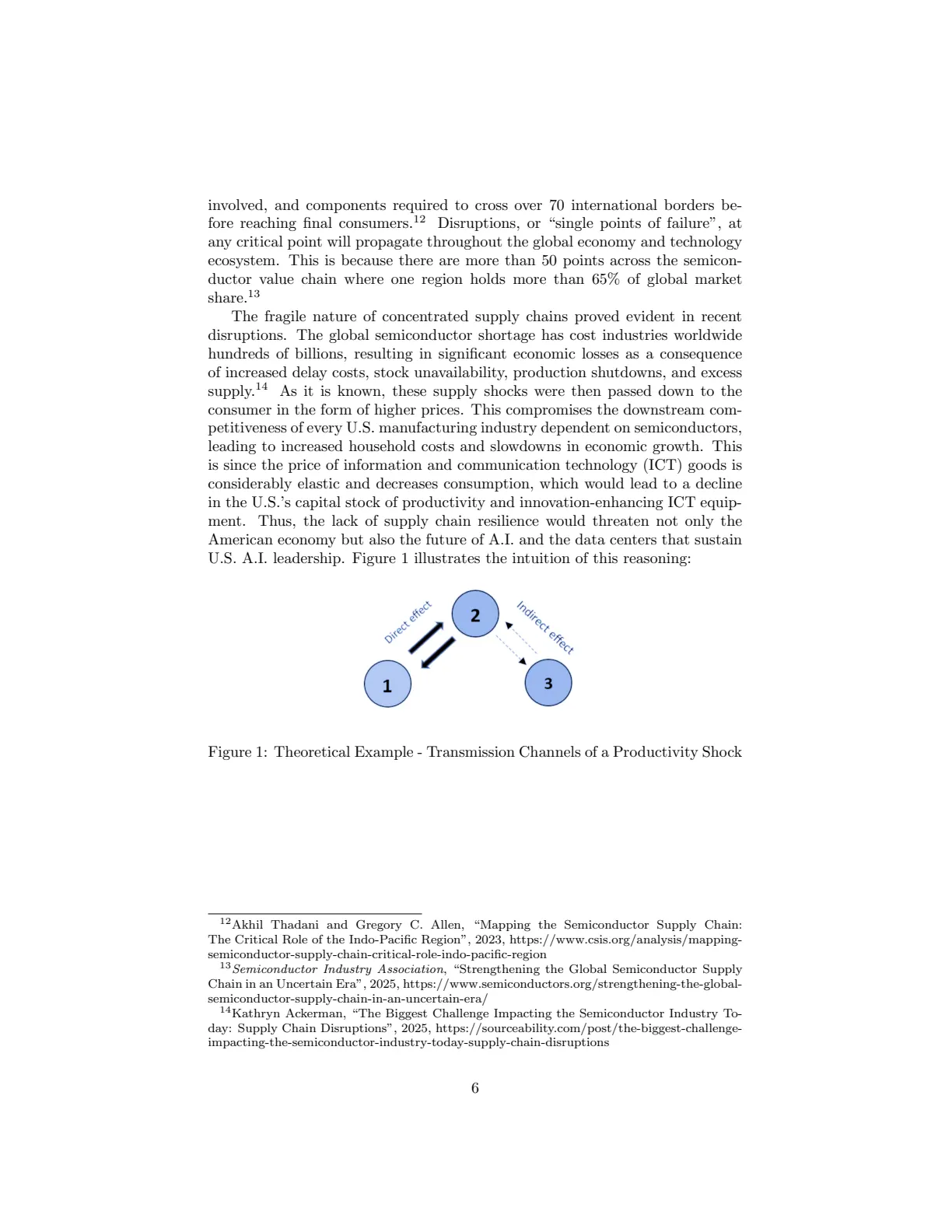
The fragile nature of concentrated supply chains proved evident in recent disruptions. The global semiconductor shortage has cost industries worldwide hundreds of billions, resulting in significant economic losses as a consequence of increased delay costs, stock unavailability, production shutdowns, and excess supply.14 As it is known, these supply shocks were then passed down to the consumer in the form of higher prices. This compromises the downstream competitiveness of every U.S. manufacturing industry dependent on semiconductors, leading to increased household costs and slowdowns in economic growth. This is since the price of information and communication technology (ICT) goods is considerably elastic and decreases consumption, which would lead to a decline in the U.S.’s capital stock of productivity and innovation-enhancing ICT equipment. Thus, the lack of supply chain resilience would threaten not only the American economy but also the future of A.I. and the data centers that sustain U.S. A.I. leadership. Figure 1 illustrates the intuition of this reasoning:
Figure 1: Theoretical Example - Transmission Channels of a Productivity Shock
- 12Akhil Thadani and Gregory C. Allen, “Mapping the Semiconductor Supply Chain: The Critical Role of the Indo-Pacific Region”, 2023, https://www.csis.org/analysis/mapping-semiconductor-supply-chain-critical-role-indo-pacific-region
- 13Semiconductor Industry Association, “Strengthening the Global Semiconductor Supply Chain in an Uncertain Era”, 2025, https://www.semiconductors.org/strengthening-the-global-semiconductor-supply-chain-in-an-uncertain-era/
- 14Kathryn Ackerman, “The Biggest Challenge Impacting the Semiconductor Industry Today: Supply Chain Disruptions”, 2025, https://sourceability.com/post/the-biggest-challenge-impacting-the-semiconductor-industry-today-supply-chain-disruptions
Page 7
The Trump administration has suggested plans to impose semiconductor tariffs at 25% and north over the course of 2025.15 Econometric modeling suggests that implementing comprehensive tariffs on semiconductor imports would impose severe macroeconomic costs. Let Yt denote U.S. GDP in year t, and τ the ad valorem tariff rate (25% as the baseline). The GDP growth reduction is derived from a dynamic general equilibrium (DGE) model, accounting for direct cost-push effects on downstream industries, reduced business profit margins, and trade diversion inefficiencies from distorted comparative advantage. The cumulative GDP loss over a 10-year horizon (t=1,...,10) can be expressed as:
10
10 (cid:88) (cid:88) b − Yt τ ) ≈ 0.76% ×
b ∆Y = (Yt Yt t=1 t=1 A sustained 25% tariff on semiconductor imports would suppress U.S. GDP growth by 0.76% in year 10. Under conservative assumptions, this translates to a cumulative loss of $1.4 trillion (2025 USD, NPV-adjusted) or 4.8% of U.S. GDP. This translates to around $4.2k per American.
Figure 2: Cumulative GDP Loss from 25% τ (2025-2035)
The 0.76% GDP decline is non-linear; marginal losses accelerate with higher tariff (τ ) (convexity in ∆Y (τ )). Conversely, regionalization of semiconductor supply chains necessitates: • Capital expenditures (CapEx): Iregional = Iglobal + ∆I, where ∆I ¿ $1
trillion. • Price effects: Scale diseconomies and labor-cost differentials induce a price premium ϕ
ϕ =
∈ [0.35, 0.65]
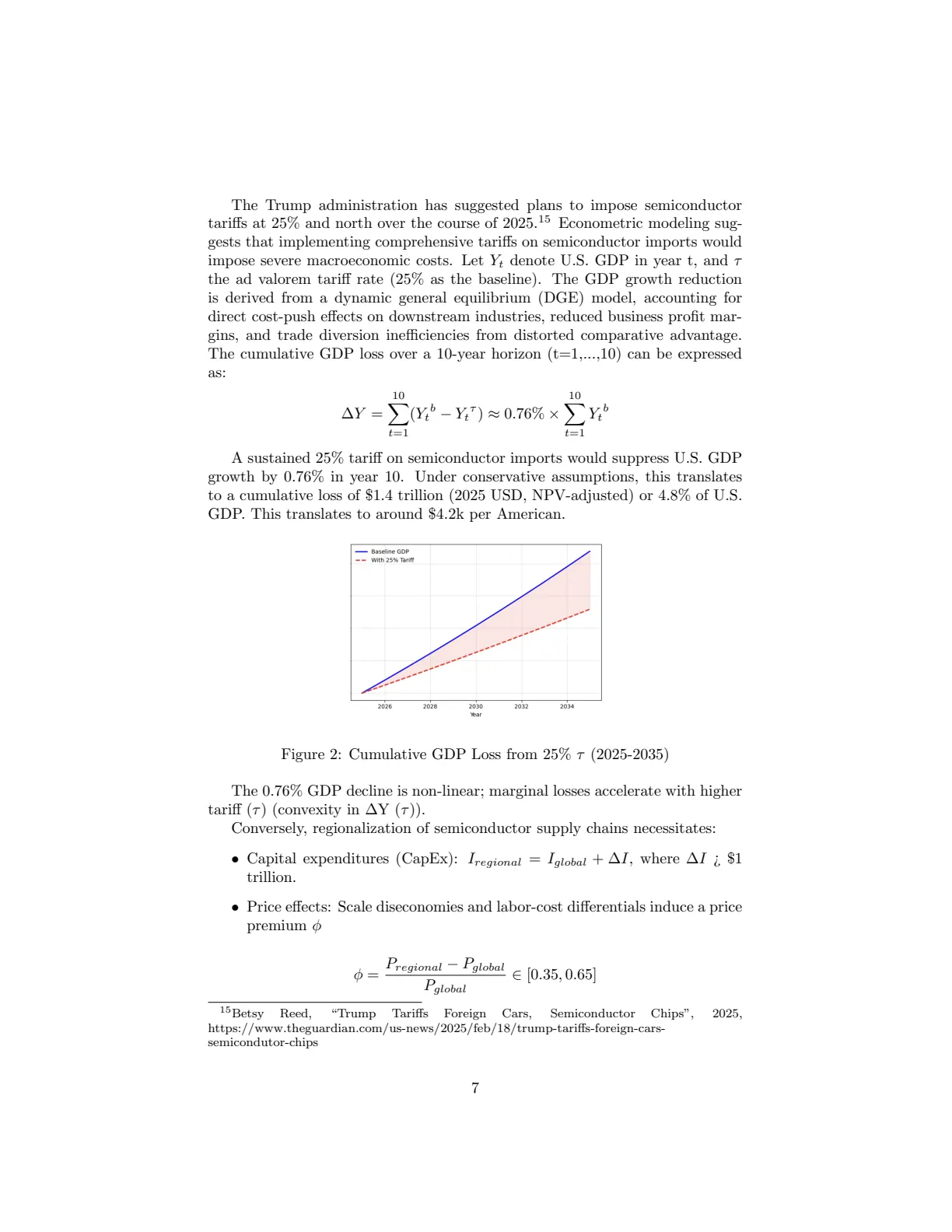
- Pregional − Pglobal Pglobal
- 15Betsy Reed, “Trump Tariffs Foreign Cars, Semiconductor Chips”, 2025, https://www.theguardian.com/us-news/2025/feb/18/trump-tariffs-foreign-cars-semicondutor-chips
Page 8
Pursuing complete supply chain regionalization would require over $1 trillion in upfront investment, inflating global chip prices by 35-65%.13 With the disruption of global semiconductor supply chains, we would consequently find a global GDP decline and thus a global welfare loss.
2.3.2 Market Size & Growth Projections
The global semiconductor market reached $700.9B in 2025, representing an 11.2% year-on-year increase from 2024’s $627.6B in sales.16 This growth trajectory positions the industry on track to achieve the anticipated $1 trillion milestone by 2030, which requires only a CAGR of 7.5% between 2025 and 2030. Regional growth patterns demonstrate significant geographical concentration with the Americas leading at 18% growth and Asia Pacific at 9.8%.16 Semiconductor companies are projected to allocate $185B to CapEx in 2025 to expand manufacturing capacity by 7%.17 The market is forecasted to grow 8.5% in 2025, reaching $760.7B.
Figure 3: Global Semiconductor Market Size Projections
2.3.3 Employment, Innovation, & Long-Term Growth Effects
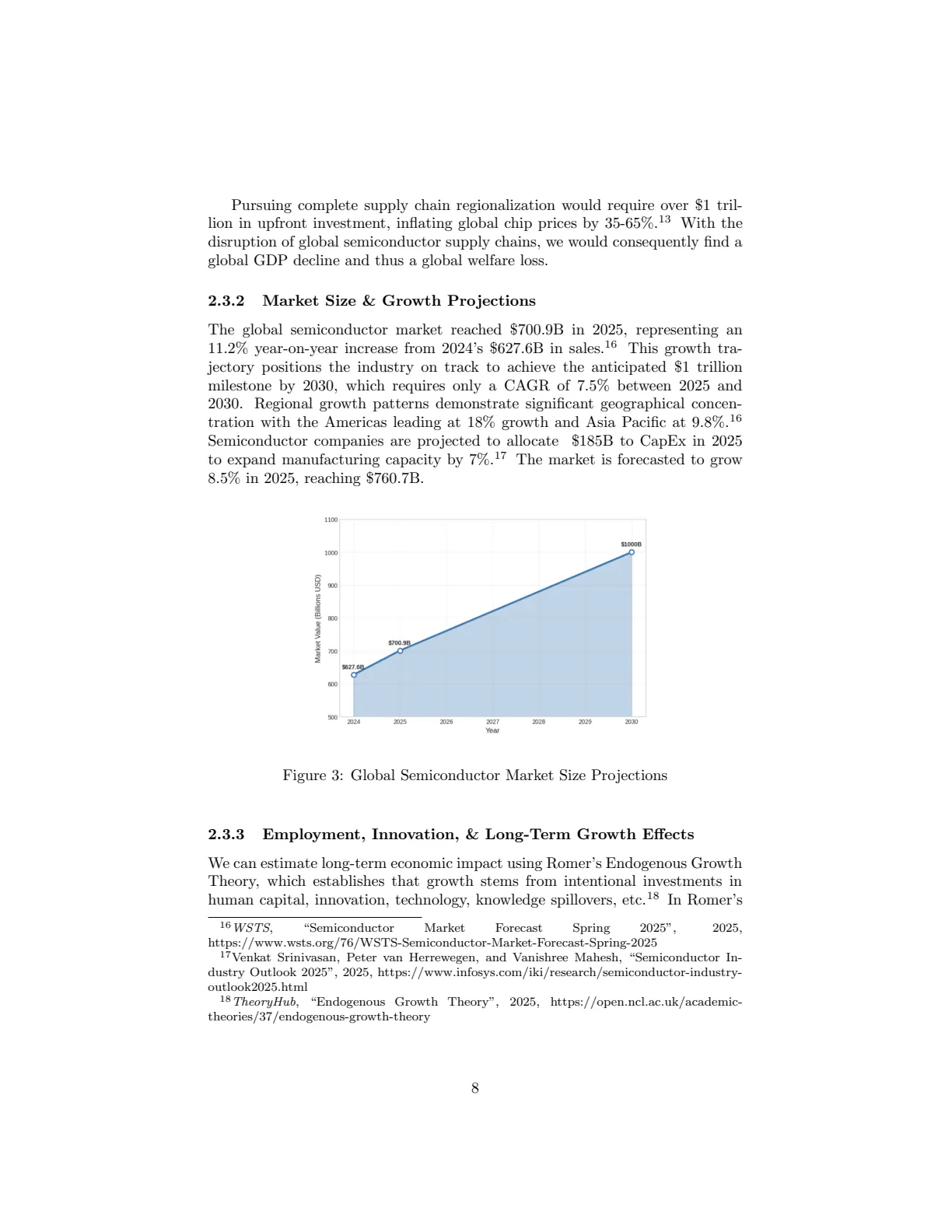
We can estimate long-term economic impact using Romer’s Endogenous Growth Theory, which establishes that growth stems from intentional investments in human capital, innovation, technology, knowledge spillovers, etc.18 In Romer’s framework, the production function for the level of technology/knowledge can be expressed as:
- 16WSTS, “Semiconductor Market Forecast Spring 2025”, 2025, https://www.wsts.org/76/WSTS-Semiconductor-Market-Forecast-Spring-2025
- 17Venkat Srinivasan, Peter van Herrewegen, and Vanishree Mahesh, “Semiconductor Industry Outlook 2025”, 2025, https://www.infosys.com/iki/research/semiconductor-industry-outlook2025.html
- 18TheoryHub, “Endogenous Growth Theory”, 2025, https://open.ncl.ac.uk/academic-theories/37/endogenous-growth-theory
Page 9
˙A = δLϕ
AAρ For steady-state growth, this simplifies to the fundamental relationship where gY represents the growth rate of output.
gY = δLA Applying this framework to the semiconductor industry, with global R&D spending of $112.1B in 2025 (16% of market revenue) and an estimated 460K researchers worldwide,19 the implied research productivity parameter (δ) = 24.35. This quantifies the industry’s exceptional capability in translating research investments into output growth, with each million research workers contributing 24 percentage points to annual growth rates. Additionally, the industry demonstrates significant employment multiplier effects consistent with Romer’s emphasis on knowledge spillovers. Each direct semiconductor job supports 5.7 additional positions throughout the broader economy (meaning a jobs multiplier of 6.7).20 Assuming a similar magnitude of jobs multipliers, the U.S. semiconductor industry is projected to support roughly 2.13 million jobs in the American economy by 2027.
3 Export Control Framework
3.1 Existing Regulations
In a renewed era of global strategic competition, with the emergence of artificial intelligence and advanced computing technologies that possess consequential military and economic applications, the United States has already moved to establish a series of policies and protocols to maintain technological supremacy in controlling access and development of high-end technologies. These developments are evidenced by the enactment of export controls to deny such access to its strategic adversaries—primarily, the People’s Republic of China.
The first of these export controls that have been mechanized to block Chinese access to high end technologies is the Department of Commerce’s Entity List—a compilation of entities identified by the United States Government to be subjected to additional licensing and regulation in regards to their exports and transfers due to the importance of the assets in question to U.S. foreign policy and national security.21 In recent years, the Entity List has been expanded to firms operating from or suspected of colluding with the Chinese Government by imposing additional checks, regulations, and restrictions on the nature of technology they are allowed to export to the PRC directly or in any way where it might benefit or strengthen the technological programs of the PRC.22 The restrictions under the expansion of the Entity List as a mechanism of U.S. export controls range from restrictions on the export of dual use microchips with applications in China’s hypersonic missile program, advanced quantum computing, artificial intelligence, and other technologies that, if developed by China, would pose a threat to the United States and its interests.
- 19Damian Scandiffio, “The Booming Semiconductor Industry Is Hungry for Talent”, 2025, https://acarasolutions.com/blog/recruiting/the-booming-semiconductor-industry-is-hungry-for-talent/
- 20IBISWorld,“Semiconductor Circuit Manufacturing in the US – Employment”, 2025, https://www.ibisworld.com/united-states/employment/semiconductor-circuit-manufacturing/752/
- 21Bureau of Industry and Security (BIS), “Entity List”, 2024, https://www.bis.gov/entity-list
Page 10
Another export control imposed by the United States as part of its broader regulations to curb Chinese access to high-end technologies is the regulations placed on domestic manufacturers of chips, known as Due Diligence Requirements. Similar to the Entity List, it places restrictions on the sale, export, and transfer of technology, but differs in nature from the Entity List in that it regulates the technology in question rather than the firms that export or transfer it. While the Entity List places blanket regulations or measures against firms, Due Diligence is a regulation against the export or transfer of specific technologies. For example, some of the latest restrictions placed in January of 2025 expanded the Due Diligence Requirements for U.S. Chip makers in limiting the maximum performance and transistor count—a key indicator and benchmark of a microchip’s capacity—of chips that are allowed to be exported. These also put requirements and restrictions on the nature of the production of microchips and the processes in which they are created to prevent Chinese technological espionage and maintain U.S. technological supremacy in microchip technologies.23
However, it should be noted that U.S. export controls on microchips and other sensitive technologies are not restricted to negative incentives for firms but also positive ones, encouraging certain practices rather than discouraging others. A key policy that implements such export controls is the “Guardrails” imposed on U.S. corporations and microchip manufacturers under the 2022 CHIPS and Science Act. Under this policy, the United States offered nearly 39 billion dollars to U.S. chip manufacturers to boost domestic innovation and production of microchips. However, in order to access these investments and maintain these favorable government contracts and funds, these companies are forbidden from engaging in major or significant technology transfers or exporting to nations deemed as strategic adversaries, including but not limited to the People’s Republic of China, Russia, North Korea, and Iran. It also prohibits firms receiving federal support under the CHIPS Act from engaging in innovation with any of these nations, and imposes stringent limits on the strength and capacity of whatever microchips that are deemed not to be a threat if transferred to such nations, referred to as “legacy” chips.24 These restrictions under the CHIPS Act impose a strong series of restrictions with a great incentive on manufacturers to further the U.S.’ technological edge while cutting off China’s access to do so.
- 22Bureau of Industry and Security (BIS), “Commerce Further Restricts China’s Artificial Intelligence and Advanced Computing Capabilities”, 2025, https://www.bis.gov/press-release/commerce-further-restricts-chinas-artificial-intelligence-advanced-computing-capabilities
- 23Bureau of Industry and Security (BIS), “Commerce Strengthens Restrictions on Advanced Computing Semiconductors”, 2025, https://www.bis.gov/press-release/commerce-strengthens-restrictions-advanced-computing-semiconductors-enhance-foundry-due-diligence-prevent
Page 11
More broadly, however, beyond semiconductors and microchips, Artificial Intelligence as a whole is also the subject of various frameworks of regulations and export controls. With strong military applications and otherwise lending itself to giving China advanced capabilities that threaten the United States and its interests, Artificial Intelligence and denying China the ability to cultivate a strong domestic artificial intelligence capability remains a key focus of current and future U.S. export controls and regulations. One key facet of the United States’ export controls guiding its regulation of the transfer and exports of technology in a manner that maintains its global position in a national security context is the Framework for A.I. Diffusion—a set of protocols and policies by the United States to regulate the development and operation of A.I. globally by the United States, its corporations, and its allies to maintain technological superiority over strategic rivals and advance its edge in this critical sphere of competition.25 This framework encompasses a wide variety of restrictions, for example, on which countries are considered acceptable for U.S. sponsored A.I. development or safe for the export of A.I. technologies such as their chips, limiting the publicity of the algorithms and training modules to prevent espionage or interference, creating systems of licenses and authorizations, and placing limits on geographical deployment of A.I. technologies. It also creates a multilateral tier system where A.I. exports or development is considered beneficial or in line with U.S. interests and is therefore allowed without restriction, nations in which restricted access is permitted with stringent regulations, and nations in which involvement, export, or transfer of any kind is not permitted.26 Altogether, this represents a multilateral effort initiated and led by the United States to regulate and sponsor favorable A.I. development in a way that safeguards against and actively prevents the proliferation of such technology to strategic adversaries.
3.1.1 International Agreements
Export controls are essentially a policy tool for managing the flow of dual-use and military technologies, especially as global competition over emerging technologies increases. This paper focuses on the two main elements of the current export control framework:
international agreements and the Wassenaar Arrangement. Together, they combine to create the global architecture for regulating sensitive goods and technologies, with a particular focus on A.I. semiconductors and the competition between the U.S. and China.
- 24Sujai Shivakumar, Charles Wessner, and Thomas Howell, “Guardrails: CHIPS Act Funding May Restrict Investments in China”, 2023, https://www.csis.org/blogs/perspectives-innovation/guardrails-chips-act-funding-restrict-investments-china-may-restrict
- 25Janet Egan and Spencer Michaels, “Five Objectives to Guide U.S. A.I. Diffusion”, 2025, https://www.cnas.org/publications/commentary/five-objectives-to-guide-u-s-ai-diffusion
- 26Lennart Heim, “Perspectives: A.I. Export Controls”, 2025, https://www.rand.org/pubs/perspectives/PEA3776-1.html
Page 12
Legal and Strategic Foundations
Export controls are mainly implemented at the national level but are heavily influenced by a network of international agreements, which provide structure, legitimacy, and connections across different jurisdictions. These include multilateral export control regimes, international treaties, and bilateral or plurilateral agreements. The strength of these agreements is mainly seen in their ability to balance the national interests of the countries with overall global security concerns, which allows states to collectively address the risks associated with the misuse of sensitive technologies.
Multilateral Export Control Regimes
These four main multilateral regimes coordinate international export controls:
• Wassenaar Arrangement: dual-use and conventional arms • Nuclear Suppliers Group (NSG): nuclear technology • Missile Technology Control Regime (MTCR): delivery systems • Australia Group: chemical/biological weapons
These regimes operate on a voluntary, consensus-based model. Members agree to maintain national controls on a common list of sensitive items and exchange information on export denials and licensing practices. Although they are not legally binding, their norms are widely followed, including by non-member states that are aiming to be aligned with the global standards. Due to this, these regimes not only serve as regulatory mechanisms but also as diplomatic tools that build trust among the suppliers and recipients of advanced technologies.
International Treaties and UN Resolutions
Treaties like the Nuclear Non-Proliferation Treaty (NPT), Chemical Weapons Convention (CWC), and Biological Weapons Convention (BWC) obligate state parties to control exports related to weapons of mass destruction. Meanwhile, UN Security Council Resolution 1540 mandates all UN members to establish and enforce effective export control systems, reinforcing multilateral standards with legal force.
These treaties form the legal backbone for which multilateral and national control systems are being built. The NPT, for example, has been incredibly important in lowering nuclear proliferation, while the CWC and BWC have been contributing to reducing chemical and biological threats around the world. UN Resolution 1540, which was adopted in 2004, currently plays an important role in universalizing the export control agenda, showing the importance that all states preventing non-state actors from acquiring WMD-related (weapons of mass destruction) materials.
Page 13
Bilateral and Plurilateral Agreements
Beyond formal regimes, countries often form coalitions or bilateral agreements to look at urgent strategic concerns. For example, the United States has worked closely with allies like Japan and the Netherlands to develop and impose semiconductor export controls on China. These agreements often function outside the formal multilateral frameworks, which allows for faster, more targeted coordination on emerging threats related to this.
Plurilateral agreements such as the U.S.-EU Trade and Technology Council or U.S. - Japan - Netherlands semiconductor deals allow for like-minded countries around the world to align their export policies without being constrained by the consensus requirements of larger multilateral groups. These frameworks offer strategic flexibility and show a shift in global governance, where coalitions of the willing parties can act even when universal agreement isn’t complete.
3.1.2 Wassenaar Arrangement
Origins and Purpose
Established in 1996 as the successor to CoCom, the Wassenaar Arrangement (WA) is the only multilateral export control regime focused on both conventional arms and dual-use technologies.
It aims to prevent destabilizing accumulations of arms and sensitive technologies through transparency and coordination among its 42 member states.
Unlike its Cold War predecessor, WA is not specifically directed against a particular nation/group of nations but rather aims to prevent destabilizing transfers globally. Its inclusive and non-discriminatory nature has allowed it to serve as a neutral forum for aligning export control practices across a variety of countries around the world.
Governance and Decision-Making
WA operates through consensus among its member states, which all meet annually in a general assembly. A small secretariat in Vienna supports the Arrangement. All decisions, including updates to its control lists or regarding the admission of new members, require unanimous agreement from all of its member states. This structure has its positives, with inclusivity being the main one, but it has its negatives as well, as seen through the slow responsiveness.
The consensus-based model, while promoting fairness, also causes the WA to be incredibly vulnerable to a geopolitical gridlock. Russia’s ongoing participation, for example, complicates the decision-making processes of the Arrangement, especially on issues where Western members aim to get tighter restrictions.
Page 14
Control Lists and National Implementation
WA maintains two main control lists:
• Munitions List (military-specific items) • Dual-Use Goods and Technologies List, categorized into ten sectors in-
cluding electronics, computers, and information security.
Members of the Arrangement are expected to implement these lists through domestic legislation and licensing systems. While the WA is not legally binding, its lists are widely adopted, and as a result, it shapes export control standards around the world. The European Union’s Dual-Use Regulation and the U.S. Commerce Control List both take significant inspiration from WA’s lists.
WA’s lists are periodically reviewed and updated based on technological advances. However, the review process is incredibly time-consuming, especially when emerging technologies like artificial intelligence or quantum computing challenge the traditional categorizations of dual-use goods.
Transparency and Information Sharing
WA pushes transparency through voluntary notifications of export denials and arms transfers, especially to non-member states. This helps members identify and analyze proliferation trends, avoid undercutting each other’s policies, and overall build mutual trust.
The transparency measures also improve accountability and enable more effective risk assessment strategies across jurisdictions. These efforts are especially important in a fragmented international landscape, where national security and commercial interests are likely to clash.
Limitations and Recent Developments
Despite its value, WA still faces several challenges:
• Consensus Requirement: Russia’s participation in the WA has stalled up-
dates since its 2022 invasion of Ukraine • Pace of Technological Change: Emerging technologies like Artificial Intelligence and Quantum Computing outpace WA’s annual review cycle • Intangible Goods: Software, technical data, and A.I. models are difficult to define and control using traditional list-based methods
Page 15
• Bypassing Multilateralism: Due to WA’s slow pace, countries increasingly
form smaller, ad hoc coalitions (for example, U.S. - Japan - Netherlands)
in order to control sensitive exports, particularly to China
An example of WA’s struggle with modern technology was seen in its controversial 2013 control on “intrusion software.” Intended to limit surveillance exports to repressive regimes, it inadvertently hindered cybersecurity research. The rule was eventually revised in 2017 after continued industry criticism, showing the tension that persists between security and innovation.
The recent U.S.-led export controls on A.I. semiconductors and advanced chipmaking tools show a parallel track export governance - one that aligns with the agreed-upon WA principles but still operates independently of its formal mechanisms. These developments show a growing admission among WA members that agility and collaboration outside the consensus framework may be necessary to keep pace with strategic threats.
3.2 Recent Policy Changes
3.2.1 Biden Administration Initiatives on A.I. Semiconductor Ex-
port Controls Under the Biden administration, the United States has implemented extensive export control measures to restrict China’s access to advanced semiconductors, particularly those capable of use in artificial intelligence (AI) and supercomputing. In October 2022, the U.S. Commerce Department’s Bureau of Industry and Security (BIS) issued restrictions that banned the export of certain cutting-edge A.I. chips to China while also placing stringent limitations on semiconductor manufacturing equipment (SME) shipments to Chinese facilities producing these advanced chips.27 Following the October 2023 update, these rules aim to “choke off China’s access to the future of A.I. and high-performance computing” by denying the most advanced A.I. chips (e.g., NVIDIA A100, H100 GPUs) and the tools to fabricate them domestically.28 Notably, the October 2022 regulations also leveraged the Foreign Direct Product Rule (FDPR) to extend U.S. export controls internationally–this would require chips made overseas to be subject to U.S. license requirements if they were produced with U.S. equipment.29 This expansive approach was described as the largest shift in U.S. export policy toward China’s technology industry; experts believe that this move could set China’s semiconductor ambitions back by multiple years.29 The intention of these measures, as stated by U.S. officials, was to slow China’s development of A.I.-operated military capabilities without completely shutting down civilian trade.
- 27Bureau of Industry and Security (BIS), “Commerce Implements New Export Controls on Advanced Computing and Semiconductor Manufacturing Items,” 2022, https://www.bis.doc.gov/index.php/documents/about-bis/newsroom/press-releases/3158-2022-10-07-bis-press-release-advanced-computing-and-semiconductor-manufacturing-controls-final/file
- 28Gregory C. Allen, “Understanding the Biden Administration’s Updated Export Controls,” 2024, https://www.csis.org/analysis/understanding-biden-administrations-updated-export-controls
- 29Stephen Nellis, Karen Freifeld, and Alexandra Alper, “U.S. aims to hobble China’s chip industry with sweeping new export rules,” 2022, https://www.reuters.com/technology/us-aims-hobble-chinas-chip-industry-with-sweeping-new-export-rules-2022-10-07/
Page 16
As mentioned before, the Biden administration tightened these controls in 2023. With the October 2023 rule revision came closed loopholes and an expanded scope of restrictions to cover additional chip technologies. For example, the 2023 updates added controls on high-bandwidth memory chips, a critical component for A.I. systems, by blocking their sale to China without a license.28 BIS also broadened the list of controlled semiconductor equipment and applied stricter FDPR criteria to prevent circumvention via shipment through other countries.28 Simultaneously, the United States has collaborated with key allies to align export policies. In mid-2023, countries such as the UK, Canada, Australia, and New Zealand pledged to align their export controls with those of U.S. policy. Adding to this, the Netherlands and Japan, home to major chipmaking tool suppliers, agreed to impose their export restrictions, mirroring U.S. guidelines on advanced ultraviolet lithography—a crucial technology in semiconductor manufacturing— and the shipment of fabrication equipment to China.24 This multifaceted approach to preventing China from obtaining or domestically producing alternatives to U.S.-originated technology further tightens the chokepoints in China’s semiconductor supply chain.28
The Biden administration’s strategy has thus been characterized by increasingly stringent controls on tangible A.I. hardware. By late 2024, additional measures were introduced to refine these controls and address emerging gaps. In December 2024, BIS announced new rules extending license requirements worldwide for certain advanced chips and clarifying definitions of applicable A.I. semiconductor items.30 After Biden’s term, an “AI diffusion” export control framework was proposed even to regulate some A.I. software and cloud computing services, including the transfer of large A.I. model parameters to foreign adversaries.30 However, this rule sparked concerns of hindrance in innovation due to overregulation. BIS ultimately rescinded the A.I. diffusion rule in May 2025, well into the Trump administration, on the basis that it was overly complex, potentially leading to harmful effects on U.S. diplomatic relations.6 Rather, U.S. authorities have opted toward prioritizing the restriction of high-end A.I. chips and enforcing end-use controls. For instance, new BIS guidance in 2025 prohibits the U.S. and allied nations from aiding China’s advanced chip development (e.g., banning support for Chinese A.I. chip projects like Huawei’s Ascend processors without a license).30 In summary, the Biden administration’s export control initiatives laid the foundation for a policy shift that utilizes both regulatory and enforcement tools to constrain China’s progress in A.I. semiconductor capabilities, while attempting to mitigate the impact on commercial U.S. chipmakers by allowing exports of lower-grade technologies.28
- 30Crowell & Moring LLP, “US Department of Commerce Rescinds Biden A.I. Diffusion Export Control Rule and Issues New Guidance on Huawei Chips,” 2025, https://www.crowell.com/en/insights/client-alerts/us-department-of-commerce-rescinds-biden-administrations-ai-diffusion-export-control-rule-and-issues-new-guidance-on-huawei-chips-for-ai-purposes-and-diligence-expectations
Page 17
3.2.2 CHIPS Act Implications for A.I. Semiconductor Industry and
Export Regulations The CHIPS and Science Act of 2022 (CHIPS Act) is a landmark U.S. industrial policy with significant ramifications for the A.I. semiconductor industry and for export control strategy. Enacted in August 2022, the CHIPS Act provides approximately $52.7 billion in federal funding to boost domestic semiconductor manufacturing, research, and workforce development.31 This includes $39 billion in incentives for building and modernizing U.S. chip fabrication facilities, as well as approximately $13 billion for R&D initiatives, such as the National Semiconductor Technology Center (NSTC).32 The Act’s overarching goal is to revitalize America’s capacity to produce advanced chips — a foundation for emerging technologies, including artificial intelligence (AI). Indeed, the White House emphasized that the law would ‘ensure U.S. leadership’ in the ‘indus-
artificial intelligence.’33 At the time of its tries of tomorrow, including. . . passage, the United States was producing none of the world’s most advanced chips (e.g., cutting-edge A.I. processors) and relied on East Asia for about 75% of global semiconductor production.33 By investing in new fabs and innovation, the CHIPS Act aims to secure the supply of high-end chips needed for A.I. and other critical applications, reducing dependency on foreign foundries and strengthening U.S. national security.33
A distinctive aspect of the CHIPS Act is its ‘national security guardrails’, which place export-like restrictions on firms receiving U.S. subsidies. These provisions are designed to prevent companies from using taxpayer funds in ways that would benefit geopolitical rivals or undermine U.S. export controls.24 The Department of Commerce’s regulations (finalized in late 2023) implement two key guardrails from the Act: the Expansion Clawback and the Technology Clawback.32 Under the Expansion Clawback, any chip manufacturer that takes CHIPS Act money must agree not to engage in “material expansion” of semiconductor manufacturing capacity in a foreign country of concern (e.g., China, Russia) for 10 years after the award.32 In effect, a funding recipient cannot build or expand advanced chip fabs in China, defined by Commerce as facilities below the ‘28 nm’ technology node threshold, for a decade.34 Only strictly limited exceptions are allowed, such as expanding ‘legacy’ (28 nm or older) production in existing facilities serving the local market of the country of concern (e.g., China, Russia) for 10 years after the award. The Technology Clawback, meanwhile, prohibits recipients from partnering with any ‘foreign entities of concern’ on sensitive technologies.32 Joint research or licensing agreements with, for example, Chinese semiconductor firms or universities are barred if they involve technologies that ‘raise national security concerns.’ These guardrail provisions directly complement the U.S. export control regime – coming on the heels of the October 2022 rules that restricted China’s access to cutting-edge A.I. chips and chip-making tools.24 Commerce Secretary Gina Raimondo noted that the guardrails will ‘help ensure that malign actors do not have access to the cutting-edge technology’ that could be used against U.S. interests.4 Thus, the CHIPS Act’s built-in restrictions align domestic investments with export controls by denying adversaries both the hardware (fabs and chips) and the know-how (research collaborations) needed for A.I.-capable semiconductors.35
- 31I-Connect007, “Fact Sheet: CHIPS and Science Act Will Lower Costs, Create Jobs, Strengthen Supply Chains, and Counter China,” https://iconnect007.com/article/132963/fact-sheet-chips-and-science-act-will-lower-costs-create-jobs-strengthen-supply-chains-and-counter-china/132966/flex
- 32Jeremy Iloulian, “Final Rule from Commerce on National Security Guardrails for CHIPS Act Funding: Restrictions on China and Other Countries of Concern,” 2023, https://www.cmtradelaw.com/2023/09/final-rule-from-commerce-on-national-security-guardrails-for-chips-act-funding-restrictions-on-china-and-other-countries-of-concern/
- 33The White House, “Fact Sheet: CHIPS and Science Act Will Lower Costs, Create Jobs, Strengthen Supply Chains, and Counter China,” 2022, https://bidenwhitehouse.archives.gov/briefing-room/statements-releases/2022/08/09/fact-sheet-chips-and-science-act-will-lower-costs-create-jobs-strengthen-supply-chains-and-counter-china
Page 18
By coupling major investments with security conditions, the CHIPS Act is poised to accelerate U.S. leadership in A.I. chip development. The influx of funding has already spurred new domestic projects — for example, the Act triggered tens of billions in private-sector fab investments announced by companies like Micron, TSMC, Samsung, and Intel.3336 These projects focus on leading-edge logic and memory chips essential for A.I. training and high-performance computing. In the short term, CHIPS Act incentives (along with a new 25% investment tax credit for chip facilities) are making the U.S. more attractive for constructing advanced foundries that can fabricate A.I. processors. Over the longer term, the Act’s R&D programs (e.g., the NSTC and National Advanced Packaging Program) aim to foster innovation in semiconductor design and packaging, including specialized A.I. accelerators and 3D chip integration.34 Boosting domestic manufacturing and innovation infrastructure for A.I. chips has two strategic benefits. First, it reduces reliance on foreign suppliers (notably Taiwan’s TSMC) for the GPUs, FPGAs, and ASICs that power A.I. systems, thereby mitigating supply chain risks (e.g. geopolitical disruptions or export bans).33 Second, it helps the U.S. maintain a technological edge over adversaries: by scaling up production of cutting-edge A.I. semiconductors at home, the U.S. and its allies retain control over who accesses these chips, reinforcing the effectiveness of export controls that block China’s imports of such technology.24
The CHIPS Act’s guardrails also carry significant international supply chain implications, influencing how foreign semiconductor firms operate, especially in
- 34Congressional Research Service, “CHIPS and Science Act of 2022: Overview,” 2023, https://sgp.fas.org/crs/misc/R47523.pdf
- 35National Institute of Standards and Technology (NIST), “Frequently Asked Questions: Preventing Improper Use of CHIPS Act Funding,” https://www.nist.gov/chips/frequently-asked-questions-preventing-improper-use-chips-act-funding
- 36Soo-Hyang Choi, “South Korea Asks US to Review China Rule in Chip Subsidies,” 2023, https://www.reuters.com/technology/south-korea-asks-us-review-china-rule-chip-subsidies-2023-05-24/
Page 19
China. Companies from allied nations, such as Taiwan’s TSMC and South Korea’s Samsung and SK Hynix, are key players in the high-end semiconductor supply chain and are investing in new U.S. fabs that are eligible for CHIPS incentives. However, to receive U.S. support, they must abide by the no-expansion rule in China. In practice, this has deterred leading firms from initiating any new advanced production lines in China beyond “legacy” nodes.37 Notably, TSMC’s existing Nanjing fab (limited to 28 nm legacy chips) remains unaffected by the guardrail, but TSMC will not be able to expand into more advanced technologies in China without jeopardizing its U.S. subsidies.37 South Korean memory giants, which have large operations in China, have been more concerned: SK Hynix and Samsung faced restrictions capping any capacity growth in their China fabs (e.g., a **5% expansion limit for advanced capacity was initially proposed).38 The South Korean government formally urged the U.S. to ease these “unreasonable burden[s]” on their companies, seeking a higher expansion threshold (up to 10%) for legacy facilities.33 U.S. officials did somewhat relax the final rule, removing fixed percentage caps and indicating some flexibility, but the core principle stands: firms taking U.S. money cannot significantly grow advanced-node production in China.32 This policy is effectively a tech “decoupling” measure that pushes multinationals to choose sides. Many are responding by scaling up investment in the United States and other friendly locations while limiting their China footprint to older technologies. Allied countries generally support the U.S. goal of a more resilient, diversified chip supply chain, even as they negotiate the exact guardrail terms to protect their firms’ interests.3639
3.2.3 Recent Entity List Updates Targeting A.I. Semiconductor Tech-
nology Further substantiating United States policy in controlling the access and flow of sensitive technologies under the CHIPS and Science Act of 2022, recent adjustments and expansions of U.S. restrictions have been put in place to target semiconductor technologies relating to artificial intelligence development by American strategic adversaries, chiefly against the People’s Republic of China. Specifically, since December, the United States has introduced new, targeted policies towards the transfer of technology with applications to Artificial Intelligence through a series of modifications and expansions of the “Entity List” - part of the broader Export Administration Regulations - enforced by the Bureau of Industry and Security which is overseen by the Department of Commerce.40
- 37Ming-Yen Ho and Chiang Min-yen, “Carrots and Sticks: Taiwan and Semiconductor Supply Chains Under Trump 2.0,” 2025, https://thediplomat.com/2025/01/carrots-and-sticks-taiwan-and-semiconductor-supply-chains-under-trump-2-0/
- 38Jenny Leonard and Debby Wu, “US Tightens China Rules for Chipmakers Getting Federal Funding from Chips Act,” 2023, https://www.bloomberg.com/news/articles/2023-03-21/us-tightens-china-rules-for-chipmakers-getting-federal-funding-from-chips-act
- 39Jordan Schneider, “Chips, China, Guardrails, Labor Hawks,” 2023, https://www.chinatalk.media/p/chips-china-guardrails-labor-hawks
- 40Bureau of Industry and Security (BIS), “Additions and Modifications to the Entity List; Removals From the Validated End-User (VEU) Program,” 2024,
Page 20
The entity list is a major tool of the U.S. government in enforcing export controls and regulation of technology transfer as it designates entities and organizations that must fulfill additional obligations and licensing as well as falling under additional scrutiny and regulation in regards to the end use of those exports of technology deemed sensitive to U.S. interests particularly in regards to national security and foreign policy.41
Beginning in December 2024, the Department of Commerce introduced 2 rules that added 140 entities to the Entity List, restricting the export and transfer of technologies considered to have a potentially malicious use by China in the development of its Artificial Intelligence and other high-end technology programs. To this end, this Entity List update saw the restriction of specific technologies deemed to be at risk of this application, for example, restricting the export of high-bandwidth memory technologies alongside other specific microchip technologies. It should be noted, however, that these restrictions have not been placed on China alone, but have also been imposed on entities in South Korea, Singapore, and Japan to restrict other potential export points of these sensitive technologies.42
These measures, as updates to the Entity List, also took place in January of 2025 where the U.S. government added an additional 16 entities based both in Singapore and China due to suspicion regarding connections with the PRC and the potential for abuse of high end chips and other technologies that would aid the Chinese Government’s expansive Artificial Intelligence program, that, among other applications, could significantly increase China’s military capabilities in such a manner that would weaken the position and wartime supremacy of the United States and thereby pose a major threat to its interests and military superiority.23
The most recent series of amendments and updates to the Entity List were made in March of 2025 by the Trump Administration’s renewed effort to engage in strategic competition with China in debilitating its efforts to develop a domestic technological capacity to produce high-end chips and platforms to support powerful and dangerous artificial intelligence systems. These involved adding 80 entities from China, the United Arab Emirates, South Africa, Iran, and Taiwan to prevent the PRC from gaining advanced computing and combat capabilities, ranging from quantum computing to various weapons systems.43
Altogether, this represents a clear expansion of the U.S.’ trade policy targeting high-end technology using the Entity List, particularly focusing on artificial intelligence and advanced computing, in preventing the PRC from emerging as a capable technological adversary to the United States.
- https://www.federalregister.gov/documents/2024/12/05/2024-28267/additions-and-modifications-to-the-entity-list-removals-from-the-validated-end-user-veu-program
- 41Bureau of Industry and Security (BIS), “Entity List,” https://www.bis.gov/entity-list
- 42Gregory C. Allen and Isaac Goldston, “Understanding U.S. Allies’ Current Legal Authority to Implement A.I. and Semiconductor Export Controls,” 2025, https://www.csis.org/analysis/understanding-us-allies-current-legal-authority-implement-ai-and-semiconductor-export
- 43Bureau of Industry and Security (BIS), “Commerce Further Restricts China’s Artificial Intelligence and Advanced Computing Capabilities,” 2025, https://www.bis.gov/press-release/commerce-further-restricts-chinas-artificial-intelligence-advanced-computing-capabilities
Page 21
4 China’s Strategy
4.1 Made in China 2025
While the plethora of U.S.-led export controls have clearly sought to constrain China’s access to advanced semiconductors and related technologies of its supply chain, such export controls have simultaneously accelerated Beijing’s push for technological self-sufficiency. In response to rising geopolitical pressure and vulnerabilities in its supply chain, China has launched a series of ambitious technological development plans to cultivate a robust domestic semiconductor industry of its own. Chief among these efforts is Made in China 2025, a strategic initiative that outlines the nation’s intent to reduce reliance on foreign technologies and become a global leader in advanced manufacturing. This section explores the role of Made in China 2025 (MIC2025), alongside the country’s broader toolkit of efforts to drive China’s pursuit of semiconductor independence.
4.1.1 Overview of MIC2025
The rise and rapid industrialization of China, from a nearly-total agrarian society to its modern-day powerhouse, has been one of the most notable economic and geopolitical phenomena of the 20th and 21st centuries; with over 1.4 billion people—making up 20% of the world’s population—the event has been highly puzzling yet influential.44 Capitalizing on its catapult into the competitive global arena, MIC2025 was born in 2015, when Chinese Prime Minister Li Keqiang of the Chinese State Council45 launched the initiative under the overarching goal of modernizing China’s industrial capabilities– to establish China’s position as a “global powerhouse” in various high-tech industries.46 Informed and drafted by the Ministry of Industry and Information Technology (MIIT) over two and a half years of 150 Chinese Engineering experts’ input,45 it sought to: 1) reduce the nation’s reliance on foreign technology; 2) enhance domestic innovation; 3) and become globally competitive in strategic industries such as robotics, semiconductors, and new energy vehicles like electric or biogas vehicles.4647 Critically, it aimed to subvert its original perception and role as the
- 44Yi Wen, “China’s Rapid Rise: From Backward Agrarian Society to Industrial Powerhouse in Just 35 Years”, 2016, https://www.stlouisfed.org/publications/regional-economist/april-2016/chinas-rapid-rise-from-backward-agrarian-society-to-industrial-powerhouse-in-just-35-years
- 45Scott Kennedy, “Made in China 2025”, 2015, https://www.csis.org/analysis/made-china-2025
- 46Bj¨orn Jerd´en, “Made in China 2025 Backgrounder”, 2018, https://www.isdp.eu/wp-content/uploads/2018/06/Made-in-China-Backgrounder.pdf
- 47Camille Boullenois, Malcolm Black, and Daniel H. Rosen, “Was Made in China 2025 Successful?”, https://rhg.com/research/was-made-in-china-2025-successful/
Page 22
“world’s factory” for cheap and low-value products by transforming these industries into leading, cutting-edge technological competitors around the globe.48
MIC2025 was developed along two sources of inspiration: Germany’s “Industry 4.0” (I40) plan, and China’s 2006 “Strategic Emerging Industries” initiative (SEI). The former was 2013 public-driven national strategy launched to “consolidate German technological leadership in mechanical engineering,” based on the German government’s High Tech 2020 Strategy; it resolved to “drive digital manufacturing forward by increasing digitization and the interconnection of products” by adopting information technology to connect small and medium-sized companies to global production networks to make them much more efficient, and subsequently, far more competitive in the global market;46 for MIC2025, China adopted this strive for efficiency through a far broader lens, given that Chinese producers currently vary in efficiency and quality, and needed to overcome more complex challenges.45 This German approach also resembled Japanese approaches to economic development, and constituted the core philosophy from which MIC 2025 drew from. The latter was an older initiative headed by the Chinese government; SEI was smaller in scope, but similarly narrowed down on upgrading advanced technologies to secure China’s position in strategic emerging industries like renewables and alternative fuels. The initiative co-opted both public and private research and development initiatives to develop cutting-edge technologies in these key sectors and to accumulate intellectual property (both domestic and foreign) to access the Chinese market.46 MIC2025, however, branched off from SEI in that it identifies “next=generation information technology” as its foremost priority, including artificial intelligence, cybersecurity services, integrated circuits, network equipment software, biotechnology, energy efficient and environmental technologies, and high-end equipment manufacturing.46 It tackled a broader scope by targeting the entire manufacturing process and supply chain rather than the preliminary technological innovations. On a broader level, MIC2025 aligns with the more general 13th Five-Year Plan (FYP) by seeking “to advance indigenous innovation and build global champions through linkages with other plans.”46
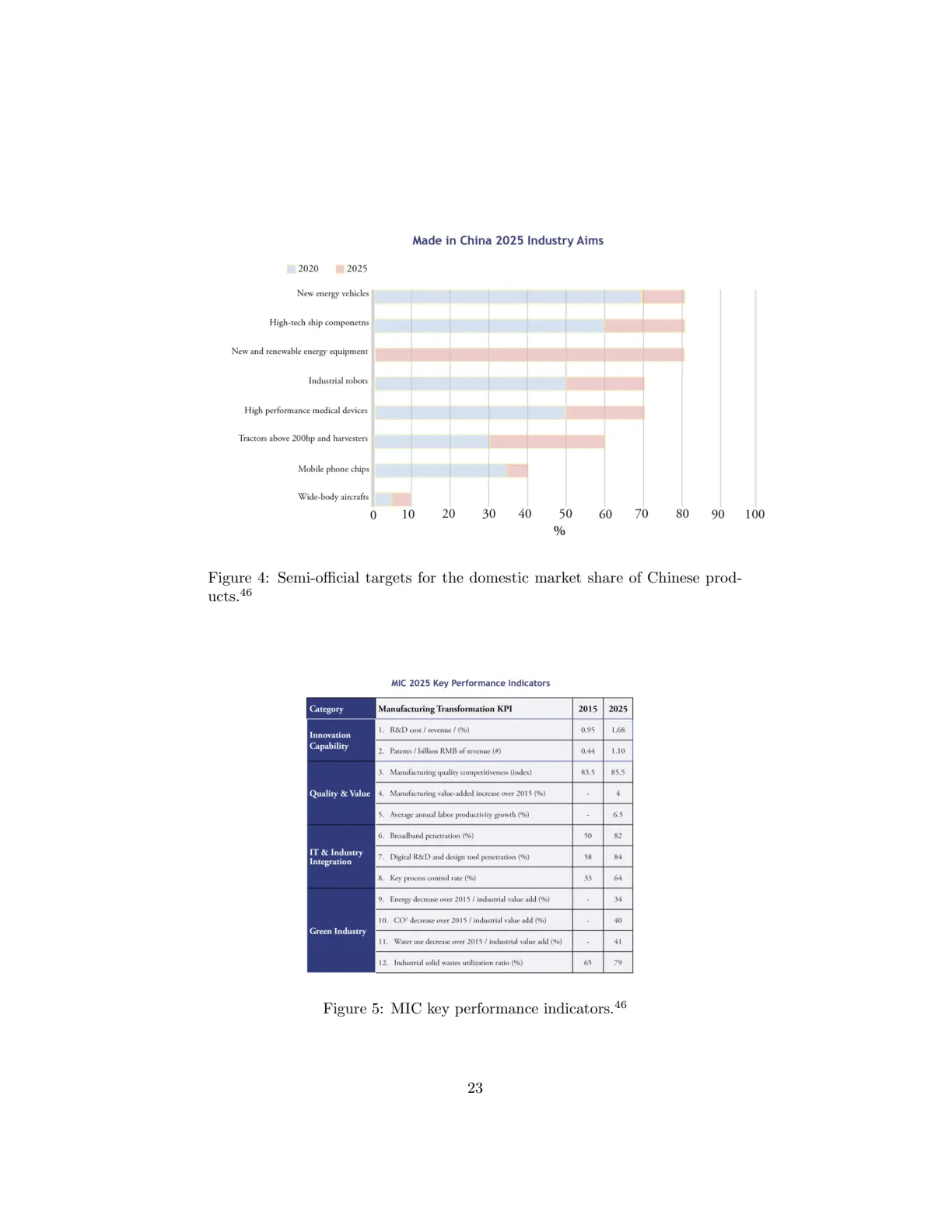
Regarding the resolutions of the MIC2025 plan itself, the Chinese government set various goals in pursuit of a position as a competitive, self-sufficient global player in technology by spurring greater innovation, product quality, efficiency, and integration– and selected 10 specific key industries: advanced information technology; automated machine tools and robotics; aerospace and aviation equipment; ocean engineering equipment and high-tech shipping; modern rail transport equipment; energy saving and new energy vehicles; power equipment; new materials; medicine and medical devices; and agricultural equipment.49 The key performance indicators and the benchmarks China set for each industry is noted below in Figures 4 and 5, for 2020 and 2025 industry aims and 2025 KPIs:
- 48David Cyranoski, “China’s bid to become a science superpower”, 2024, https://www.nature.com/articles/d41586-024-03522-y
- 49CSET Georgetown, “Made in China 2025”, https://cset.georgetown.edu/wp-content/uploads/t0432madeinchina
- 2025E N.pdf
Page 23
Figure 4: Semi-official targets for the domestic market share of Chinese products.46
Figure 5: MIC key performance indicators.46
Page 24
Ultimately, the quantified goal of MIC2025 was to increase the domestic production of core components and materials– or, in other words, self-sufficiency– to 40% by 2020 and 70% by 2025.45
To achieve the objectives of MIC2025, Beijing sought to introduce uniform standards for targeted industries and changing certain regulations to set an innovation-oriented policy direction; these changes were often based around Beijing’s “secure and controllable” standard, with one example of one such policy being the requirement of banks to reveal source code and to use domestic IP and encryption.45 Alongside regulations and industry standards, the Chinese government also facilitated collaboration between central and provincial governments and state-run entities to stimulate supply-side innovation, such as the creation of 40 national and 48 provincial innovation centers by 2025 to facilitate partnership and innovation. The final and arguably most impactful mechanism to achieve MIC2025’s goals is financial support for various initiatives, ranging from state-owned banks distributing subsidies, low-interest loans, and bonds, to a specific semiconductor fund for the consumer electronics company Xiaomi to develop its first smartphone processors.45
4.1.2 Semiconductors in MIC2025
Given the highly strategic role of semiconductors in any kind of technology, especially in the context of A.I. and its hardware,50 China has consistently prioritized the semiconductor and given it high consideration relative to its other technological development goals. Semiconductors have been the country’s “top industrial innovation priority” since the 2013 Third Party plenum, have had $150 billion in investments called for them in the 2014 “National IC Strategy”, and have been deemed a highly vulnerable technology “chokepoint” by the Chinese government, a phrase signifying “key and core technologies controlled by [the U.S. and its allies]”, where semiconductor-related technologies constitute 7 of 35 identified chokepoints51 In MIC2025 specifically, a goal of achieving 40% self-sufficiency in semiconductors by 2020 and 70% by 2025 was set.52 Notable progress in the field has been made prior to MIC2025, reflecting China’s dedication to enhancing innovation, is shown in Figure 3.
4.1.3 MIC2025 Outcomes and External Discourse
Following MIC2025’s announcement in 2015, the initial reaction of the international community was not particularly accepting. The U.S. feared that it would dismantle the former competitiveness of American companies, since
- 50Venus Kohli, “AI Semiconductors: The Talk of the Hardware Industry”, 2024, http://power-and-beyond.com/ai-semiconductors-the-talk-of-the-hardware-industry-a-bbe42809a2803eaaed7c5dda9790338e/
- 51Gregory C. Allen, “China’s New Strategy for Waging Microchip Tech War”, 2023, https://www.csis.org/analysis/chinas-new-strategy-waging-microchip-tech-war/
- 52Stephen Ezell, “How Innovative Is China in Semiconductors?”, 2024, https://itif.org/publications/2024/08/19/how-innovative-is-china-in-semiconductors/
Page 25
MIC2025 provides “preferential access to capital to domestic companies in order to promote their indigenous research and development capabilities, support their ability to acquire technology from abroad, and enhance their overall competitiveness”– being especially concerned by the potential that Beijing may supersede Washington in new energy, self-driving vehicles, aerospace equipment, and more, which would confer to China unique advantages.46 In 2018, U.S. President Donald Trump, likely influenced by much of those fears, directly called MIC2025 insulting– and consequently imposed various tariffs, such as a 25% tariff on $50 billion’s worth of goods imported from China “containing industrially significant technology, including those related to the ‘Made in China 2025’ program”; and in the same year, sent a trade delegation to Beijing to explicitly demand that China cease its subsidies for high-tech sectors related to MIC2025 (like robotics and new energy vehicles).53
In the ten years since MIC2025 was announced in 2015, many have analyzed whether the plan was successful and the implications it holds for the future. With regards to successful accomplishments of the past 10 decades, China has become either a global leader or a close follower in almost all 10 industries of MIC2025’s focus; examples being Huawei’s global leadership in 5G and clean energy developments and BYD surpassing Tesla in 2024 as the largest electric vehicle maker in the world.53 However, in other industries– particularly in the semiconductor and advanced materials sectors, China remains largely reliant on foreign suppliers, and remains far from its intended state of self-sufficiency. As of 2020, Chinese companies were reported to constitute only 38% of the domestic market in carbon fibers, 20% for silicon carbide, and 23% for electroceramics; and only 10% for semiconductor photoresist materials, leaving imports still essential for the most advanced components.47 Thus, while China is perhaps the most competitive player in fields such as electric vehicles, renewable power generation, telecommunications, drones, and high-tech ships– which are characterized by high capital intensity (meaning state support gave Chinese firms a substantial “leg up” over competitors, a large domestic demand base to rapidly scale up, and lack established global leaders due to the technology’s emerging nature– China lags in critical areas like semiconductor manufacturing equipment, high-end instruments, and advanced aerospace components, with the most cutting-edge and sophisticated intellectual property and technologies under foreign control.47 Despite the critiques of many researchers and industry experts on the unrealistic nature of MIC2025,54 given that such rapid industrialization and dominance across nearly all cutting-edge technologies of the modern day was an inherently ambitious goal– and unachieved by any other industrial power in the past– the principles of MIC2025 have been projected to guide Chinese policymaking for several decades into the future,55 and its demonstrated ability to innovate will bolster growth regardless of the current challenges in the technology war with the U.S.56
- 53Sally Brooks and Jason Fang, “Made in China 2025 a Success Despite US Tariffs”, 2025, https://www.abc.net.au/news/2025/01/22/made-in-china-2025-a-success-despite-us-tariffs/104816206
- 54Kenneth Ong, “China’s Defiant Chip Strategy”, 2024, https://www.fpri.org/article/2024/06/chinas-defiant-chip-strategy/
- 55Brad Glosserman, “MIC2025 Remains China’s Roadmap”, 2025,
Page 26
4.1.4 Industrial Policy
Due to the top-down nature of the Chinese political and governmental decision-making system, Chinese leaders appointed for two five-year terms are far more immune to the pressures of public opinions than leaders in liberal democracies, allowing them to concentrate on leveraging policies and tools to most efficiently and effectively achieve long-term goals like those outlined in MIC2025. This sub-section explores how the Chinese government implements policy in a top-down approach to stimulate sectors of interest and achieve MIC2025 and MIC2025- related goals.
A hallmark of Chinese industrial policy in the semiconductor industry is the large government funds and subsidies granted and channeled into areas of priority.
In 2016, the Chinese government established the Advanced Manufacturing Fund: a 20 billion CNY, or 2.7 billion EUR fund; for reference, the German government has provided only 200 million EUR for research and innovation for I40 technologies, highlighting how substantial Chinese state funding is. The State Development and Investment Corporation, furthermore, set up a limited partnership company to manage that fund– with 15 billion CNY paid to the fund directly– and has, since then, been making investments into industries of priority, like purchasing 1.5 billion CNY’s worth of shares in the Chinese battery and electric vehicle company BYD.57 Other funds such as the National IC Fund (139 billion CNY) and the Emerging Industries Investment Fund (40 billion CNY) have been instituted by the Chinese government to develop smart manufacturing technologies;57 and a 2019 OECD study noted that 43% of registered capital (a total of $51 billion) in the Chinese semiconductor industry was directly or indirectly owned or controlled by the Chinese state– alongside other government-implemented fiscal policies and economic incentives like grants, reduced utility rates, low-interest loans, significant tax breaks, and free or discounted land.58
As U.S. export controls strengthened, the Chinese government’s domestic market interference heightened: when the U.S. added Huawei to its trade blacklist in 2019 under the Trump administration, the Chinese government increased direct government subsidies and tax incentives for the company, which Huawei, SMIC, and other state-fund beneficiaries used to import billions of dollars’ worth of semiconductors and semiconductor supply chain equipment to stockpile it in the event of future restrictions, protecting its supply.54
- https://www.japantimes.co.jp/commentary/2025/05/20/world/mic2025-remains-chinas-roadmap/
- 56Safia Khan, “Lessons from Made in China 2025: Will China Achieve Its Vision for 2035?”, https://yris.yira.org/column/lessons-from-made-in-china-2025-will-china-achieve-its-vision-for-2035/
- 57Jost W¨ubbeke, Mirjam Meissner, Max J. Zenglein Jaqueline Ives, and Bj¨orn Conrad, “Made in China 2025”, 2020, https://merics.org/sites/default/files/2020-04/Made%20in%20China%202025.pdf
- 58Semiconductor Industry Association, “Taking Stock of China’s Semiconductor Industry”, 2021, https://www.semiconductors.org/wp-content/uploads/2021/07/Taking-Stock-of-China%E2%80%99s-Semiconductor-Industryf inal.pdf
Page 27
Perhaps the most notable and central industrial fund implemented by the Chinese government is the National Integrated Circuits Industry Development Investment Fund (otherwise known as the “Big Fund”)—$21 billion of state-backed financing distributed across various domestic state-backed semiconductor companies in 2014.
4.1.5 Investment in Domestic Capabilities
Amid rising tensions between the two countries, China recognizes the need to be able to manufacture top-end semiconductors independently of U.S. involvement. Limiting U.S. dependence is an important strategic goal for China and undergirds the philosophy behind their investment in domestic capabilities.
China has long recognized the need to invest in the industry. In 2000, Shanghai helped finance the Semiconductor Manufacturing International Corporation (SMIC). To contextualize China’s domestic capabilities, its capacity across the many steps of the Semiconductor value chain should be analyzed individually (see figure for the steps and rough explanations)52
China’s limitations in regards to EDA software and lithography equipment have obvious implications for their ability to produce semiconductors (crippling them in steps 2 and 3 above). These limitations, combined with other factors, have led to China falling well behind the global innovation frontier. Intel CEO Pat Gelsinger in January 2024 estimated that China was 10 years behind the global industry; however, that estimate has been disputed, with some sources arguing that it is closer to 5 years.52 The difference in lithography appears to be a major limiting factor, as the gap between Shanghai Micro Electronics Equipment (SMEE) and the global standard (ASML) is about two decades. Despite quibbling over the precise estimate, there is no question that China is behind the global industry.59
China massively subsidizes its domestic industry at staggering levels. The Organization for Economic Cooperation and Development (OECD) conducted a study of 21 international semiconductor firms over the years 2014 to 2018 and drew several conclusions on the scale of Chinese support to their domestic companies. Particularly, China is uniquely active in the realm of below-market equity financing (purchasing stock from the companies for a below-market price, effectively acting as a subsidy, although technically differing because China gets a stake in the company in return. However, in a Communist country like China, the government is already greatly involved in company involvement, even if it doesn’t have formal equity. For the four Chinese firms covered in this study (Hua Hong Semiconductor, JCET, SMIC, Tsinghua Unigroup), government funds have committed equity funding of about USD 22 billion in total to date (2019), with the largest share going towards SMIC and Tsinghua Unigroup (and their subsidiaries).60
- 59Alex He, “In the Global A.I. Chips Race, China Is Playing Catch-Up”, 2024, https://www.cigionline.org/articles/in-the-global-ai-chips-race-china-is-playing-catch-up/
Page 28
Beyond investing in companies as a whole, China has more targeted investments in improving their domestic semiconductor capabilities. Examples from the companies in the OECD study are Yangtze Memory Technologies Co., Ltd. (“YMTC”), which has a memory fab (a semiconductor foundry) specialised in 3D-NAND chips and located in Wuhan, Hubei, and managed by the parent Tsinghua Unigroup. The investment, announced in 2016, is $7.5 billion and “has received $1.35 billion injection from China’s National IC Fund and additional equity (USD 667 million) provided by the local Hubei IC Fund,” with the government having 74% equity in the project.60
Another fab, SIMC North in Beijing, controlled by the parent company SIMC, has received a $1.5 billion injection from China’s National IC Fund and additional equity $432 million provided by the local Beijing IC Manufacturing Fund, with the government having over 57% equity in the project.60 A third example, slightly more unique due to two parent companies, the Shanghai SASAC and the state-owned Hua Hong group, with this nature resulting in the government having over 95% equity, with investments from of $1.8 billion from China’s National IC Fund and additional equity of $316 million from the Shanghai IC Manufacturing Fund.60
Unsurprisingly, China and its domestic manufacturers are inextricably financially linked due to this barrage of investments. From 2014-2018, state subsidies accounted for slightly over 40 percent of SMIC’s revenues over this period: 30 percent for Tsinghua Unigroup, and 22 percent for Hua Hong, compared to global competitors of TSMC, Intel, and Samsung, for which subsidies were under 3 percent of their revenues.52 Since this, tensions between the U.S. and China have increased, resulting in fewer U.S. exports to China, necessitating even more subsidies from China to develop a domestic semiconductor ecosystem as explored earlier, thus, current measures of this metric are likely much higher for Chinese companies.
Overall, China’s semiconductor catch-up to the global standard is uneven. Therefore, broad estimates on China’s semiconductor capacity/innovation, like five-year risk, obscure important nuances across the value chain. For example, in aspects of semiconductor manufacturing, notably the design of logic chips, China is much closer to the global standard, with an estimated gap of “only” two years. Comparatively, China is much further behind in other aspects, such as “ in memory chips, semiconductor manufacturing equipment (SME), and assembly, test, and packing (ATP).”52 However, in practical terms, China’s isolation from global markets means that it is as far from the global standard as its weakest link. Chinese reliance on global markets stretches beyond just the United States, although the U.S. plays a big role in pressuring other countries to follow its course in its trade war against China. In particular, China relies greatly on Japan, the Netherlands, South Korea, Taiwan, and the United States. Illustratively, China imported $8.75 billion of chip-making equipment in 2023, with the Netherlands making up 30% of that and Japan constituting 25%.61 Examining the market share, in the fabless segment, the U.S. semiconductor industry is the global leader; in terms of foundries, Taiwan and Japan remain the leaders; and in manufacturing equipment, the global leaders are the Netherlands and the U.S.62
- 60Organisation for Economic Co-operation and Development (OECD), “Digital Government Review of China”, 2019, http://dx.doi.org/10.1787/8fe4491d-en
Page 29
Therefore, these predictions have little value as an honest assessment of China’s progress in the overall semiconductor landscape or in communicating the technological complexity of all parts of China’s current semiconductor industry, but do still retain a practical time value given the unique nature of China’s situation and lack of access to global trade.
4.2
Import Substitution Efforts
4.2.1 Domestic Manufacturers
Cut off from access to the United States due to entity list updates, and with many of its workarounds cut off from additional updates, domestic manufacturers, like Huawei, are increasingly critical to the development of China’s domestic semiconductor sector.63 At a February 17th meeting between Xi Jinping and Chinese technology executives, the founder of Huawei, Ren Zhengfei expressed optimism on Huawei’s ability to succeed despite export controls due to recent technical advances by both Huawei and its partners.64 Zhengfei has not always been this sanguine: just months before in October 2024, Zhengfei didn’t believe that Huawei had even “secured survival” and that they were “still struggling” due to U.S. sanctions. But at the February meeting, Ren said that he was leading a network of over 2,000 Chinese companies that are working together to achieve Chinese self-sufficiency over the entire semiconductor value chain by 2028.64
However, outside assessments of China’s ability to achieve this, defining self-sufficiency as complete independence, meaning all demand, supply, and intellectual property, comes from within China, have been skeptical.65 For one thing, China debatably has an oversuppliance problem, where it is subsidizing more than domestic demand can absorb, leading to exports, a phenomenon known as overcapacity. This is typical of Chinese industrial cycles, which usually begin with the entry of numerous firms, both public and private, that have scant experience in the sector, entering a new industry. With such competition and firm entry, the product margin is very small, incentivizing mass production that can sometimes sacrifice quality. However, in contrast to the capitalist system where failed firms simply leaving to make room for the few firms that can operate at a high level, with a Communist economic system and government investment in companies, market exit is very slow, as governments fall victim to the sunk cost fallacy and try to predict these firms from the harsh realities of the market. As a consequence, this system is inefficient and results in destabilizing boom and bust cycles. While inefficient in certain aspects, this can lead to innovation at an extremely low cost (in other words, if the companies respond to the necessity of mass production by finding ways to maintain quality, leading to a more efficient process, rather than sacrificing policy in pursuit of output).66
- 61Jiawei Steven Hai, “What’s Happening in China’s Semiconductor Industry”, 2025, https://www.economicsobservatory.com/whats-happening-in-chinas-semiconductor-industry
- 62Daxue Consulting, “China Semiconductor Industry”, 2024, https://daxueconsulting.com/china-semiconductor-industry/
- 63Karen Freifeld, “US Adds 16 Entities to Its Trade Blacklist, 14 from China”, 2025, https://www.reuters.com/world/us/us-adds-16-entities-its-trade-blacklist-14-china-2025-01-15/
- 64Gregory C. Allen, “DeepSeek, Huawei, Export Controls, and the Future US-China A.I. Race”, https://www.csis.org/analysis/deepseek-huawei-export-controls-and-future-us-china-ai-race
- 65Christopher A. Thomas, “Lagging but Motivated: The State of China’s Semiconductor Industry”, 2021, https://www.brookings.edu/articles/lagging-but-motivated-the-state-of-chinas-semiconductor-industry/
Page 30
Without the ability to trade with Western markets, which is where the excess supply of overcapacity would usually go, China is effectively left subsidizing subpar equipment for itself, furthering a feedback loop of continuing to use the technology. Previously, China could at least export the equipment, the excess supply, to receive money to buy higher-quality equipment in return, and also reverse-engineer the technology to improve their own capabilities. These are holdovers of how China entered the market in the first place. China entered the lowest-skill, most mass-produced areas of the supply chain: namely, using large amounts of low-skilled laborers to turn foreign wafers into semiconductors. The first firms in China’s fledgling industry were unsurprisingly foreign: including TSMC in Nanjing, Intel in Dalian, SK Hynix in Wuxi, and Samsung in Xian.67 However, China’s semiconductor industry has long roots: the earliest beginnings can be traced to the Cold War in the 1950s and 1960s, with the Soviet Union supporting China’s earliest semiconductor efforts. By the late 1960s and early 1970s, basic transistors and integrated circuits, crucial components of semiconductors, were being produced. However, progress accelerated after China largely opened itself up to international trade in the 1970s, and Chinese industrial policy began to treat semiconductors as a priority in the 1990s.61
Besides the previously mentioned investments by China, domestic manufacturers are investing their own resources to close the gap between China and the U.S. Huawei currently has two semiconductor manufacturing research facilities: one each in Shanghai and Shenzhen, with Huawei spending $1.66 billion in Shanghai alone and drawing personnel with experience with leading global companies, such as TSMC.68 These efforts appear to be yielding fruit, with Huawei’s breakthroughs in the Mate 60 Pro smartphone in August 2023, following years of strict U.S. sanctions, surprising the world.59ration Ascend 910B A.I. chips, using a process released only in late 2022. Some observers commented that this chip was only, at worst, 18 months behind Samsung and may even be just as good in certain facets.52
- 66Joshua P. Meltzer and Margaret M. Pearson, “How the US Should Address Chinese Overcapacity and Its Impact on International Trade”, 2024, https://www.brookings.edu/articles/how-the-us-should-address-chinese-overcapacity-and-its-impact-on-international-trade/
- 67Chad P. Bown, “How the United States Marched the Semiconductor Industry into Its Trade War with China”, 2020, https://www.piie.com/publications/working-papers/how-united-states-marched-semiconductor-industry-its-trade-war-china
- 68Cheng Ting-Fang, “Huawei Building Vast Chip Equipment R&D Center in Shanghai”, 2024, https://asia.nikkei.com/Business/Tech/Semiconductors/Huawei-building-vast-chip-equipment-R-D-center-in-Shanghai
Page 31
However, a closer look reveals that these advances were not sustainable. Specifically, in the step of lithography, Huawei was using a deep ultraviolet (DUV) lithography machine rather than the more advanced extreme ultraviolet (EUV) lithography machine.59 To pattern the same 7 nm chip, lithography, which transfers circuit patterns onto the chip, EUV takes only a single exposure to pattern a wafer, while DUV takes three or four rounds. With these extra rounds, this not only consumes more resources but also increases the complexity of an already complex process and sacrifices precision.
This places these feats from Huawei as a stunt and not a general statement of sustainable mass production. The production costs for that chip were extremely high, and therefore, the Ascend 910B A.I. chips were not mass-produced. The yield rate for this process, the percentage of working chips on each wafer, was 20 percent, compared to the ideal of 90 percent.59 There are domestic efforts to close this gap and develop commercially viable EUV systems. While the full details are not known, one effort is being led by the Changchun Institute of Optics, Fine Mechanics, and Physics (ciomp) and the Chinese Academy of Sciences, with another likely involving Huawei.69
Beyond simply a technology problem, there is a material problem for Chinese lithography, specifically in photoresists. Numerous companies are working on developing photoresists for Chinese use, such as Shanghai Sinyang, Xuzhou Bokang, Jingrui, Nata Opto-electronic Material, and Red Avenue, which are at various stages of developing photoresists for use in lithography. From a technical software perspective, a partnership between Huawei and China’s leading EDA company, Empyrean, is the best China has to offer, but other companies are in the space, including GWX Technology, Primarius, Semitronix, Shenzhen Giga Design Automation, UniVista, and X-EPIC.52 Apart from companies, China’s universities are becoming involved to close the knowledge gap: with Southeast University in Nanjing launching a National EDA Innovation Center in 2023, with the express purpose of dismantling the U.S. “chokehold in EDA software.”
Beyond simply EUV, Huawei is using its considerable resources to facilitate the creation of a Chinese semiconductor ecosystem around itself.52 Huawei created investment sources such as the Hubble Technology Investment and provided seed funding to companies in all areas of the semiconductor supply chain. Huawei is additionally devoting its efforts towards closing the aforementioned gap in EDA technology with its chip design arm HiSilicon.69
Analyzing Chinese companies from a Huawei-centric perspective, however, would be a gross oversimplification. In particular, Biren is one of China’s most promising companies, especially relative to how it compares to the global gold standard.52 Biren, founded in 2019, attracted over $6.6 million in financing, which broke the record for China’s domestic chip industry. In 2022, Biren released a general-purpose GPU chip (the BR100), which set a global computing power record. The chip’s peak computing power was three times faster than the best products of other manufacturers and it was “the first time a Chinese company had broken the international power record for general-purpose GPUs held by leading global competitors”.52 Biren is certainly a global powerhouse and a credible competitor to even companies such as NVIDIA. In terms of intellectual property, Biren has 249 patents, 23 software copyrights, and 23 trademarks, with the USPTO issuing 21 patents to Biren.52 U.S. export controls have stalled Biren’s progress, but it is still expected to be a formidable competitor in the GPU market, even compared to the best global standard.
- 69
- 69Paul Triolo, “A New Era for the Chinese Semiconductor Industry: Beijing Responds to Export Controls”, 2024, https://americanaffairsjournal.org/2024/02/a-new-era-for-the-chinese-semiconductor-industry-beijing-responds-to-export-controls/
Page 32
4.2.2 Research and Development Initiatives
China’s adoption of its 14th Five-Year Plans has emphasised a focus on Chinese independent manufacturing of semiconductors. This has been a significant policy change from China’s position as the world’s largest consumer of semiconductors, accounting for over half of the global chip sales. However, it is precisely this dependency on imports for chips that has caused China to invest heavily in domestic research and products.
To increase innovation and productivity in the semiconductor sector, the Chinese government has undertaken two major policy actions:
1. Investing heavily in state-backed funds, subsidies, and tax breaks.
2. Providing lax controls and greater autonomy to some of the country’s
leading chip manufacturers over state-owned resources.
In 2014, the PRC launched the National Circuit Industry Investment Fund, also called “the Big Fund”. The fund was financed by China’s Ministry of Finance and China Development Bank, raising $21 billion in its first phase, and was later distributed to at least 3,000 entities operating in the industry. While economic scholars like Xin Yao and Jiajia Zhao have concluded that the Big Fund improved the operational efficiency of semiconductor companies by a very slim margin of 0.084, the Fund was marred by corruption.70 The former head of the Ministry of Industry and Information Technology, chairman of the Big Fund, and several senior executives were reported to be engaged in corruption. The fund has also proven to be effective in de-stimulating when, in 2020, a $20 billion government-backed startup in Wuhan collapsed without producing a single wafer, which was a huge deal considering that government subsidies were mostly targeted towards the expansion of wafer manufacturing capacity.71
- 70Xin Yao and Jiajia Zhao, “Semiconductor Industry Analysis”, 2024, https://www.sciencedirect.com/science/article/abs/pii/S092552732400286X
- 71Nir Kshetri, “Semiconductor Technology Paper”, 2023, https://ieeexplore.ieee.org/stamp/stamp.jsp?arnumber=10132020
Page 33
In addition to the Big Fund, the PRC employed a range of fiscal strategies—including subsidies, grants, tax breaks, and low-interest loans—to support the domestic semiconductor industry. These measures produced uneven results depending on a company’s size and reputation. Leading firms like Huawei and SMIC successfully leveraged government subsidies to stockpile chip-making equipment and buffer their supply chains against U.S. export controls.47 However, these generous incentives also triggered a surge of opportunistic firms into the sector. In the first ten months of 2022 alone, over 58,000 integrated circuit-related firms were registered, with more than 13,000 of them shifting from previously unrelated industries.71 This suggests that many of these companies lacked genuine technological expertise and registered solely to capitalize on government benefits, ultimately undermining China’s broader goals of fostering innovation and high-quality industrial development. Such efforts, undoubtedly, hindered China’s efforts for progress and innovation.
However, recognizing the lack of efficacy of such initiatives combined with the increasing pressure from U.S. export controls on the Chinese import of chips, the government introduced a new policy of greater private control over state resources.72 Companies like Semiconductor Manufacturing International (SMIC), Hua Hong Semiconductor and Huawei, as well as equipment suppliers Naura and Advanced Micro-Fabrication Equipment Inc China, have been allowed greater access to additional government funding, including increased control over state-backed projects, without having to achieve performance benchmarks that were previously necessary. This increased liberalisation of the Chinese Semiconductor industry was coming at a time when the industry was seeing itself attacked by U.S. restrictions on the export of advanced chips, while US-induced pressures on the Netherlands led to the curbing of computer chip technology to China.73 However, this increase U.S. pressure led to PRC increasing investment on its chip investment with an additional $40 billion in 202372 and the strengthening of R&D tax incentives such that 120 percent of the cost of all R&D by Chinese semiconductor companies could then be deducted from taxes.74
At the same time, the environmental impacts of existing wafer factory regulations also initiated a change in the government subsidy model. Wafer factories had to now obtain orders first and have a certain degree of capacity utilization to get government subsidies. This shift made Chinese wafer fabs more active in attracting customers through different strategies, like low pricing. Compared with the previous subsidy model, this incentivized local fabs and IC design companies to expand their business.75
- 72Qianer Liu, “China Semiconductor Development”, 2023, https://www.ft.com/content/d97ca301-f766-48c0-a542-e1d522c7724e
- 73Michael Race, “Dutch to restrict chip equipment exports amid US pressure,” 2023, https://www.bbc.com/news/business-66063594
- 74Gregory C. Allen, “Chip Race: China Gives Huawei the Steering Wheel”, 2023, https://www.csis.org/analysis/chip-race-china-gives-huawei-steering-wheel-huaweis-new-smartphone-and-future
- 75International Data Corporation (IDC), “China’s Three-Way Recipe for Semiconductor Autonomy and Global Industry Impact”, 2024, https://blogs.idc.com/2024/02/26/chinas-three-way-recipe-for-semiconductor-autonomy-and-global-industry-impact/
Page 34
Policy changes such as these have been linked to certain successes,
like Huawei’s release of the Mate 60 smartphone series in 2023, featuring a seven-nanometer chipset manufactured by SMIC. The achievement was considered a major leap forward as SMIC had been able to manufacture seven nanometer chipsets in two years from the conventional fourteen nanometers without access to foreign technology, however, companies like TSMC and Samsung had taken almost five years to reach the same level with access to the global chip supply chain,47 but before the release of the Mate 60 smartphone series by Huawei, TSMC and Samsung had already been ramping up for 5 nanometer and 3 nanometer chips which were slated for 2022.76 Despite this, China is still not at the global state of the art for semiconductor manufacturing, but the gap between the peak technological level of China and that of the rest of the world has shrunk, massively.
So far, the greatest investments by the Chinese government have been in the following sectors:
I Wafer factories, as discussed above
II Gallium Nitride
III Chiplet packaging
IV NAND technology
V Lithography & IC manufacturing
VI RISC-V
One of China’s strengths in the semiconductor industry has been its large-scale production of gallium nitride and silicon carbide, and dramatic expansion in the foundries and markets of such products. Currently, China is a primary producer and exporter of both primary and refined gallium, cornering a staggering 98 percent of the worldwide primary low-purity gallium production.8 Gallium Nitride on silicon can power electronics across diverse industries, from consumer chargers and power supplies, electric vehicles, data center power management, to defense technology like military radars and aerospace systems. China has already smartly invested in 25 projects in both Silicon Carbide and Gallium Nitride at a cost of $10.9 billion. Of those figures, China has around 14 production lines for 6-inch Silicon Carbide wafers, in combination with HDSC, Sanan IC, and Tankeblue.76
Interestingly, the U.S. defense industry already relies heavily on GaN semiconductor technology for advanced radar systems and other applications.8 To curb U.S. access to these minerals, China announced control export restrictions on gallium to the United States, exacerbating the vulnerability of the United States’ gallium supply chain. As a result, there have been growing concerns about the depletion of gallium stocks in North America, especially for advanced semiconductor chip manufacturing in the U.S. industry.
- 76Mark LaPedus, “China Accelerates Foundry Power Semi Efforts”, 2021, https://semiengineering.com/china-accelerates-foundry-power-semi-efforts/
Page 35
Similarly, China has invested in and created initiatives to optimize the supply chain and packaging for chiplet technologies. The Chinese government has made active strides to address such issues. Established in 2023, the “Advanced Costdriven Chiplet Interface (ACC 1.0)”, created by the China ChipLet League, produced a chiplet alliance and the first chiplet technical standard, which focused on optimizing China’s packaging and substrate supply chain through chiplets and expanding packaging technologies. Despite this, there have been concerns that not all chips are suitable for chiplets, citing examples like increased requirements of IP in consumer products and advanced packaging technology, which are “not China’s strength.”75
The private sector has also taken the lead on such initiatives. Huawei has been pursuing R&D for designs using chiplets, with packaging becoming a key part of production. Back-end packaging is being designed into the production process, from EDA tools–on which Huawei has collaborated with domestic packaging giants like JCET and Tongfu to create its own EDA tools—to integration of IP from companies such as ARM, and 3D packaging designs that enable greater functionality with semiconductors at varying levels of complexity. Government R&D efforts have also been pursued under the National Natural Science Foundation of China, which released the 2023 project guide for the Scientific Basics Major Research Plan for Integrated Chip Frontier Technology and included support for research on 2.5- and 3D packaging.69
At the same time, China has also been attempting to focus innovation on memory and mature node logic foundries. Since 2016, the Chinese government has invested $16 billion into state-owned memory fabs to develop China’s domestic 3D-NAND Flash and DRAM industry, and the efforts have yielded some success. Companies like YMTC, that rely on more than $24 billion in government subsidies, have evidenced by now, shipped and are producing the highest density 3D NAND. Their product Xtacking 3.0 is the densest commercial 1Tb TLC NAND at 15.2Gbit/mm2 a, utilizing a similar 6-plane architecture with a 2.4Gbps data rate, can easily be compared to Micron’s 232-layer NAND in terms of performance.77 Other companies like Dongxin Semiconductor Co. Ltd have also received funding to conduct advanced testing on the integration of 3D-NAND components into China’s 5G infrastructure.78
China’s expertise in mature-node chips—those manufactured at 28 nanometres (nm) and above—has been well-established. G7 members and other nations have as such raised concerns that this could result in potential chip dumping, thereby driving down prices and luring companies in the UK and South Korea into dependency on Chinese chipmakers. This would lead to the dominance of Chinese mature nodes in a strategically vital part of the semiconductor industry.79
- 77Dylan Patel, “2022 NAND Process Technology Comparison”, 2022, https://semianalysis.com/2022/08/12/2022-nand-process-technology-comparison/
- 78Datenna,“China’s NAND Capability: A Data-Based Deep Dive”, https://www.datenna.com/resources/chinas-nand-capability-a-data-based-deep-dive/
Page 36
Lithography has, historically, been a particular weakness of China. The country has faced consistent difficulties in developing its own lithography technology and relies heavily on companies like ASML to provide the needed equipment. To remedy this situation, the CCP launched a lithography machine research project in 2002, a part of the National High-Tech R&D program, that led to the formation of 45 institutes that once developed projection lithography machines into one company–the Shanghai Micro Electronics Equipment (SMEE), government backed semiconductor manufacturing firm, which focused specifically on developing lithography and EUV technologies.80 It developed the first Chinese produced lithography machine under 100 nm in 2007. However, because most of the components of this machine were imported, Western countries immediately imposed an embargo. The embargo stopped the mass production of the machine.81
China’s partnerships and relations with other countries in the semiconductor industry have been defined by the Wassenaar Agreement. China is not a part of this Agreement that lays down several important provisions for the trade of the latest technology amongst the 31 member nations. Such exclusion has fed into the ‘N-2’ generation gap that refers to China lagging behind Western nations technologically, by two generations.81 The results of such have caused repeated export controls by the U.S. and a high dependency on the exports of semiconductors by leading firms from countries like the Netherlands, Japan, and the U.S. This “N-2” behavior has also prevented the pioneering of Chinese production of semiconductors by the imposition of embargoes.
So, to push for the production of domestic lithographic materials, the Chinese government enacted Special Project 02, under the Chinese government’s ‘National Outlines for Medium and Long-term Planning for Scientific and Technological Development’ program. The 02 Special Project focused on circuit integration and peripheral equipment manufacturing, where domesticating the lithography machine supply chain was one of the top priorities. The project gathered select domestic companies in subfields of lithography equipment manufacturing and provided them with funding to produce materials for advanced lithography.80
SMEE has been a recipient of many such grants from Project 02 and has gradually risen to the position of the primary designer of made-in-China lithography equipment components. To date, the company’s most advanced tool is the SSX600, which can be used to make chips on 90nm, 110nm, and 280nm process technologies.82 In 2024, the SMEE applied for a patent for ‘extreme ultraviolet (EUV) radiation generators and lithography equipment’ to the National Intellectual Property Administration of China. China’s ability to produce EUV equipment can be considered revolutionary for its development of semiconductors.83
- 79Ardi Janjeva, Seoin Baek, and Andy Sellars, “China’s Quest for Semiconductor Self- Sufficiency”, 2024, https://cetas.turing.ac.uk/publications/chinas-quest-semiconductor-self-sufficiency
- 80Robert D. Atkinson, “China Is Rapidly Becoming a Leading Innovator in Advanced Industries”, 2024, https://itif.org/publications/2024/09/16/china-is-rapidly-becoming-a-leading-innovator-in-advanced-industries/
- 81Li Mubai, “China Semiconductor Development”, 2022, https://en.eeworld.com.cn/mp/XSY/a142463.jspx
- 82Ivan Platonov and Xiwen Zheng, “China Semiconductor Analysis”, 2021,
Page 37
SMEE’s patent filing represents a significant step forward in China’s efforts to develop its own EUV lithography tools. Shanghai Microelectronics Equipment is not the only company in China that has filed a patent concerning EUV lithography. Huawei, too, filed an EUV system-related patent in China back in 2022. These patents hold significance in China’s push to become independent in terms of semiconductor manufacturing. If SMEE produces advanced DUV and EUV tools, China will be able to reduce its reliance on foreign firms like ASML for such materials and gain ground in the global semiconductor market.84
Another sub-industry that China has been making investments in is advanced ISA models. The Reduced Instruction Set Computing Five (RISC-V), is a type of ISA that is smaller, processes faster speeds, and is easily adaptable to various applications as compared to ISAs like CISC. In recent years, momentum has been building from major tech giants eager to build products based on RISC-V, which has become the first market alternative for many years.
There are over 300 companies in China developing products using RISC-V technology. In 2021, the Beijing Municipal Bureau of Economy and Information Technology established the Beijing Institute of Open Source Chip. With support from the Municipal Science and Technology Commission and the Administrative Committee in Zhongguancun, the institute has built a collaborative model linking industry and academia, which has been instrumental in developing and applying RISC-V technology. The initiative aims to increase RISC-V adoption, with leading Chinese experts viewing its open and flexible architecture as a potential disruptor to Nvidia’s CUDA software dominance. A notable achievement of the initiative was the release of a laptop powered by a RISC-V-based Alibaba processor.80
Other government investments have included the establishment of the China RISC-V Industry Alliance, which comprises 194 members and helps attract new talent and startups to China, amplifying China’s global RISC-V influence; and the formation of the RISC-V Patent Alliance, which seeks to consolidate and defend IP related to RISC-V.
RISC-V could be invaluable to the PRC. It could disrupt the long-standing duopoly of conglomerates like Intel and ARM, and reduce the United States’ ability to exercise control over parts of the semiconductor industry. RISC-V signifies a strategic attempt by the Chinese government to break out of the cycle of export controls led by the United States by leveraging open-source hardware. There is a clear strategic goal to increase the development of such hardware in the use of RISC-V, which could potentially heighten geopolitical tensions but reduce supply chain vulnerabilities. Most importantly, it would strengthen China’s primary goal in the semiconductor industry: self-sufficiency.85
- https://equalocean.com/analysis/2021062316392
- 83Djoomart Otorbaev, “China Technology Development Opinion”, 2024, https://www.bjreview.com/Opinion/Voice/202411/t20241128
- 800385484.html
- 84Anton Shilov, “China’s SMEE Files Patent for an EUV Chipmaking Tool”, 2024, https://www.tomshardware.com/tech-industry/chinas-smee-files-patent-for-an-euv-chipmaking-tool-tool-aims-to-break-the-shackles-of-asml-export-restrictions
Page 38
5 Designing New Export Controls
5.1 Policy Objectives
To determine the optimal next step for U.S. export controls, it is crucial to analyze the following overall policy objectives: national security goals, economic considerations, and international cooperation requirements.86
5.1.1 Three Implementory Pillars
It is a common misconception of political and general entities that using export controls is a binary argument of whether it should be applied or not; however, it is more efficient to weigh the nuances for the long run.105The effectiveness of implementing international export controls largely depends on three pillars: (1) authority, (2) capacity, and (3) will. In brief, authority includes the laws, tools, and mechanisms a nation possesses to enact controls when desired. Capacity is the funding, human resources, and technology required to execute export controls at a specific time. Will is the political inclination of a nation to use its authority and capacity for a purpose. Together, these components determine the likelihood that an export control decision is viable and beneficial for a nation.42
5.1.2 The U.S. Export Control Position
A. Authority
The current U.S. export control regime uses a “divide and conquer” strategy to apply robust statutory authority. The Department of Commerce (DOC) uses its Export Administration Regulations (EAR) to regulate dual-use and less sensitive technology trade, the Department of State (DOS) leverages the International Traffic in Arms Regulations (ITAR) to monitor military-grade and licensed weapons dealing, and the Department of Treasury (DOT) relies on the Office of Foreign Assets Control (OFAC) to oversee exports regarding financial sanctions. Many control mechanisms have been legalised and enacted as tools to supplement these departments, such as list-based, end-use, and service controls.
- 85Sunny Cheung, “Examining China’s Grand Strategy for RISC-V”, 2023, https://jamestown.org/program/examining-chinas-grand-strategy-for-risc-v/
- 86Miko(cid:32)laj Barczentewicz, “US Export Controls on A.I. and Semiconductors: Two Divergent Visions”, 2025, https://laweconcenter.org/resources/us-export-controls-on-ai-and-semiconductors-two-divergent-visions/
- 105https://www.csis.org/analysis/reaction-strategy-new-framework-us-export-control-enforcement
Page 39
Another key advantageous policy measure is one of extraterritoriality, which expands U.S. controls to foreign products that have components with a direct U.S. origin, through the Foreign Direct Product Rule (FDPR) and A.I. Diffusion Framework. This provides a wide toolkit for enforcement in the U.S. trade ecosystem, which exceeds the authority baseline.42
B. Capacity
The U.S. administrative capacity to execute export controls far exceeds that of most other nations, with specialized personnel in the bureaucracy, separate government funding in recent years, and technological infrastructure that enables its broad reach.87 Despite U.S. leadership in this pillar, resources are becoming more and more constrained.88 As a part of the U.S. DOC, the Bureau of Industry and Security (BIS) regulates exports of technology, software, and commodities under EAR. Consisting of its Export Administration, Office of Exporter Services, and Office of Technology Evaluation, the BIS is responsible for analyzing export data for EAR items, reviewing BIS license applications, and assessing global trade trends to make informed decisions.89 Although given the rising threat landscape, increase in export-controlled items, and greater international pressure, the BIS budget has not increased proportionally to efficiently handle the required export control regime. The primary barriers are a lack of investment and knowledgeable staff. The agency would need approximately a $44.6 million increase in annual funding to account for staffing, modernizing technology, creating a classified space, and a stronger regime. This minimal investment (in comparison to the U.S. budget) could lead to a 5 to 10x productivity boost for BIS analysts. This highlights the call for restructuring government funding priorities to better suit the present and expected future sophistication of allied and rival export control strategies.88
C. Will
The U.S. government has demonstrated consistent use of authority and capacity to administer export controls, exceeding that of most foreign entities, but political will involves important nuances. A recent example is the BIS’s implementation of advanced computing, circuitry, and A.I. model weight export controls on January 15, 2025, displaying a domestic push for controls in the new presidency. Another change is using controls as a geopolitical tool through new presumption-based licensing, which allows denial of exports to strategic rivals and approval for U.S. allies. The BIS 2025 regulations have expanded certain restrictions to a universal scale, showing the willingness to assert broad authority even at the risk of diplomatic pushback. Even with many export control decisions being bipartisan, the enforcement and specific direction of export controls are contingent on political pressures, election cycles, public sentiment, national interests, and international considerations.90 While the U.S. has the institutional authority and capacity to develop stricter controls, the calibration of these tools remains bound to shifting priorities and strategic calculations of governing bodies.
- 87Learn Export Compliance, “A Comparison Between U.S. Export Controls and European Export Controls”, 2023, https://www.learnexportcompliance.com/a-comparison-between-u-s-export-controls-and-european-export-controls/
- 88Gregory C. Allen, Emily Benson and William A. Reinsch “Improved Export Controls Enforcement Technology Needed for US National Security”, 2022, https://www.csis.org/analysis/improved-export-controls-enforcement-technology-needed-us-national-security
- 89Trade.gov, “US Export Controls”, https://www.trade.gov/us-export-controls
Page 40
I. National Security Goals
National security goals are the overall objectives nations strive to accomplish in the interest of citizen safety, encompassing protection, social stability, and international diplomacy. With A.I. semiconductor technology as a rising focus of global competition, restricting trade through export controls is becoming a major national security priority. Understanding and quickly aligning with this renewed landscape is crucial to further U.S. innovation, prevent rivals from acquiring vital technology, and facilitate future international agreements.
1. Preserving U.S. Technological Leadership
Maintaining U.S. leadership in the global technology race, especially for A.I., is crucial for national security, giving the U.S. the upper hand and supporting economic competitiveness. As a technology leader, the U.S. has the leverage to shape global norms and standards for tech development, directly influencing emerging innovations. An example of a crisis that occurred without strong enforcement measures in place to preserve U.S. leadership is China’s rapid dominance in critical sectors of A.I. and digital infrastructure. In 2017, China announced its goal of leading A.I. development by 2030, and it has so far surpassed the U.S. in several A.I. technologies, showing a clear example of the effect of weak countermeasures.91 To align with the evolving trade and innovation landscape, it is essential for the nation to become cognisant and take steps to further U.S. dominance.
2. Accelerate Nationwide Adoption and Responsible Use of A.I.
Although A.I. is a somewhat integral part of life for many U.S. people, exploiting the full potential of A.I. throughout the business and governing sectors can bring economic growth, increased employment, and an overall higher quality of life. The U.S. requires a new focused national security goal of promoting the adoption of A.I. across government and critical areas, both removing bureaucratic barriers while upholding ethics, civil rights, and privacy.92 Without prioritizing A.I. adoption, rivals like China may rapidly become tech powerhouses, especially with China’s notoriety for adapting quickly.93 Key technologies like A.I. semiconductor chips play a role in widespread domestic distribution, and following a thorough and protected export control regime can safeguard this future.
- 90Sidley, “New US Export Controls on Advanced Computing Items and Artificial Intelligence Model Weights”, 2025, https://www.sidley.com/en/insights/newsupdates/2025/01/new-us-export-controls-on-advanced-computing-items-and-artificial-intelligence-model-weights
- 91Doug Kelly, “America Must Act Now to Secure Tech Leadership, New Study Finds”, 2025, https://americanedgeproject.org/america-must-act-now-to-secure-tech-leadership-new-study-finds/
Page 41
3. Protect Critical Infrastructure and Supply Chains
Shielding important global supply chains and infrastructure from foreign interference, cyberattacks, and supply disruptions is vital to maintain U.S. economic stability, preserve national security, and technological competitiveness. Disruptions can halt production in critical industries, causing large-scale shortages of commodities, high prices for consumers, and delays in fast-moving sectors like healthcare and defense. Major U.S. defense systems rely on semiconductors as well, and sudden interruptions to supplies can undermine military operations. A concrete example took place during the 2021 global chip shortage, which had drastic consequences on the U.S. automotive industry, leading to losses of over $210 billion and a 12% drop in global car sales compared to previous years.94 In order to enforce shielding mechanisms, diversifying suppliers, increasing domestic manufacturing, and enhancing transparency by requiring companies to map supply chains can make a big difference in risk aversion and management for future years. With expanding export controls, it is becoming increasingly necessary for people to become aware of the nuances that can directly or indirectly affect businesses and the economy as a whole.
4. Promote Multilateral Cooperation and International Trade Standards
International export control agreements are crucial in differentiating an effective regime from one that backfires.
In brief, multilateral and plurilateral coordination reduces supply alternatives for rivals, promotes innovation, enhances IP protection, and creates a more level playing field in comparison to unilateral regimes, which are often easy to bypass as a rival through third-party sourcing. A strategic cooperation that had many benefits in the past was the
- 92Congressional Budget Office, “Economic Impact Analysis”, 2025, https://www.cbo.gov/publication/61147
- 93Kaiser Kuo, “China A.I. Breakthroughs No Surprise”, 2025, https://www.weforum.org/stories/2025/06/china-ai-breakthroughs-no-surprise/
- 94Mark Ludwikowski and William Sjoberg, “Semiconductor shortage and the U.S. auto industry,” 2021, https://www.reuters.com/legal/legalindustry/semiconductor-shortage-us-auto-industry-2021-06-22/
Page 42
United States-Mexico-Canada Agreement (USMCA) of 2020. After its implementation, North American trade surged by 50%, expanded market access for U.S. products, increased internal investment by 134%, and created 17 million more jobs across the continent. It also provided a stable supply chain system for the three nations, helping the three countries compete more effectively with China and other rivals.95 Participating in more multilateral movements that align with U.S. goals can take this achievement further, giving the U.S. leverage over China with more resilient regional supply chains in critical industries.
II. Economic Considerations
Understanding economic factors that could affect export controls is an essential step in designing new control policies because strong control frameworks achieve security and policy objectives without disrupting domestic industries’ competitiveness in the long run.96 In order to take economic considerations into account when designing policies, policymakers should conduct economic impact assessments, weigh whether the costs outweigh the benefits, and consult with allies and partners to align objectives. Poorly calibrated controls can backfire on the nation and result in chain reactions throughout the economy, with devastating financial risks like weakening crucial industries and drastically reducing innovation.97 The following goes into more detail about baseline aspects of economic impact to consider when creating export control policies, including domestic effects, supply chain harm, the possibility of retaliation, fiscal impacts, and enduring results. With careful investigation and analysis of proposed control policies, the U.S. can ensure new measures are successful without devastating unintended consequences on the infrastructure it seeks to protect.
1. Domestic Impact on Industries and Prices
When used irrationally without strategic planning, export controls can limit U.S. industry access to international export markets, which can lead to enormous damage to the economy and businesses with excess supply and downward pressure on prices.
In 2022, the US semiconductor industry’s export restrictions on Chinese firms backfired, causing U.S. revenues to drop by 8.6%, which later resulted in a 6.6% employment decrease among affected domestic suppliers. This was due to losing access to large export markets in China, and it caused an extreme excess in supply and lowered prices, harming businesses and making re-entry challenging.98 To avoid this in the long-run, export control designers must create risk management pathways, including stimulating domestic demand for affected products with targeted investment and creating incentives, altering product design to minimize sensitive import reliant components, diversifying supply chains, and finding new export markets that are not at risk of US export control implementation.99 Domestic impact is an important factor to consider when making policy decisions regarding trade barriers, especially because more often than not, there is a high potential for retaliation or backfiring.
- 95Vaibhav Tandon, “Reflecting on the Impact of the USMCA”, 2024, https://www.northerntrust.com/europe/insights-research/2024/weekly-economic-commentary/reflecting-on-the-impact-of-the-usmca
- 96ohn Villasenor, “The Tension Between A.I. Export Control and U.S. A.I. Innovation”, 2024, https://www.brookings.edu/articles/the-tension-between-ai-export-control-and-u-s-ai-innovation/
- 97Joanna Bonarriva, Michelle Koscielski, and Edward Wilson, “Trade Impact Analysis”, 2009, https://www.usitc.gov/publications/332/ID-23.pdf
Page 43
2. Retaliation and Escalating Trade Barriers
In many cases, implementing a threatening export control regime pushes the rival nation to retaliate with more trade barriers, worsening the impact for both countries. These escalating trading barriers are a common occurrence in the U.S. and China’s diplomatic relationship, and need to be addressed and planned for when designing controls. In the aforementioned example of the U.S. semiconductor industry export restriction on Chinese firms, a part of why it backfired was due to China’s swift retaliation by banning critical mineral exports that were used to design semiconductors throughout the U.S., directly harming critical sectors of defense and innovation.98 Typically, this “tit-for-tat” situation results in many damages, such as global supply chain disruption, increasing costs for manufacturers in both countries, losing key input access, narrowing global markets, and undermining the economic stability and innovation levels for both locations.100 Although there is no way to fully avoid retaliation, it can be strategically maneuvered around, through building multilateral coalitions to reduce vulnerabilities, establishing negotiation and dialogue frameworks with China, and adjusting and reviewing controls over time to minimize collateral damage to domestic commerce.101 Thoughtful preparation, collaborations, and niche controls can be very effective in the long run.
3. Fiscal and Consumer Impacts
U.S. tariffs and export controls act as a double-edged sword, as they are de facto taxes and increase federal revenue and limit U.S. competition in certain sectors, but also make it costlier for domestic businesses, therefore disincentivizing consumers. The 2025 Trump administration tariffs are projected to increase federal tax revenue by $156.4 billion this year, allowing critical government sectors to have necessary funding. Conversely, this action is projected to raise costs for businesses and consumers, and create an additional average household tax burden of $1,183 this year alone.102
- 98Matteo Crosignani, Lina Han, Marco Macchiavelli and Andr´e F. Silva, “Export Controls Economic Analysis”, 2024, https://www.newyorkfed.org/medialibrary/media/research/staff reports/sr1096.pdf
- 99Cindy Levy, Matt Watters, and Shubham Singhal, “Restricted: How Export Controls Are Reshaping Markets”, 2025, https://www.mckinsey.com/capabilities/geopolitics/our-insights/restricted-how-export-controls-are-reshaping-markets
- 100Joseph Waring, “China groups retaliate, claim US chips not reliable,” 2024, https://www.mobileworldlive.com/regulation/china-groups-retaliate-claim-us-chips-not-reliable/
- 101Philip Luck and Richard Gray, “Hidden Risk of Rising US-PRC Tensions: Export Control Symbiosis”, 2025, https://www.csis.org/analysis/hidden-risk-rising-us-prc-tensions-export-control-symbiosis
Page 44
In future years, it will increase further, decrease household and market income, and narrow consumer choice. There are methods to minimize the economic collateral, including developing export controls with a narrower market scope, consistently reviewing export controls, and coordinating with trading partners to reduce retaliatory risk.103 The most effective and viable export controls for the long term require careful navigation to minimize potential costs and maximize benefits.
4. Market Diversification and Long-term Adaptation
The last major economic factor to consider is the possibility of rivals using alternative markets and suppliers once export controls are implemented against them, and this is recognized as an expected response from a nation that can be prepared for. China’s responses to 2025 export controls and tariffs, when the U.S. export market to China decreased, Chinese firms focused on increasing self-sufficiency and turned toward alternative markets and improved trade with the Association of Southeast Asian Nations (ASEAN) countries, like Malaysia, Singapore, and Vietnam.104 This significant form of market diversification eroded U.S. export market share, fragmented global supply chains, raised transaction costs, and made it more difficult for U.S. businesses to re-enter fast-growing areas with a now-narrowed market scope. To solve this obstacle, U.S. policy makers must use export controls selectively when collaborating with allies to reduce retaliation risks, support domestic industry adaptations shifting to self-sufficiency or ally-based sufficiency, and continue engaging in diplomatic and economic dialogue amongst international manufacturing bodies. Setting up these necessary backup measures can prevent export control measures from being rendered ineffective if rivals find quick alternative suppliers, or worse, cause controls to backfire on the U.S. itself.
III. International Cooperation Requirements
Although export controls are enacted by individual countries, the necessity of multilateral cooperation among allies for export control regimes is widely recognized to be crucial to success. Without international coordination, rivals can quickly bypass unilateral controls by purchasing from another supplying country without the restrictive controls.105 Policy makers can act on this by meeting with international representatives to craft controls that could benefit both parties, clearly explaining the end goal the nation has, forming broad coalitions for highly specific controls, and fostering transparency among collaborators.106 Designing multilateral efforts, complying with international standards, retaining secure connections with solid security, parallel enforcement, and ongoing dialogue can help create highly functional and effective trade regimes for many countries.
- 102Erica York and Alex Durante, “Trump Tariffs: Tracking the Economic Impact of the Trump Trade War,” 2025, https://taxfoundation.org/research/all/federal/trump-tariffs-trade-war/
- 103Akrur Barua and Michael Wolf, “United States Tariffs Impact on Economy”, 2025, https://www.deloitte.com/us/en/insights/topics/economy/spotlight/united-states-tariffs-impact-economy.html
- 104Rule Ltd, “China Trade Diversification Strategy”, 2025, https://ruleltd.com/china-trade-diversification-strategy/
Page 45
5.1.3 Contextualizing the Three Pillars
In the context of U.S. international affairs, the authority, capacity, and will of allied nations play a multifaceted role in trade decisions and strength, but U.S. efforts can influence this to create more alignment. To coordinate global export controls, representatives from 30-50 like-minded member countries come together to agree on items, establish criteria for export license authorization, and share information on control evasion efforts. Typically, these coalitions operate with membership policies by consensus, so securing agreement can be quite challenging with differing opinions and national goals. In the past, the difficulty could be alleviated to a degree by following the authority, capacity, and will framework, which highlights the three factors necessary for effective controls for any country. This is also a tool that can be leveraged by diplomats. Former U.S. officials have stated that allied governments did not understand the U.S.’s justification for implementing China-specific controls, and officials took the authority nations had for granted, without convincing nations to use their capacity and will. Clear communication and more transparency are essential to help foreign nations see the U.S. perspective. If there are significant shortfalls in capacity for allied countries, high-level communication is even more critical to convince allies of the importance of denying adversarial access to key technologies.107
1. Multilateral Coordination and Alignment with Allies
Harmonizing export regimes with partnered nations is a necessary measure to take to prevent rivals from quickly leveraging alternative markets and reduce retaliatory risks, as the full export control burden is not just on one nation, but rather many. The trilateral export controls agreement between the U.S., the Netherlands, and Japan on semiconductor manufacturing equipment in 2023 caused Chinese imports to drop by 15.44% in 2023, which was the largest annual fall on record, highlighting the sharp impact of such restrictions.108 Combining capacity and funding allows for much stronger export control regimes, and the U.S. can push for stricter enforcement regulations in allied countries, similar to the U.S.’s FDPR, to maximize authority. The U.S. has an attractive, authoritative export control environment, which is helpful in coordinating multilateral fronts, where the U.S. often takes the lead. Aligning with allies reduces potential regulatory loopholes that rivals may try to follow, increases the impact of the regime for the long and short term, and reduces the enforcement burden, making it a very viable step in export controls, especially regarding China-specific measures.
- 105Trade Compliance, “Export Control Analysis”, 2024, https://www.tradecompliance.io/node/61
- 106Martijn Rasser, “Rethinking Export Controls: Unintended Consequences and the New Technological Landscape”, 2020, https://www.cnas.org/publications/reports/rethinking-export-controls-unintended-consequences-and-the-new-technological-landscape
- 107Gregory C. Allen and Isaac Goldston, “AI Export Controls Analysis”, 2025, https://csis-website-prod.s3.amazonaws.com/s3fs-public/2025-03/250314 Allen AI Controls.pdf?VersionId=tEDXBBOHSccmcS0c7FM0s.E5184mrvqY
Page 46
2. Compliance with International Agreements and Nonproliferation Norms
Adhering to global treaties and conventions is crucial in ensuring that export controls support multi-national goals and that they do not undermine international access to technology for peaceful purposes. International agreements and nonproliferation norms exist to ensure nations uphold order, reduce bias, create standards, and follow ethics, and they maintain a fragile balance between superpowers, which is exactly why it is vital to value these norms with every new policy decision. When the Nuclear Suppliers Group (NSG), a group of nations that supply standard nuclear equipment as a way to prevent proliferation of nuclear weapons without authorization or for illicit purposes, implemented export controls, they received backlash from developing nations because of infringing on nuclear tech access under the Nuclear Non-Proliferation Treaty (NPT). Without considering current standards, the NSG put out export control policies that went against the “inalienable right” of the NPT, illustrating the tensions that arise when standards are not followed.109 Ensuring that commitments are aligned and followed allows export controls to reinforce global commitments, maintain international trust and cooperation, and support equitable technology access for conflict-free purposes.
3. Information Sharing Mechanisms and Enforcement
Another aspect of international cooperation is clear communication, and establishing robust information exchange channels, verifying end-use, and conducting joint enforcement actions enables this. Relevant to the prior example, the NSG developed a secure Info Sharing System (NISS), managed by the U.S., that enabled 49 member governments to exchange notifications on relevant matters. This improved the effectiveness and efficiency of the nonproliferation work, prevented unauthorized access, and ensured timely communication efforts.110 In summary, maintaining proper information sharing mechanisms helps detect and prevent illicit transfers, build mutual trust among supplier states, and protect sensitive technology.
- 108Jingyue Hsiao, “2023 China Memory Chips Semiconductors”, 2024, https://www.digitimes.com/news/a20240116VL200/2023-china-memory-chips-semiconductors.html
- 109Ian Anthony, Vitaly Fedchenko and Christer Ahlstr¨om, “Reforming Nuclear Export Controls: Future Nuclear Suppliers Group”, 2007, https://www.sipri.org/publications/2007/reforming-nuclear-export-controls-future-nuclear-suppliers-group
Page 47
4. Dialogue, Dispute Resolution, and Avoiding Retaliatory Measures
Ongoing dialogue and diplomatic engagement prevent retaliation, resolve disputes, and reduce misunderstandings, which could otherwise swiftly harm supply chains at the international level. A prominent mediator that has solved many problems in international trade is the World Trade Organization (WTO) dispute resolution mechanism, which has mediated many trade disputes successfully, including high-profile cases of semiconductor trade disagreements, leading to negotiated settlements and preventing damaging retaliation.111 These mechanisms also work to strengthen connections and foster trust among trading partners, which are essential for long-term cooperation. Through prioritizing diplomatic engagement and establishing channels for dispute resolution, policymakers can preserve global security and remain resilient in the face of change.
5.2 Technical Parameters
Export controls serve as critical instruments in regulating the dissemination of sensitive technologies that possess both civilian and military applications. In the realm of advanced computing and semiconductor technologies, technical parameters such as performance thresholds, manufacturing equipment specifications, and software and intellectual property (IP) restrictions are pivotal in delineating the boundaries of permissible exports. These parameters are meticulously defined to prevent the proliferation of technologies that could enhance military capabilities or undermine national security.
5.2.1 Performance Thresholds
A. Adjusted Peak Performance (APP)
The Adjusted Peak Performance (APP) metric, introduced by the U.S. Department of Commerce’s Bureau of Industry and Security (BIS), quantifies a computing system’s capability to perform floating-point operations per second (FLOPS). This metric is instrumental in assessing the potential use of computing systems in nuclear weapons simulations and other military applications. Export controls often set APP thresholds to restrict the export of high-performance computing systems that exceed specified computational capabilities.28 Image 1 (see below) visually delineates these thresholds by plotting systems based on Total Processing Performance (TPP) and performance per die area, thereby distinguishing between export-controlled data center-class chips and less restricted commercial-grade processors. By mapping APP against physical and architectural characteristics, the BIS provides a clearer regulatory framework to identify chips subject to licensing, especially those optimized for A.I. and high-throughput processing applications.112
- 110Department of Energy, “NNSA Launches New Web Platform to Support Nonproliferation Work”, 2020, https://www.energy.gov/nnsa/articles/nnsa-launches-new-web-platform-support-nonproliferation-work-nuclear-suppliers-group
- 111World Trade Organization (WTO), “Dispute Settlement”, https://www.wto.org/english/tratop e/dispu e/dispu e.htm
Page 48
B. High-Bandwidth Memory (HBM) Controls
High-Bandwidth Memory (HBM) is integral to advanced computing systems, particularly in artificial intelligence (AI) and machine learning applications. Recognizing its strategic importance, BIS has implemented new controls on HBM, specifically targeting memory stacks with high bandwidth density. These controls aim to prevent the export of HBM technologies that could significantly enhance data processing capabilities in A.I. training models and supercomputing applications.28
C. Performance Density Thresholds
To address potential circumvention of export controls, BIS has introduced performance density thresholds, which consider the computational performance relative to the physical size of the chip. This approach ensures that restrictions apply to compact, high-performance chips that could be used in advanced military systems, even if they do not exceed traditional performance metrics.28
D. Aggregate Transaction Caps
Export controls are increasingly using aggregate shipment limits to restrict exporting high-performance A.I. chips. One notable implementation is the U.S. cap on Total Processing Performance (TPP): for example, until 2027, there is a global ceiling of approximately 790 million TPP units. This is roughly equivalent to 50,000 Nvidia H100 GPUs per country. Once a country exhausts its TPP allocation, further exports require special licensing, even for entities under existing license exceptions. This mechanism ensures nation-level enforcement, complementing chip-level APP thresholds by imposing hard caps on to-
- 112Hanna Dohmen and Jacob Feldgoise, “A Bigger Yard, A Higher Fence: Understanding BIS’s Expanded Controls on Advanced Computing Exports”, 2024, https://exportcontrol.lbl.gov/a-bigger-yard-a-higher-fence-understanding-biss-expanded-controls-on-advanced-computing-exports/
Page 49
Figure 6: A Bigger Yard, A Higher Fence: Understanding BIS’s Expanded Controls on Advanced Computing Exports112
tal deployment.113 Additionally, small-scale exports, such as shipments under around 1,700 GPUs, can proceed under government notification rather than full licenses, expediting low-risk transfers to universities, research labs, and medical institutes. This tiered model balances security with the need to support civilian R&D and academic work.114
5.2.2 Manufacturing Equipment Controls
A. Semiconductor Manufacturing Equipment (SME)
The production of advanced semiconductors relies on specialized manufacturing equipment, including photolithography machines, etching tools, and deposition systems. Export controls have been expanded to include 24 types of semiconductor manufacturing equipment, with the intent of hindering the development of advanced-node semiconductors in countries of concern. These controls are designed to impede the production of technologies that could be utilized in next-generation weapon systems and A.I. applications.115
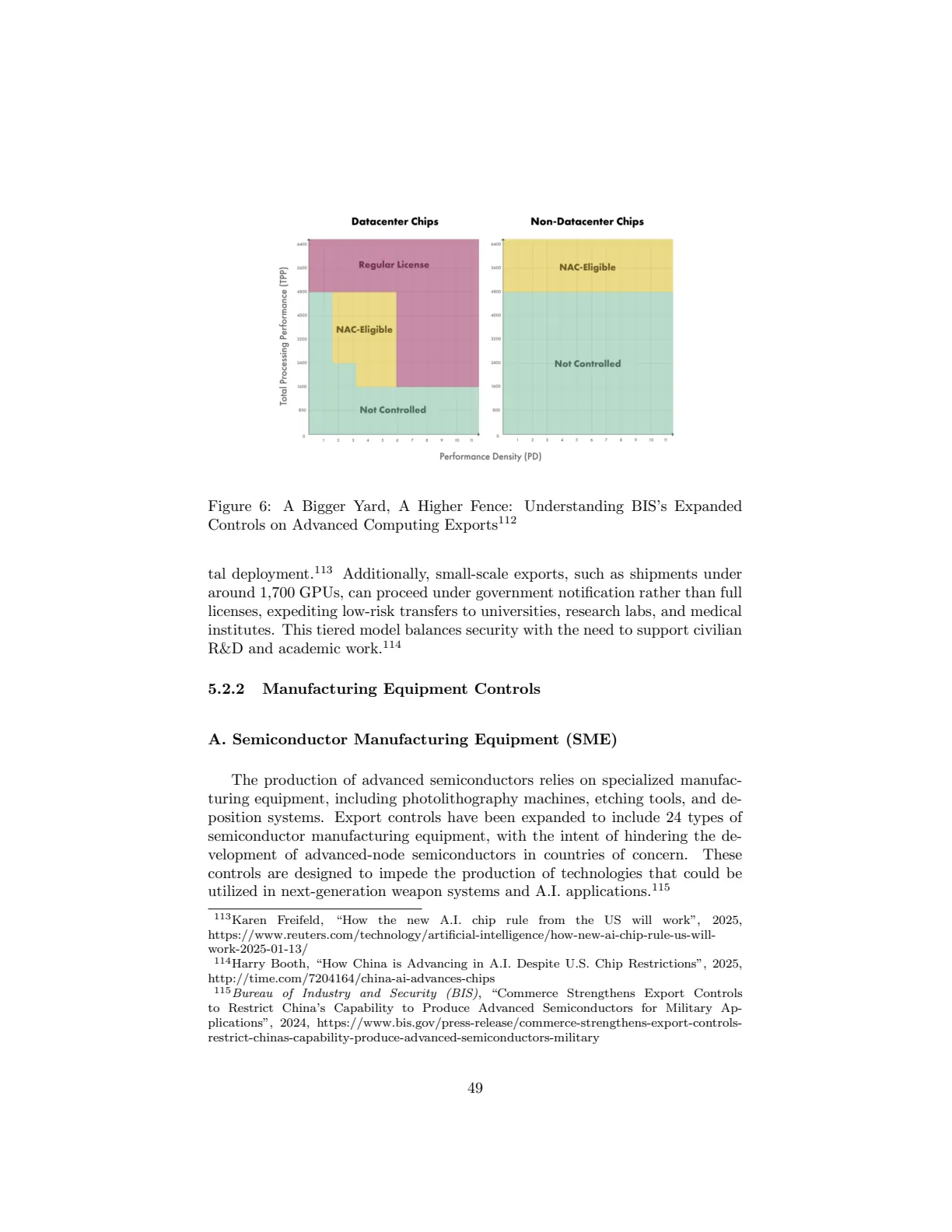
- 113Karen Freifeld, “How the new A.I. chip rule from the US will work”, 2025, https://www.reuters.com/technology/artificial-intelligence/how-new-ai-chip-rule-us-will-work-2025-01-13/
- 114Harry Booth, “How China is Advancing in A.I. Despite U.S. Chip Restrictions”, 2025, http://time.com/7204164/china-ai-advances-chips
- 115Bureau of Industry and Security (BIS), “Commerce Strengthens Export Controls to Restrict China’s Capability to Produce Advanced Semiconductors for Military Applications”, 2024, https://www.bis.gov/press-release/commerce-strengthens-export-controls-restrict-chinas-capability-produce-advanced-semiconductors-military
Page 50
Beyond the generalized foreign direct product rule (FDPR), export controls now utilize a “Footnote 5 FDP Rule” tailored for SME. Under this rule, any foreign-made SME that is a direct product of U.S.-origin technology, or contains components produced by plants using U.S. technology. This is destined for entities listed with ‘Footnote 5’ (a designation for heightened-risk Chinese semiconductor firms) and subject to full EAR licensing.115
B. Entity List Additions
In conjunction with equipment controls, BIS has added numerous Chinese entities to the Entity List, thereby requiring U.S. companies to obtain licenses before exporting specified items to these organizations. This measure targets firms involved in semiconductor fabrication and manufacturing, aiming to restrict their access to critical technologies necessary for producing advanced semiconductors.115
5.2.3 Software and Intellectual Property Restrictions
A. Electronic Design Automation (EDA) Software
Electronic Design Automation (EDA) software is essential for designing and verifying complex semiconductor chips. Recognizing its strategic value, the U.S. has imposed restrictions on the export of EDA tools to certain countries, notably China. These restrictions aim to curtail the development of advanced semiconductors that could be employed in military applications.116
B. Intellectual Property (IP) Considerations
Export controls also extend to the transfer of intellectual property related to sensitive technologies. This includes restrictions on licensing agreements, technical data, and proprietary designs that could facilitate the development of advanced military systems abroad. By controlling the dissemination of such IP, export regulations seek to prevent the unauthorized replication and advancement of critical technologies.28
C. License Exception ACE for Cybersecurity Items
Export control measures have broadened to encompass ‘Authorized Cybersecurity Exports’ (ACE), a license exception under EAR § 740.22, covering new ECCNs: 4A005, 4D004, 4E001.c, 5A001.j, and 5A004.b. These ECCNs regulate both intrusion software (tools that evade detection or subvert systems) and network surveillance/extraction tools. While these items are generally controlled, ACE permits exports to “favorable treatment” end users, such as U.S. banks or medical institutions, for legal cybersecurity and incident response, provided the exporter exercises due diligence in knowing the end-use and end-user This exception encourages legitimate cybersecurity activities while maintaining a guardrail against misuse in unauthorized or hostile cyber environments.115
- 116Financial Times, “Donald Trump orders US chip software suppliers to stop selling to China,” 2025, https://www.ft.com/content/2c0db765-03ac-4820-8a02-806469848bee
Page 51
Page 52
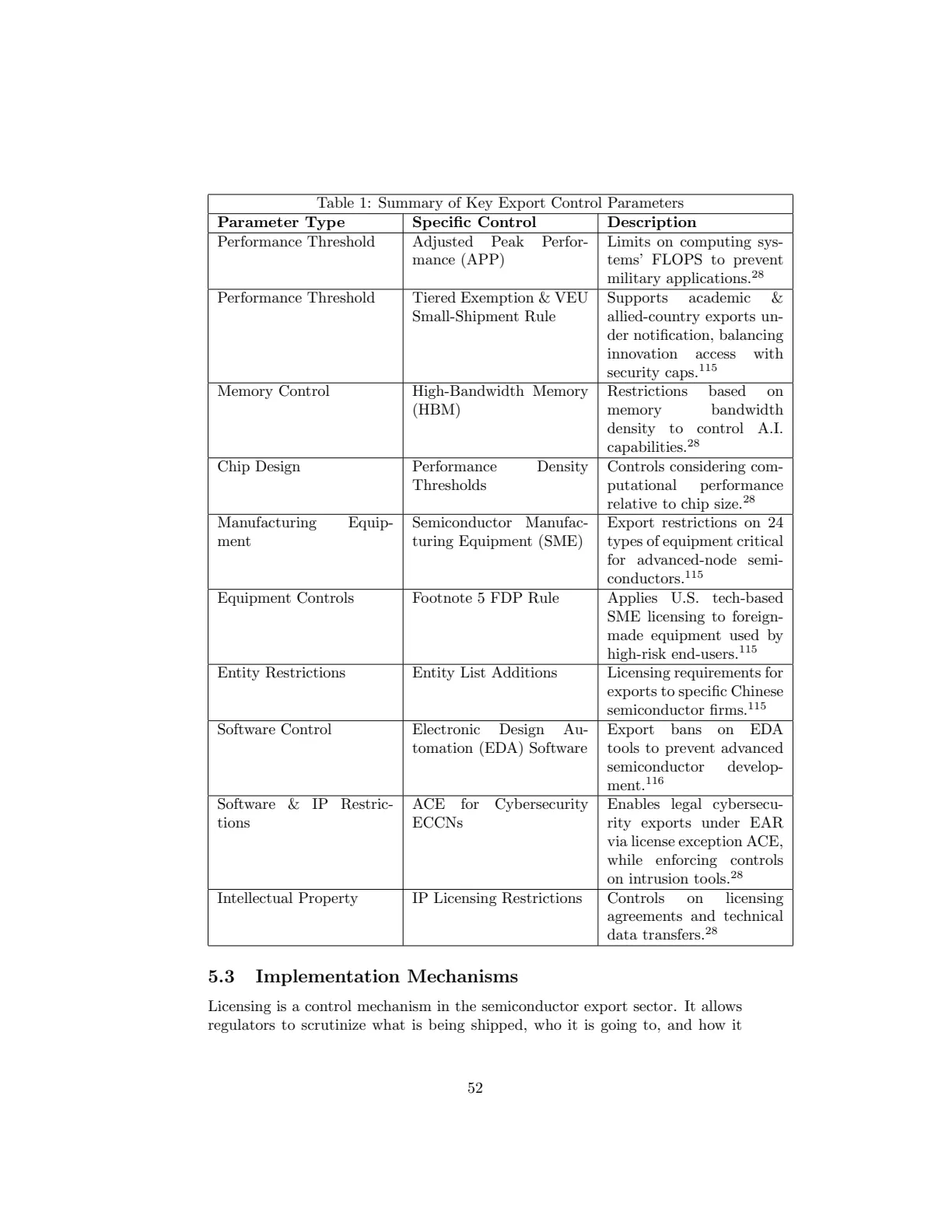
Page 53
5.3.1 Licensing Procedures
A. Definition and Scope
Export licensing refers to the most formal authorization provided by U.S. authorities, mostly the Bureau of Industry and Security (BIS), before restricted goods or software can leave the country. Licensing exists because advanced semiconductor chips, design tools, and fabrication systems are viewed as critical dual-use technologies that can also be changed to weapons programs or extraneous A.I.-equipped military platforms.
Items controlled under the Export Administration Regulations (EAR) fall into two categories: those listed on the Commerce Control List (CCL) and lower-risk EAR-99 items when their end-use seems concerning. Semiconductor chips below certain nodes (e.g., 14 nm FinFET) or ones with high performance (e.g., ECCN3A090) almost always require licensing, even if it is for seemingly inconspicuous places.117
B. Types of Export Licenses
Export licenses fall into three main types: general, individual, and global.118
• General Licenses: License Exception STA (Strategic Trade Authorization)
or GBS covers broad categories of exports to pre-approved destinations
under specified conditions. A semiconductor manufacturer shipping ad-
vanced memory chips to a verified university in an allied country may rely
on a general license instead of applying for an individual one. • Individual Licenses: These apply when exporters face non-standard cir-
cumstances, such as shipping brand-new GPUs to a new facility in a non-
listed country. These require detailed assessment by BIS, including tech-
nical specifications and end-user information.
- 117Neal McGrath, “U.S. Export Restrictions: What Are They, and How Do They Work”, 2023, https://www.investopedia.com/u-s-export-restrictions-6753407
- 118Federation of American Scientists, “Export USA: A Basic Guide to Exporting,” n.d., https://nuke.fas.org/control/mtcr/docs/bgec11a.htm
Page 54
• Global Licenses: Otherwise known as Special Comprehensive Licenses,
these are tailored to recurring large-scale programs. For example, this
could be a U.S. government-funded semiconductor research initiative in-
volving multiple countries. These licenses cover all related shipments un-
der a central authorization, saving applicants from filing serial applica-
tions.119
C. Application and Review Process
The licensing process proceeds through several stages. First, exporters determine jurisdiction: they must assess whether U.S. export rules apply under the EAR, Foreign Direct Product Rule, or even ITAR in rare military-design cases. Next, items are classified using ECCNs to specify sensitivity and exemptions. For semiconductors, ECCNs like 3A090 or 3B001 are common. The classification will determine the correct license type.120
Applications are submitted via BIS’s SNAP-R portal. Required materials include technical specifications, the exporter’s compliance program, affidavits from the end user, and details on planned use and final destination. Review times also vary with a standard individual license requiring 30–60 days, while complex cases involving military end-use or new regimes can take over 120 days.121
D. End-User and End-Use Screening
Due diligence procedures require exporters to vet recipients rigorously. This includes validation that the end user is not on the Entity, Unverified, or Military End User (MEU) lists. For semiconductors, even academic or research institutions require due diligence. This is especially if located in or affiliated with China, Russia, or countries of concern under Section 744.21 (Military End User rule). Technical audits are often required to confirm that recipients cannot repackage or alter chips for unintended use. Screening extends to ultimate end use, checking for ties to weapons systems, nuclear programs, or military A.I. applications.122
- 119FreightAmigo, “Navigating Export Licensing: A Comprehensive Guide for US Businesses”, 2025, https://www.freightamigo.com/blog/navigating-export-licensing-a-comprehensive-guide-for-us-businesses/
- 120Bureau of Industry and Security (BIS), “Export Controls on Semiconductor Manufacturing Items,” 2023, https://www.federalregister.gov/documents/2023/10/25/2023-23049/export-controls-on-semiconductor-manufacturing-items
- 121Bureau of Industry and Security (BIS), “Guidance for Preparing Export License,” n.d., https://www.bis.doc.gov/index.php/16-policy-guidance/product-guidance/267-guidelines-for-preparing-export-license
- 122Bureau of Industry and Security (BIS), “Guidance on End-User and End-Use Controls and U.S. Person Controls”, n.d., https://www.bis.gov/licensing/guidance-on-end-user-and-end-use-controls-and-us-person-controls
Page 55
Figure 7: Items Subject To 744.21 Controls123
E. Approval, Denial, and Appeals
Once a license application is submitted, BIS communication follows a defined path: approval, denial, or a request for modification. Approvals include an explicit license document outlining conditions, timelines, and allowable technical scope. A denial is accompanied by a formal notice, and exporters can submit a redress request or appeal under EAR § 756. BIS also allows supplementary submissions if new information can reasonably address the denial. License exceptions, such as STA, may let exporters proceed in limited ways while resolving the decision.117
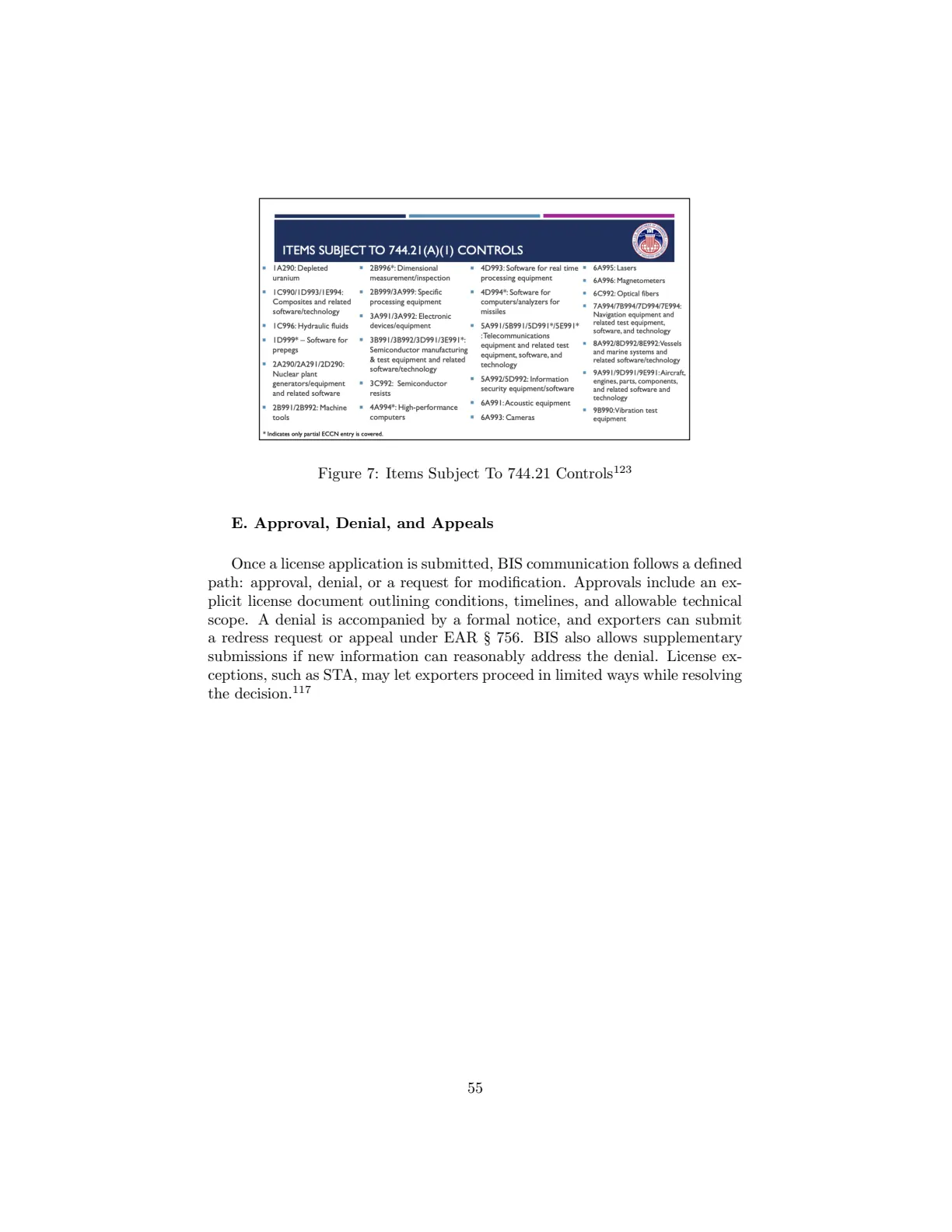
Page 56
5.3.2 Enforcement Methods
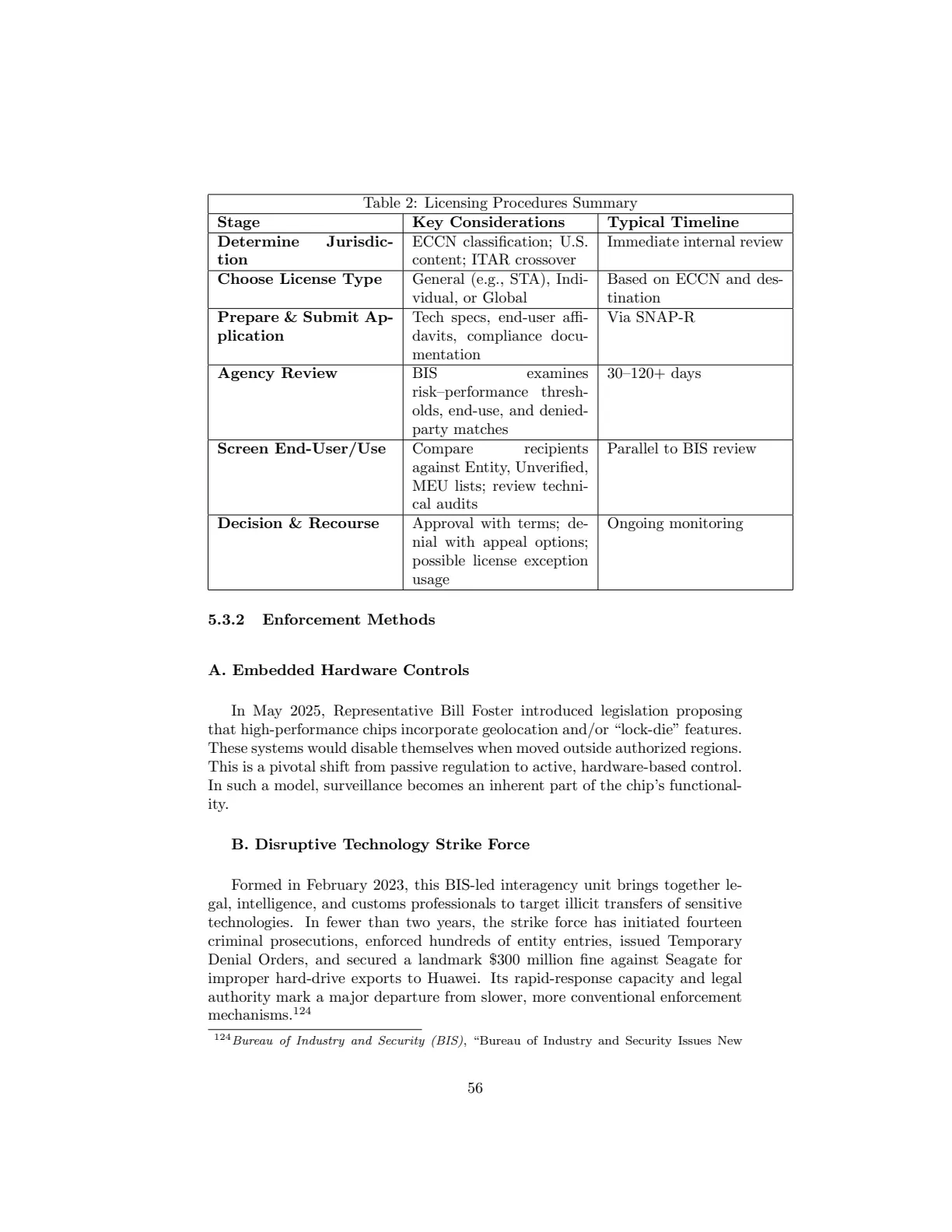
Page 57
C. Financial System Integration
In October 2024, BIS and FinCEN issued joint guidance requiring banks to monitor export-linked “red flags” such as funneling payments through shell companies or transactions involving Entity-List firms. The guidance explicitly warns that ignoring such indicators may constitute “knowledge” of violations under EAR General Prohibition 10. Effectively, financial institutions are now modern-day compliance partners, unwittingly positioned at the heart of regulatory monitoring.125
D. Enforcement Challenges
Enforcement is difficult when design, fabrication, and packaging occur across multiple legal jurisdictions. For instance, U.S.-designed chips fabricated in Taiwan and packaged in Malaysia may fall into gray zones of enforcement unless the FDPR is applied. Countries often diverge in classifying chip technologies. Some may classify advanced GPUs as commercial, while others see them as dual-use. This results in inconsistent enforcement of the same product. To manage a globally integrated semiconductor supply chain, export control authorities are pushing for standardized thresholds for chip performance, export notifications, and licensing metrics. Initiatives are underway at the OECD and G7 levels to draft shared technical definitions.126
5.3.3 Compliance Requirements
A. Export Management & Compliance Programs (EMCPs)
Exporters must maintain comprehensive EMCPs that include oversight from senior management, automated screening tools for restricted parties, regular employee training, and systematic internal audits. In January 2025, BIS updated its “Red Flag Indicators,” highlighting warning signs specific to A.I. and semiconductor exports, such as incomplete technical dossiers, vague client profiles, and unverified logistic routes.124 Companies are now required to demonstrate regular updates to their EMCPs in alignment with emerging risks.
B. A.I.-Chip Self-Reporting Requirements
- Guidance to Financial Institutions on Best Practices for Compliance with the Export Administration Regulations,” 2024, https://www.bis.gov/media/1325
- 125Bureau of Industry and Security (BIS), “BIS Export Enforcement Year in Review 2023”, n.d., https://media.bis.gov/media/documents/bis-export-enforcement-year-review-2023
- 126Aamer Madhani and Josh Boak, “US Tightens Export Controls on China and Russia Over National Security Concerns”, 2024, https://apnews.com/article/china-russia-semiconductors-export-controls-advanced-chips-5b1bd1748d74a7e45dd0c91979215ef3
Page 58
Recent regulations mandate self-certifications for A.I.-capable systems. Exporters must disclose metrics such as peak training throughput (peta-FLOPs), inference energy consumption, reinforcement learning capacities, and performance density figures. These technical disclosures are evaluated within a tiered licensing framework that includes carve-outs for Verified End Users (VEUs) and allied nations.127 The result is a shift from abstract regulation to metrics-driven control that directly reflects a chip’s potential application.
C. Foundry and Outsourced Test Provider Obligations
As of January 2025, semiconductor foundries and outsourced assembly/test (OSAT) firms must validate that their products fall within controlled specifications. Where verification is impossible, licensing becomes mandatory regardless of declared end-use. Any lapses may lead to entity-list placement or financial penalties, threatening the company’s ability to operate on global platforms.127
D. Know-Your-Customer (KYC) Responsibility
According to EAR Supplement No. 3 to Part 732, companies cannot employ willful ignorance when dealing with suspicious clients or vague transactional requests. Failure to investigate or escalate concerns may, in itself, be grounds for enforcement action. Firms are mandated to perform due diligence, document unresolved concerns, and escalate to senior compliance personnel.124
E. Third-Party Audits and Certifications
Regulators increasingly expect external attestation of compliance efforts, especially in high-risk sectors such as semiconductor and A.I. Independent audits and certifications modeled on ISO standards are becoming standard requirements rather than optional enhancements.128 These external validations help establish credible, verifiable compliance footprints.
- 127Anton Shilov, “U.S. Inks Bill to Force Geo-Tracking Tech for GPUs and Servers: High- End Gaming GPUs Also Subject to Tracking”, 2025, https://www.tomshardware.com/pc-components/gpus/u-s-inks-bill-to-force-geo-tracking-tech-for-gpus-and-servers-high-end-gaming-gpus-also-subject-to-tracking
- 128Financial Integrity Network, “Leveraging Artificial Intelligence for Enhanced Financial Compliance,” n.d., https://finintegrity.org/
Page 59
6
Impact Assessment
6.1 Economic Effects
6.1.1
Industry Impact In the simplest terms, A.I. semiconductors are hardware that facilitates the operating processes within A.I.112 When looking at them through this lens, the relationship between A.I. and their semiconductors are entirely symbiotic, where the immense pressure for A.I. innovation pushes for more efficient semiconductors, and more advanced semiconductors enables the development of A.I. breakthroughs.113 As an increasing emphasis is placed on technological superiority for political dominance, semiconductors have recently become a topic of tension between the United States and China, two of the world’s major A.I. powerhouses and competitors. It is crucial to determine whether U.S. national security and technological superiority outweigh the economic implications of export controls. One of the most important concepts to understand in the context of weighing the benefits and pitfalls of export controls is that, although they are intended to limit a competitor, export controls always have adverse effects on the entity initiating them, which, in this case, is the United States. This was exhibited in October 2022, when the United States restricted U.S. companies from exporting advanced semiconductors and SME for making chips smaller than 14 nanometers (nm) to China.114
In May 2023, China banned the use of U.S. semiconductor manufacturer Micron’s chips in various infrastructure projects. Then, in July 2023, China announced its export restrictions on germanium and gallium, two vital components in manufacturing semiconductors, which China produces 60% and 90% of the world’s supply, respectively. Similarly, in October 2023, the United States updated its semiconductor export controls to close various loopholes. Within that same month, China announced its export restrictions on graphite, a vital component of electric car batteries. This is particularly significant because China is the world’s largest graphite producer.114 As is shown through this back-and-forth, the United States, when Former President Biden’s administration initiated export controls on A.I. semiconductors, prompted China to do the same.
Although export controls may have the benefit of significantly bolstering U.S. national security as advanced A.I. semiconductors open doors to immense military and technological advancement, there are significant and tangible adverse industry impacts. A more obvious effect, U.S.-based semiconductor firms are denied business opportunities in the Chinese market without a license. Hence, if a firm cannot procure a license, it must make up for that deficit by finding other buyers. The Federal Reserve Bank of New York published a report that found a statistically significant drop in profitablility in affected U.S. firms after the October 2022 export controls imposed by the U.S.115 Although this conclusion is supported by various research and statements, other data suggests that U.S. firms undergo temporary difficulty following these controls, but are able to recover in as quickly as a few fiscal quarters.86 These firms undergo an initial blow to business that is alleviated by clients outside of China. In fact, the “24 months under export controls have been among the best in history for American WFE suppliers” (WFE being wafer fabrication equipment, a vital tool in the manufacturing of semiconductors). When looking solely at the data surrounding economic impact on China-U.S. semiconductor export controls, the data shows that, in the long term, these controls may not have as immense an impact as could be assumed at first glance.
- 112Venus Kohli, “AI Semiconductors: The Talk of the Hardware Industry”, 2024, https://www.power-and-beyond.com/ai-semiconductors-the-talk-of-the-hardware-industry-a-bbe42809a2803eaaed7c5dda9790338e/
- 113MicroChip USA, “The Intersection of A.I. and Semiconductors: Advancements, Implications, and Future Opportunities”, 2025, https://www.microchipusa.com/industry-news/the-intersection-of-ai-and-semiconductors-advancements-implications-and-future-opportunities
- 114Kirti Gupta, Chris Borges, and Andrea Leonard Palazzi, “Collateral Damage: The Domestic Impact of U.S. Semiconductor Export Controls”, 2024, https://www.csis.org/analysis/collateral-damage-domestic-impact-us-semiconductor-export-controls
Page 60
Similar to profit margins, stock market capitalization experiences a temporary decrease during the time immediately after an export control is announced. With the acknowledgment that they recovered eventually, it is still worthwhile to note that the PHLX Semiconductor Sector Index, a market-cap-weighted index of the 30 largest U.S. semiconductor companies, decreased by 8% after the October 2022 export control announcement and by 3% after the October 2023 announcements.114 This supports the concept that, from an economics perspective, U.S. semiconductor manufacturers suffer an initial blow that they are more than capable of recovering from by engaging with ex-China buyers. Based on this alone, it can be argued that the adverse effects from these controls do not outweigh the national security benefits offered by initiating semiconductor export controls. On this topic, Anthropic CEO Dario Amodei states that export controls on semiconductors are immensely vital to our immediate future. As early as 2026-2027, A.I. will reach a point of development where it will be capable of vastly more than it currently is. To sustain this, billions of dollars and millions of semiconductors are required. China’s DeepSeek has allowed for A.I. advancements near that of the U.S. frontiers at a cheaper price. If China gains access to the necessary amount of semiconductors, or chips, and achieves a level of parity with the U.S. in terms of A.I., China would be better prepared to utilize them for military purposes. This poses an immediate threat. Thus, the nature of the Chinese A.I. industry and subsequent national security concerns, the evident economic effects caused by chip export controls, do not outweigh the necessity of imposing them.
While the direct economic effects on U.S. semiconductor firms are significant, the impact of export controls extends far beyond industry margins. To effectively conceptualize the broader consequences of these policies, it is essential to assess their influence on the structure and stability of global supply chains and long-term implications for innovation.
- 115Matteo Crosignani, Lina Han, Marco Macchiavelli, and Andr´e F. Silva, “The Anatomy of Export Controls”, 2024, https://libertystreeteconomics.newyorkfed.org/2024/04/the-anatomy-of-export-controls/
Page 61
U.S. semiconductor export controls have not only affected direct company profitability but have also disrupted the entire global supply chain that supports A.I. development. Semiconductor production is deeply globalized, as it relies upon rare earth metals mined in Africa and refined in China, equipment like lithography machines from Europe, and chips fabricated in Taiwan and South Korea. The export controls have strained the interdependence by halting access to key tools, materials, and markets.
6.1.2 The Supply Chain & Impacts on Innovation
Access to critical tools has been disrupted most directly through restrictions on wafer fabrication equipment (WFE). In October 2022, the U.S. Department of Commerce banned the export of advanced chipmaking tools needed to manufacture chips—smaller than 14 nanometers—from U.S. companies such as Applied Materials, Lam Research, and KLA to China. Additionally, the U.S. leveraged its global influence to pressure allied nations like the Netherlands and Japan to follow suit. Consequently, firms like ASML and Tokyo Electron were barred from selling extreme ultraviolet (EUV) and high-end deep ultraviolet (DUV) lithography machines to Chinese foundries, even though they are not based in the U.S. Therefore, China’s ability to fabricate advanced semiconductors has diminished, causing production delays that have shaken the global supply chain.27
Material access has simultaneously been further destabilized by China’s retaliatory export controls. China began by introducing licensing requirements for gallium and germanium in July 2023, which are two metals crucial for highspeed, military-grade semiconductors and photonics. While officially framed as national security measures, these restrictions were widely interpreted as a direct retaliation against U.S. semiconductor controls. In reality, China’s dominance over these materials (producing 90% of the world’s gallium and 60% of its germanium) gave it strategic leverage to disrupt upstream inputs. By December 2024, the restrictions had evolved into a de facto export ban to the U.S., and in May 2025, China reinforced the policy by expanding licensing requirements to downstream derivatives and alloys.116
These dispositions carry three-layered effects. First, they raise prices and delay shipments for firms across the A.I. value chain, including those in allied nations not directly involved in the dispute between the U.S. and China. Second, they force rapid and costly adjustments, such as qualifying new suppliers in countries that may lack the scale or reliability to meet demand in the short term, such as India and Vietnam. Third, they reveal the true fragility of the A.I. supply chain. Even minerals sourced from Africa often flow through Chinese refineries, providing China with enduring influence over inputs that many wrongly assume are safely diversified.117
- 116Sarah Godek, “China’s Germanium and Gallium Export Restrictions: Consequences for the United States”, 2025, https://www.stimson.org/2025/chinas-germanium-and-gallium-export-restrictions-consequences-for-the-united-states/
- 117S&P Global Market Intelligence, “China Responds to US Restrictions with Export Ban
Page 62
The U.S. has responded by shifting its regulatory posture.
In May 2025, the Biden Administration rescinded the broad A.I. Diffusion Rule, and the U.S. Department of Commerce adopted a more targeted, risk-based licensing model. As a result, trading restrictions slightly eased for close U.S. allies, such as India and Vietnam. However, this was paired with a lowered de minimis threshold (from 25% to 10%), which dramatically expanded U.S. jurisdiction over foreign-made chips containing U.S. technology. Therefore, the U.S. tightened control over third-country supply chains.118
Raw material sourcing has also grown more fragile. While Africa supplies key minerals like cobalt (DRC), tantalum (Rwanda and DRC), and graphite (Mozambique and Madagascar), many of these are refined in China; this reinforces the same dependencies the U.S. is attempting to unwind. For instance, over 70% of the world’s cobalt, which is an element essential for chip batteries and A.I. data center cooling, is mined in the DRC but processed through Chinese-controlled smelters. This interdependence emphasizes the impossibility of minimizing China’s involvement in the short-term.119
To mitigate risk, companies and governments are diversifying. Manufacturing is shifting toward India, Malaysia, and the U.S., and the CHIPS Act has incentivized domestic fab construction, but these solutions take years. In the meantime, the disruption caused by these layered restrictions has made A.I. hardware more expensive, slower to deliver, and geopolitically entangled, fundamentally reshaping how and where the future of computing is built.114
Export controls also have second-order effects on technological innovation, which is a less visible but equally vital concern. A.I. progress depends not only on chip access but also on open collaboration across academia, firms, and countries. Therefore, restrictions fracture this synergetic ecosystem.
Chinese A.I. labs, which are cut off from high-performance GPUs like Nvidia’s A100 and H100, must now train large models with slower, less efficient chips or attempt to build domestic alternatives. While the Chinese are no longer able to harness high-performance GPUs, this restriction has resulted in innovation. DeepSeek-V2, a GPT-4 level model, emerged in 2024 to mitigate the hampering effects of restriction, demonstrating critical adaptation.120
In the U.S., the revenue losses from reduced access to Chinese customers may shrink R&D budgets, especially for small-to-mid-sized firms. Even resilient giants like Nvidia face greater uncertainty when planning high-risk, long-term chip innovations. This can chill ambition, particularly in speculative architecture development that requires high capital and long lead times.121
- on Select Critical Minerals”, 2025, https://www.spglobal.com/market-intelligence/en/news-insights/research/china-responds-to-us-restrictions-with-export-ban-on-select-critical-minerals
- 118Bureauof Industry and Security (BIS), “AI Diffusion Revision”, 2025, https://www.bis.doc.gov/index.php/fr-05-13-2025-ai-diffusion-revision
- 119Ashley Fish-Robertson, “China Introduces Export Restrictions on Some Rare Earths”, 2025, https://magazine.cim.org/en/news/2025/china-introduces-export-restrictions-on-some-rare-earths-en/
- 120Dario Amodei, “On DeepSeek and Export Controls”, 2025, https://www.darioamodei.com/post/on-deepseek-and-export-controls
Page 63
Export controls also minimize global collaboration. Joint U.S.-China research programs in A.I. and semiconductor physics have been paused or cancelled. Academic conferences and cross-border data sharing now face stricter restrictions, leading to slower, siloed progress on key breakthroughs.115
In addition, U.S. allies may suffer. Japan, South Korea, and the Netherlands have seen exports to China decline due to pressure to comply with U.S. restrictions. With fewer Chinese customers, these countries face diminished economies of scale that once supported aggressive innovation in semiconductor tooling and photonics.122
What emerges is a sobering dynamic: while export controls are justified on national security grounds, their innovation cost is real. According to Anthropic CEO Dario Amodei, transformative A.I. may arrive by 2026–2027. To stay ahead of adversaries, democratic nations need not only to restrict but to invest heavily and collaboratively. Otherwise, the very tools designed to maintain a technological edge may dull it over time.123
6.2 Strategic Implications
The semiconductor industry is currently the most intense point of contention in the United States and China’s technological rivalry, where both countries are employing drastic measures, including tariffs and export controls, to restrict each other’s market access. As their rivalry intensifies, export controls emerge as a policy tool for regulating access to market technologies. These measures represent strategic efforts to actively isolate the global distribution of technological power in favor of national interests. Export controls are reshaping the global semiconductor environment, forcing states, relations, and alliances to adapt in real time.
6.2.1 U.S.-China Relations
A. Structural Interdependence
The United States has significantly reduced the amount of U.S. imports from China, reflecting changing United States’ changing trade desires. This reduction in imports has cost the U.S. nearly USD 150 billion in lost exports since
- 121Eversheds Sutherland, “US and China Tighten Respective Export Restrictions on Advanced Technology and Critical Minerals”, 2025, https://www.eversheds-sutherland.com/en/united-states/insights/us-and-china-tighten-respective-export-restrictions-on-advanced-technology-and-critical-minerals
- 122Financial Times, “China Tightens Export Controls on Critical Minerals”, 2025, https://www.ft.com/content/e679b887-00d8-4937-8a9d-1e2a8dd9c19a
- 123Reuters, “China to Strengthen Control Over Strategic Minerals Exports”, 2025, https://www.reuters.com/markets/asia/china-strengthen-control-over-strategic-minerals-exports-2025-05-12/
Page 64
2017.124 However, despite the United States’ efforts to dominate the technological landscape and slow down China’s advancements in the semiconductor industry, there exists a mutual interdependence between the two nations.
For example, almost 29% of U.S. semiconductor manufacturing machinery exports go to China, demonstrating that the U.S. is a critical supplier for China’s global chip production, reflecting an intertwined relationship. Simultaneously, U.S. electronics imports from Mexico, Taiwan, and Vietnam are built with a significant percentage of Chinese components, indicating that China is vital for the construction of electronics, solidifying its importance in the global electronics supply chain, even for goods outside of its borders.124
Both countries heavily depend on each other for not just machinery and components, but also talent, intellectual property, and manufacturing networks. Specifically, for the U.S., China’s market remains a key site for semiconductor sales, diversifying their supply chain. For China, U.S.-origin machinery is vital for advancing its domestic chip fabrication capabilities, which is essential for structural independence. However, both countries wish to reduce vulnerabilities and push towards independence by promoting decoupling ambitions.
B. Decoupling Ambitions
Although there is an inherent current interdependence between the two countries, the U.S. government and policymakers are actively working to constrain China’s importance and reliance in the global market. This can be depicted in policies such as the CHIPS & Science Act, which aims to increase domestic chip production by incentivizing onshore manufacturing and R&D, and in multiple export controls designed to limit China’s access to crucial semiconductor technologies.
China, a nation that has the largest consumer market for electronics and one of the world’s biggest manufacturing hubs, has had massive technological developments and rising sales; however, it only secured 7% of global electronic profits while the U.S. secured 54%.124 This imbalance in profit shows how the U.S. leads in semiconductor design and intellectual property, while China handles the low-margin assembly and component manufacturing. For China, the challenge is not scaling production, but rather climbing up the value chain to attain greater profit shares, a move that the U.S. desires to block through export control and strategic alliances. For China, the imperative to reach self-sufficiency in the semiconductor industry has intensified due to U.S. restrictions and the risk of future supply chain disruptions, attributed to the fact that they have doubled semiconductor manufacturing machine imports since 2017. Furthermore, China is heavily investing in domestic companies such as Huawei, Biren, and SMIC, to reduce reliance on foreign chips.125
- 124Coface, “Tech Wars: US vs China Rivalry for Electronics Out to 2035”, https://www.coface.com/news-economy-and-insights/tech-wars-us-vs-china-rivalry-for-electronics-out-to-2035
- 125Brenda Goh, “US Exaggerating Huawei’s A.I. Chip Achievements, China State
Page 65
Despite U.S. efforts to detach from the Chinese market, China has remained a strong pillar in the semiconductor industry, reflecting its importance in global supply chains and thereby contradicting the interests of corporate America.124 This intertwined web illustrates the dependencies rooted in the semiconductor ecosystem, further complicating efforts to completely decouple despite strong efforts from both sides.
6.2.2 Global Technological Landscape
A. Competing Technological Blocs
The global technological landscape is rapidly splintering into competing blocs, where the U.S. and China lead efforts to build parallel supply chains and technology and regulatory standards. These emerging trends and blocs are actively redefining how devices are produced, governed, and consumed, reflecting a transition from a united, global technological system to a competing, divided one.
For example, increased U.S. tariffs on Chinese-manufactured smartphones and components to 20% have triggered a major shift in supply chain geography, reshaping the movement of technological goods and components. Additionally, in May 2025, Chinese smartphone imports to the U.S. fell from 67% to 8%, as many manufacturers moved from China to countries like India or Vietnam.126 Although exports have risen from these other countries, many of these smartphones are still made with Chinese components, highlighting the redundancy of tiered supply chains.
Meanwhile, the U.S. is consolidating a Western-aligned technological bloc through policies such as the CHIPS & Science Act and initiatives like the U.S.- EU Trade and Technology Council, where the U.S. hopes to create a networked ecosystem among allies for chip manufacturing, research, standards, and export control enforcement. Conversely, China is creating the formation of a China-aligned ecosystem, one that is self-sufficient and minimizes reliance on foreign technology. This effort builds upon its previous industrial blueprint, “Made in China 2025,” an internal plan within China to move it up the global value chain, by embedding artificial intelligence as core infrastructure across its manufacturing base.127 As a result, companies now face divergent regulatory and certification systems and increasingly design distinct products for U.S.-aligned versus China-aligned markets. The emergence of these distinct, competing blocs shows how geopolitical tensions are transforming the bifurcated global technology landscape.
- Media Quotes CEO Saying,” 2025, https://www.reuters.com/business/media-telecom/us-exaggerating-huaweis-ai-chip-achievements-china-state-media-quotes-ceo-saying-2025-06-10/
- 126Adam Levine, “Trump Sectoral Tariffs Smartphones China”, https://www.barrons.com/articles/trump-sectoral-tariffs-smartphones-china-2d9675a6
- 127Kaiser Kuo, “How China Is Reinventing the Future of Global Manufacturing”, 2025, https://www.weforum.org/stories/2025/06/how-china-is-reinventing-the-future-of-global-manufacturing/
Page 66
B. Impact on Innovation and Market Access
These technological blocs are significantly changing the dynamics of innovation and global market access. The fragmentation of the technological market is slowing the diffusion of new technologies as companies and states increasingly develop products in isolated environments. For example, firms in the U.S.-aligned bloc are restricted from selling advanced semiconductor equipment to Chinese firms, curbing design software and potential revenue streams from China, trampling on Chinese aspirations for a broader market.128 Simultaneously, Chinese companies are racing to develop domestic alternatives; however, with limited international cooperation, progress can be slowed, and standards may diverge.129
The divergence in regulatory environments, IP rules, and compliance requirements further raises the barrier for firms to operate effortlessly outside of their borders. Particularly, small and mid-sized technological firms are forced to choose a bloc, limiting their reach and fragmenting their customer base.130 Furthermore, large multinationals are increasingly designing region-specific products, diverting R&D from universal innovation and towards incompatible dual-system products. Moreover, technological fragmentation could lead to wasted resources and duplicative efforts as both blocs aim to reinvent tools, platforms, and ecosystems that were once globally shared, such as chip architectures and A.I. development platforms. This fragmentation of the global technological ecosystem has deep economic and scientific consequences, potentially stalling crucial global progress and reinforcing competition at the expense of proper cooperation.
C. Challenges to Multilateral Governance
Multilateral export frameworks like the Wassenaar Arrangement, originally designed to prevent the spread of conventional arms and dual-use goods, are increasingly ill-equipped to regulate emerging technologies like artificial intelligence and semiconductors. These frameworks rely on consensus-based decisions, which slow responsiveness and often lead to diluted controls.131 Furthermore, many of the regimes established in the post-Cold War era are not designed to handle the rapid pace and dual-use ambiguity of semiconductor chips, which can be embedded for both civilian and military uses.
- 128Karen Freifeld, “Trump Tells US Chip Designers Stop Selling China FT Reports”, 2025, https://www.reuters.com/world/china/trump-tells-us-chip-designers-stop-selling-china-ft-reports-2025-05-28/
- 129Bevan Hurley, “China Chips US Trump Selling”, 2025, https://www.thetimes.com/us/american-politics/article/china-chips-us-trump-selling-tgz86b5n9?®ion=global
- 130International Chamber of Commerce, “Harmonised A.I. Standards to Reduce Fragmented Global Rules”, https://iccwbo.org/news-publications/policies-reports/harmonised-ai-standards-to-reduce-fragmented-global-rules/
- 131Andr´e Brunel, “Adopt a Treaty for Semiconductor Export Control”, 2024,
Page 67
For example, the Wassenaar Arrangement lacks sufficient coverage for high-bandwidth A.I. accelerators, advanced neural processing units, or A.I.-specific software frameworks despite their growing significance. As a result, the U.S. has resorted to unilateral or plurilateral controls, for example, restricting exports of NVIDIA’s A100/H100 chips to China, effectively bypassing multilateral systems.132
6.2.3 Alliance Dynamics
A. Strengthening U.S.-Led Export Control Coalitions
In response to concerns about China’s growing technological rise, the U.S. has increasingly relied on coalition-based governance models to enforce semiconductor-related export policies, forming many strategic alliances. For instance, alliances such as the Quad Technology Working Group (U.S., Japan, Australia, and India), the CHIP4 alliance (U.S., Japan, Taiwan, and South Korea), and the U.S.-EU Trade and Technology Council have arisen as crucial platforms to align policy on semiconductor supply chains, technology standards, and export enforcement. These smaller coalitions offer faster and more flexible decision-making than ordinary multilateral institutions. For example, the TTC established a working group specifically on export controls, aiming to create shared approaches on semiconductor export controls, leading to more effective coordination between the TTC.133
Moreover, in January 2025, the U.S. implemented a three-tiered licensing system, aspiring to control the flow of A.I.-related semiconductors. This system granted unrestricted access to 20 trusted allies, including the Netherlands, Japan, and South Korea, while placing licensing requirements on other countries such as China and Russia.134 This would significantly affect China’s access to global semiconductor technology, further isolating the country.
B. Diverging Interests and Enforcement Challenges
These initiatives also reflect diverging geopolitical values as the U.S.-led bloc promotes democratic norms and national security-first frameworks, while China and its aligned partners emphasize techno-sovereignty and digital self-reliance. As a result, competing norms are emerging with each hoping to define the governance of semiconductors, A.I. safety, and cross-border data flows. Moreover, this divergence has led to regulatory fragmentation that increases the cost of compliance and raises uncertainty in global technology trade, burdening small or mid-sized companies with multiple, incompatible rule sets.
- https://www.defensenews.com/opinion/2024/02/07/adopt-a-treaty-for-semiconductor-export-control/
- 132Tom Jowitt, “Nvidia Expects 5.5 Billion Hit as US Tightens Export Controls”, 2025, https://www.silicon.co.uk/cloud/ai/nvidia-expects-5-5-billion-hit-as-us-tightens-export-controls-608558
- 133USTR,“US-EU Joint Statement Trade and Technology Council”, 2024, https://ustr.gov/about-us/policy-offices/press-office/press-releases/2024/april/us-eu-joint-statement-trade-and-technology-council
- 134Financial Times, “Export Controls Impact Analysis”, 2025, https://www.ft.com/content/f83f30be-d673-4f00-b9e5-9e9293512010
Page 68
Furthermore, allies display various economic dependencies on China, which complicates the cohesive enforcement of export semiconductor controls. For example, the Netherlands, home to ASML, the only manufacturer of advanced EUV lithography materials, was facing pressure from the U.S. to curb exports from China; however, China was a major contributor to ASML’s revenue. In 2023, the Dutch government withheld public disclosure of ASML sales to China.135 By not publishing their data, they could give the appearance of alignment with U.S. controls while also maintaining economic ties with China, hoping to maintain strategic ambiguity and satisfy both sides.
Similarly, nations like South Korea and Japan, which are aggressively integrated into China’s supply chains, have faced internal debates on tightening export control restrictions to China. While both countries are joining U.S. efforts to restrict advanced chip technologies, they have also hesitated on measures like servicing restrictions due to potential economic backlash, representing crucial enforcement challenges towards export restrictions.
C. Middle Powers
Although U.S. efforts to curb Chinese access to semiconductor technologies are employed, major semiconductor-producing nations such as the Netherlands, Japan, and South Korea play a pivotal role in shaping the effectiveness of these efforts. For example, Japan, which has traditionally followed U.S. policies, backtracked on its planned chip restrictions after China’s Ministry of Commerce stated that this could harm bilateral business relations between the two nations.136
7 Recommendations
7.1 Policy Recommendations
The imperative to control semiconductor exports has evolved far beyond a matter of tactical denial between the U.S. and China. In a world where computing power is the basic defining input of both economic scale and advantage on the international level, chip controls function as levers of geopolitical tensions, shaping not only who builds what, but under what rules, and in whose orbit. Yet the durability of such controls cannot be solely based on restrictions. As China accelerates towards indigenous chip self-sufficiency, as alliances face the strain of asymmetric burdens, and as technological advances outpace static regulations, U.S. policy ought to outgrow the status quo’s approach of reactive controls.
- 135Toby Sterling, “Dutch Government Excludes Most ASML Sales China Dual Use Export Data”, 2025, https://www.reuters.com/technology/dutch-government-excludes-most-asml-sales-china-dual-use-export-data-2025-01-17/
- 136Reuters, “China Says Japan’s Plans Chip Export Controls Could Damage Business Relations”, 2025, https://www.reuters.com/technology/artificial-intelligence/china-says-japans-plans-chip-export-controls-could-damage-business-relations-2025-01-31/
Page 69
To strike a balance between heightened effectiveness for the United States’ A.I. semiconductor export controls and minimal unintended economic and strategic consequences, the U.S. must pursue a multi-pronged strategy spanning the short, medium, and long term. The overarching goal of each phase will be to reinforce not only national security but also the stability of the global supply chain, the vitality of innovation around the world, and cohesion between the U.S. and its allies.
7.1.1 Short-term (0 to 18 months)
In the immediate future, U.S. export controls must be refined to close existing loopholes and overcome the limitations of its current “list-based” and reactive control frameworks. For instance, the October 2022 and January 2023 BIS rules sought to restrict the export of advanced A.I.-capable chips by implementing performance thresholds (such as the Aggregate Performance Parameter) estimated to be similar to such chips.137 However, Chinese firms as of that time had adapted to much of the U.S.-implemented controls through various evasion strategies. Firms have deployed lower-clocked chips combined through parallel processing—artificially reducing individual chip metrics while maintaining disproportionately higher levels of A.I. compute; smuggled over 50,000 chips from neighbouring countries;138 and various shell entities and cloud workarounds (through smuggling or renting) to gain possession of the chips.138
To effectively seal these loopholes, U.S. export controls ought to transition from the current static, list-based frameworks towards a non-static data-driven framework, and better enforce export controls, adapting to changes, in a sense. For one, this could be done through adopting a modern analytics platform– equipped with automated document scanning, A.I.-powered pattern recognition, and auditable logs– which possesses the potential to dramatically boost BIS productivity (essentially converting time spent searching into time spent analyzing); as well, it would reduce license processing delays and expose smuggling networks and shell entities in near real-time.88139140 A well-integrated analytics platform could fuse commercial registries, customs data, and shipping records into a single enforcement interface– drastically decreasing the time required to link U.S. exports to blacklisted entities. Additionally, shifting BIS toward a digitally auditable system would not only improve enforcement but accelerate average license processing times (now 26 days) and ease regulatory burdens on compliant firms. Though this would require an initial investment of $44.6 million annually– $25 million covering crucial tech infrastructure, upskilling of analysts, and access to data, and $18.4 million funding 48 new enforcement agents and SCIF expansions to meet the the growing need from intelligence-driven cases– the return on investment is projected to be high, as export enforcement becomes faster and far more precise in a compounding manner, deemed “one of the best opportunities available anywhere in U.S. national security”.88 Regarding feasibility, the $44.6 million figure pales in comparison to the 18.3 billion funneled into Ukraine post-Russian invasion, often spent to destroy Russian weapons powered by smuggled U.S. components.
- 137Bureau of Industry and Security (BIS), “Implementation of Additional Export Controls Certain Advanced Computing Items Supercomputer”, 2023, https://www.federalregister.gov/documents/2023/10/25/2023-23055/implementation-of-additional-export-controls-certain-advanced-computing-items-supercomputer-and
- 138Tim Fist, Jordan Schneider, and Lennart Heim, “Chinese Firms Are Evading Chip Controls”, 2023, https://www.cnas.org/publications/commentary/chinese-firms-are-evading-chip-controls
Page 70
In parallel, BIS can mold more accurate and effective export controls by institutionalizing formal industry-government consultation forums141– bringing semiconductor manufacturers (such as Intel and TSMC), A.I.-capable cloud providers (AWS, Azure), and supply chain logistics firms into structured roundtables;142 those industry actors directly operate amidst current export controls and within the current semiconductor landscape, and can often detect patterns BIS misses.141 These engagements could tackle and adapt to emerging evasion tactics—such as smuggling via satellite foundries or rental compute loopholes—and co-develop agile compliance protocols. Such partnerships would ensure U.S. export policy, rather than lagging behind Chinese technological adaptation as it does in the status quo of list-based export control approaches, anticipates and counters it.
7.1.2 Medium-Term (18 months to 5 years)
Over the next several years, the U.S., more broadly, ought to reduce structural exposure to chokepoints vulnerable to geopolitical coercion by fleshing out resilient and geopolitically secure semiconductor supply chains. The vulnerabilities exposed by Taiwan’s dominance in advanced logic chip fabrication– their production of 92% of global sub-10nm semiconductors—make clear that the long-term viability of U.S. technological leadership cannot be contingent on a single point of failure, susceptible to natural disasters, infrastructure shutdowns, or international conflicts.13 To that end, despite the CHIPS and Science Act of 2022 allocating $52.7 billion toward domestic semiconductor RD, manufacturing, and workforce development,143 noting the staggering intensiveness in capital of advanced-node fabrication (which can cost as much as $10 billion)144—as well as geographic concentration of critical upstream tools, materials, and packaging capabilities—the $52.7 billion fund should not only accelerate domestic manufacturing scale-up, but simultaneously be paired with a strategy to regionalize production and assembly of semiconductors across politically aligned, cost-competitive nations. Thus, the U.S. must scale both domestic re-shoring and strategic “friend-shoring” with trusted allies and partners.
- 139Barath Harithas, “Reaction Strategy New Framework US Export Control Enforcement”, 2024, https://www.csis.org/analysis/reaction-strategy-new-framework-us-export-control-enforcement
- 140William Alan Reinsch, John Hoffner, and Jack Caporal, “Unpacking Expanding Export Controls and Military Civil Fusion”, 2020, https://www.csis.org/analysis/unpacking-expanding-export-controls-and-military-civil-fusion
- 141SEMI, “SEMI Consortium to Develop Cybersecurity Strategy and Roadmap for the Semiconductor Industry in NIST Framework”, 2024, https://www.newswire.ca/news-releases/semi-consortium-to-develop-cybersecurity-strategy-and-roadmap-for-the-semiconductor-industry-in-nist-framework-834545161.html
- 142Sujai Shivakumar, Charles Wessner, and Thomas Howell, “Balancing Ledger Export Controls US Chip Technology China”, 2024, https://www.csis.org/analysis/balancing-ledger-export-controls-us-chip-technology-china
Page 71
Mexico and Southeast Asia have emerged as prime candidates for friend-shoring. Mexico’s electronics manufacturing ecosystem—especially the Guadalajara corridor in Jalisco—hosts global semiconductor firms such as Intel, Jabil, and Flex.145 Benefiting from the USMCA trade agreement, integrated automotive and electronics supply chains, and cross-border logistics efficiencies, Mexico is both geographically proximate and aligned in its institutional capabilities146 In addition, labor costs remain relatively competitive compared to the U.S., while legal frameworks governing IP and foreign investment are, as well, comparatively robust.146 Expanding OSAT (outsourced semiconductor assembly and test) and printed circuit board (PCB) capacity in this corridor would, thus, act almost as a pressure valve for any congestion in the U.S. supply chain.147
Meanwhile, Southeast Asia continues to be a critical node in backend and midstream semiconductor processing.148 Malaysia, for example, accounts for 13% of global OSAT capacity149 and houses backend facilities for Texas Instruments, ASE, Infineon, and Amkor.150 Penang, dubbed the “Silicon Island,” has been a backend manufacturing hub for over five decades and continues to attract expansion capital.151 In 2021 alone, Intel announced a $7 billion investment to expand its advanced packaging facility in Penang, further deepening its footprint in the Southeast Asian area.152 Vietnam, too, has gained prominence: its labor cost advantages, rapidly improving infrastructure, and government-backed digital strategy have made it Intel’s largest overseas test and assembly site.153154
- 143Michael Taylor, “Semiconductor Industry Analysis”, 2023, https://link.springer.com/article/10.1557/s43577-023-00581-w
- 144Michaela D. Platzer and John F. Sargent Jr., “CRS Report”, 2016, https://cdn2.hubspot.net/hubfs/409470/documents/CRS report.pdf
- 145Roberto Cornejo, “Guadalajara the Mexican Silicon Valley”, 2025, https://start-ops.com.mx/guadalajara-the-mexican-silicon-valley/
- 146Co-Production, “Semiconductor Manufacturing in Mexico New Insights Opportunities”, 2024, https://www.co-production.net/mexico-manufacturing-news/semiconductor-manufacturing-in-mexico-new-insights-opportunities.html
- 147IPC,“IPC Advanced Packaging Ecosystem Report”, 2021, https://emails.ipc.org/links/IPCadvpack-ecosystem-report-final.pdf
- 148EAC Consulting, “Southeast Asia Rising Pillar in Global Semiconductor Ecosystem”, https://eac-consulting.de/southeast-asia-rising-pillar-in-global-semiconductor-ecosystem/
- 149UB Speeda, “Semiconductors Assembly Testing Industry in ASEAN”, https://sea.ub-speeda.com/vn/asean-insights/industry-reports/semiconductors-assembly-testing-industry-in-asean/
- 150Hongyan Zhao, Marthe M. Hinojales, and Wee Chian Koh, “Time Is Ripe for Malaysia to Move Upstream into Designing Chips”, 2024, https://amro-asia.org/time-is-ripe-for-malaysia-to-move-upstream-into-designing-chips
Page 72
Page 73
Domestically, however, the U.S. must overcome hurdles in implementation & execution to fully realize the promise of CHIPS Act funding and maximize its potential. As of 2024, over $39 billion in grants and $75 billion in loan guarantees have been made available to incentivize fab construction and R&D.143 Yet, many interfering factors threaten the timelines for rolling out fab constructions, such as permitting delays, workforce bottlenecks, and project coordination. For instance, TSMC’s Arizona fab– intended to be operational by 2024– has experienced multiple delays due to skilled labor shortages and supply chain issues.162163 Similarly, Intel’s $20 billion expansion in Ohio has faced timeline slippages due to operational obstacles as well.164
To address these constraints, the U.S. should create a federal–state–local coordination mechanism modeled after Germany’s Fraunhofer Institutes and Mittelstand apprenticeship pipelines.165 Establishing regional semiconductor talent accelerators– focused on technician training, process engineering, and lithography operations– would bridge the current labor shortfall.160 According to the Semiconductor Industry Association (SIA), the U.S. will face a shortfall of 67,000 skilled workers by 2030 without targeted educational intervention.166 National apprenticeship initiatives, combined with expanded STEM visa quotas for high-skilled foreign talent, would enhance labor supply in the long term and reduce any frictions in the hiring process.167
7.1.3 Long-term (5 to 15 years)
Over the long term, the U.S. semiconductor strategy must evolve from its current strategy of forcibly inhibiting competitors and should gravitate towards a stable, durable leadership in the global technology industry. The objective is not simply to deny adversaries like China access to high-end chips, but to sustain American and allied innovation ecosystems in a way that maximizes economic dynamism while maintaining asymmetric advantages in national security. This requires a carefully assessed position: to prevent the diffusion of technology that undermines U.S. superiority, while avoiding a zero-sum decoupling from global competitors that fragments global knowledge production, limiting the frontier of innovation.
- 161Kenneth Flamm and William B. Bonvillian, “Solving America’s Chip Manufacturing Crisis”, 2025, https://americanaffairsjournal.org/2025/05/solving-americas-chip-manufacturing-crisis/
- 162Maria Deutscher, “TSMC’s 40B Fab Construction Project Arizona Expected Face Additional Delays”, 2024, https://siliconangle.com/2024/01/18/tsmcs-40b-fab-construction-project-arizona-expected-face-additional-delays/
- 163Amy Edelen, “TSMC Delays Arizona Chip Factory Production Citing Skilled Labor Shortage”, 2023, https://www.abc15.com/news/business/tsmc-delays-arizona-chip-factory-production-citing-skilled-labor-shortage
- 164Charlotte Trueman, “Chemical and Material Suppliers for TSMC and Intel Pause Arizona Construction Plans Citing Rising Costs”, 2024, https://www.sdxcentral.com/news/chemical-and-material-suppliers-for-tsmc-and-intel-pause-arizona-construction-plans-citing-rising-costs/
- 165Diego Comin, Gunnar Trumbull, and Kerry Yang, “Fraunhofer Innovation in Germany”, 2012, https://myscma.com/wp-content/uploads/2024/01/Franhoefer-Innovation-in-Germany.pdf
- 166Semiconductor Industry Association, “America Faces Significant Shortage of Tech Workers in Semiconductor Industry and Throughout US Economy”, 2023, https://www.semiconductors.org/america-faces-significant-shortage-of-tech-workers-in-semiconductor-industry-and-throughout-u-s-economy/
- 167NIST, “STEM Pathways Webinar”, 2024, https://www.nist.gov/system/files/documents/2024/03/11/1.22.24%20-%20STEM%20Pathways%20Webinar%20-%20CLEARED1-508C-updated.pdf
Page 74
To achieve this, the U.S. should pursue a strategic doctrine rooted in three pillars: (1) enduring investment in upstream innovation; (2) institutionalized technology coordination with allies; and (3) stable engagement with the Global South.
First, the United States must double down on frontier R&D and innovation. Semiconductor advances increasingly hinge on breakthroughs in atomic-level design, new materials science, and non-von Neumann architectures.168169 These advances require long-term patient capital and public-private collaboration.170 Just as the Defense Advanced Research Projects Agency (DARPA) catalyzed key inflection points in microelectronics in the Cold War era, a modernized U.S. approach should prioritize large-scale pre-competitive research consortia.171 Specifically, the U.S. should create a National Semiconductor Science Initiative (NSSI) focused on post-silicon materials, energy-efficient A.I. accelerators, and quantum-enabled circuitry.172173174 This initiative would provide long-term funding for multi-institution research hubs composed of national labs, research universities, and leading firms. These hubs should be evaluated on metrics of knowledge spillover, IP generation, and workforce development.175 Crucially, NSSI should also coordinate with allies’ equivalents (e.g., Japan’s
- 168Soliton Technologies, “Why A.I. Is the Future of Atomic Level Semiconductor Manufacturing”, n.d., https://www.solitontech.com/why-ai-is-the-future-of-atomic-level-semiconductor-manufacturing/
- 169Semiconductor Industry Association, “SIA SRC Vision Report”, 2017, https://www.semiconductors.org/wp-content/uploads/2018/06/SIA-SRC-Vision-Report-3.30.17.pdf
- 170Semiconductor Industry Association, “SIA 2024 State of Industry Report”, 2024, https://www.semiconductors.org/wp-content/uploads/2024/10/SIA 2024 State-of-Industry- Report.pdf
- 171Bryan Leese, “Cold War Computer Arms Race”, n.d., https://www.usmcu.edu/Outreach/Marine-Corps-University-Press/MCU-Journal/JAMS-vol-14-no-2/Cold-War-Computer-Arms-Race/
- 172Institute of Electrical and Electronics Engineers, “Leveraging Silicon Photonics Scalable Sustainable”, 2025, https://techxplore.com/news/2025-04-leveraging-silicon-photonics-scalable-sustainable.html
- 173Peng Gao, Muhammad Adnan, “Semiconductor Technology Research”, 2025, https://www.sciencedirect.com/science/article/pii/S2772949425000026
- 174Adam Zewe, “New 3D Chips Could Make Electronics Faster and More Energy Efficient”, 2025, https://news.mit.edu/2025/new-3d-chips-could-make-electronics-faster-and-more-energy-efficient-0618
- 175Rim Chatti, Manass´e Drabo and Dominique Gagnon, “Canadian Technology Statistics”, 2024, https://www150.statcan.gc.ca/n1/pub/11-633-x/11-633-x2024003-eng.htm
Page 75
Page 76
Page 77
8 Conclusion
Page 78
United States’ technological and military hegemony; thus, a reexamination of U.S. leveraged export controls against China is necessary, especially in 2025, as the Trump administration pursues increasingly hostile measures to achieve U.S. policy objectives, such as the Liberation Day tariffs, and as the end of China’s 14th Five-Year Plan comes in to sight.
Semiconductor technologies are uniquely central to preserving U.S. national security. In the context of national defense, military applications of semiconductors include modern active phased-array radar systems, found in the Army’s LTAMDS tracking systems and both naval and air force aircraft like the F-35 and F-15 EX; missiles and precision-guided munitions, notably including intercontinental ballistic missiles; and battlefield computing systems like the U.S. Army’s new Artificial Intelligence Processor (AIP), introduced by Leonardo DRS. Furthermore, the U.S. semiconductor industry is crucial for U.S. economic growth, generating an export revenue of $52.7 billion in 2023170 and projected to support over 2 million jobs by 2027. It is thus in the best interest of the United States to sustain and secure its leading position within the global semiconductor industry.
To curb the access of the U.S.’s strategic adversaries—China, Russia, North Korea, Iran—to more advanced computing technology, the U.S. has levied export control regimes like the multilateral Wassenaar Arrangement and the Bureau of Industry and Security’s (BIS) Entity List, while further moving to invest in domestic fabricaiton policy measures, exemplified by the Biden administration’s CHIPS Act, to incetivize R&D and manufacturing of high-end chips within the U.S. to decrease U.S. reliance on the international manufacturing of semiconductors. China has similarly shifted its focus to its domestic production capability, investing in fiscal strategies involving state-backed funds, subsidies, and tax breaks (e.g., the National Circuit Industry Investment Fund) to drive domestic innovation while simultaneously diminishing regulation and state oversight over semiconductor manufacturing, opting for greater private control and liberalisation of the industry by domestic manufacturers.
Going forward, however, semiconductor trade between the U.S. and China remains structurally interdependent. While the U.S. maintains dominance in semiconductor design and intellectual property, low-margin assembly and component manufacturing — crucially still taking place in China —supplies manufacturing for more advanced electronics in countries like Mexico, Taiwan, and Vietnam. Further, the fragmentation and regionalization of these markets will serve to slow the diffusion of innovative technologies, forcing domestic firms to invest either in new fabrication plants in the case of the U.S. or accelerated R&D in China. Thus, to successfully decouple the U.S. semiconductor industry from China’s will not only be a costly but also a difficult endeavor for either nation to accomplish.
While the U.S. already maintains an impressive export regime, this paper ultimately recommends that the U.S. revise its export policy on several fronts. In the short term, the U.S. ought to invest in the Bureau of Industry and Security (BIS) to equip it with a non-static data-driven framework, such as a modern analytics platform that integrates commercial registries, customs data, and shipping records into a single enforcement interface to more effectively enforce export controls. Further, the U.S. must scale both domestic re-shoring and strategic “friend-shoring” with trusted allies and partners; as Taiwan serves as a principal chokepoint, wherein failure—natural disasters, infrastructure shutdowns, or international conflicts—will undoubtedly lead to major consequences, the U.S. must either formalize “trusted backend zones” and form multilateral agreements with promising candidates for friend-shoring (e.g., Mexico, Southeast Asia), eliminate obstacles that hinder the consturction of fabrication plants on U.S. soil through establishing regional semiconductor talent accelerators, or do both at once. Lastly, this paper emphasizes the importance of avoiding a zero-sum decoupling from global competitors, the result of which would ultimately fragment pathways for innovation and global knowledge diffusion, insofar as the U.S. is still able to maintain an asymmetric advantage in national security, such as through solely restricting the export of technologies that would interfere with U.S. technological superiority. The U.S. should thus pursue formalized and operational export control alliances with allied states, such as Japan, South Korea, the Netherlands, Taiwan, Germany, the UK, France, Canada, and Finland, while interacting with the Global South as an active partner in technology ecosystems as fledgling markets like Brazil, India, and Indonesia emerge. While striking a balance between techno-isolationism and a compromised national security will be difficult, it is necessary to ensure a future in which technological advancement, of which semiconductors play a vital role, is not hindered but instead supported by the U.S.’s hegemonic status; the U.S. must pursue a long-term export regime in which national interests are still defended, but through which the entire world can prosper as a result.
Page 79
Page 80
9 References
[1] Ellen Glover, "AI Chips: What Are They?", 2025, https://builtin.com/articles/ai-chip
[2] Mesh Flinders and Ian Smalley, "What is an AI chip?", IBM Think, 2024, https://www.ibm.com/think/topics/ai-chip
[3] Saif M. Khan, "AI Chips: What They Are and Why They Matter", 2020, https://cset.georgetown.edu/publication/ai-chips-what-they-are-and-why-they-matter/
[4] Thomas Andersen, "AI Chip Architecture Explained", Synopsys Blog, 2023, https://www.synopsys.com/blogs/chip-design/ai-chip-architecture.html
[5] Sudipto Das, "AI and Semiconductors: Fueling Each Other’s Evolution", n.d., https://www.questglobal.com/insights/thought-leadership/ai-and-semiconductors-fueling-each-others-evolution/
[6] Ahmad Helal, "Global Semiconductor Industry Trends, Key Players & Geopolitics", 2025, https://infomineo.com/technology-telecommunication/global-semiconductor-industry-trends-key-players-geopolitics/
[7] Yash Shah, "AI in Semiconductor Industry", 2025, https://www.aegissofttech.com/insights/ai-in-semiconductor-industry/
[8] Sujai Shivakumar, Julia Yoon, and Tisyaketu Sirkar, "Gallium Nitride: A Strategic Opportunity for the Semiconductor Industry", 2024, https://www.csis.org/analysis/gallium-nitride-strategic-opportunity-semiconductor-industry
[9] Gary Elinoff, "Wide Bandgap Semiconductors: Key for Modern Military Technology", 2025, https://www.electropages.com/blog/2025/05/wide-bandgap-semiconductors-key-modern-military-technology
[10] Steve Vather and Michael Mount, "Leonardo DRS Launches Next Generation A.I. Processor to Give Warfighters Greater Tactical Edge", 2025, https://www.leonardodrs.com/news/press-releases/leonardo-drs-launches-next-generation-a-i-processor-to-give-warfighters-greater-tactical-edge/
[11] Patrick Tucker, "Military Funding New Chip Designs for the AI Era", 2024, https://www.defenseone.com/technology/2024/03/military-funding-new-chip-designs-ai-era/394749/
[12] Akhil Thadani and Gregory C. Allen, "Mapping the Semiconductor Supply Chain: The Critical Role of the Indo-Pacific Region", 2023,https://www.csis.org/analysis/mapping-semiconductor-supply-chain-critical-role-indo-pacific-region
Page 81
[13] Semiconductor Industry Association, "Strengthening the Global Semiconductor Supply Chain in an Uncertain Era", 2025, https://www.semiconductors.org/strengthening-the-global-semiconductor-supply-chain-in-an-uncertain-era/
[14] Kathryn Ackerman, "The Biggest Challenge Impacting the Semiconductor Industry Today: Supply Chain Disruptions", 2025, https://sourceability.com/post/the-biggest-challenge-impacting-the-semiconductor-industry-today-supply-chain-disruptions
[15] Betsy Reed, "Trump Tariffs Foreign Cars, Semiconductor Chips", 2025, https://www.theguardian.com/us-news/2025/feb/18/trump-tariffs-foreign-cars-semicondutor-chips
[16] WSTS, "Semiconductor Market Forecast Spring 2025", 2025, https://www.wsts.org/76/WSTS-Semiconductor-Market-Forecast-Spring-2025
[17] Venkat Srinivasan, Peter van Herrewegen, and Vanishree Mahesh, "Semiconductor Industry Outlook 2025", 2025, https://www.infosys.com/iki/research/semiconductor-industry-outlook2025.html
[18] TheoryHub, "Endogenous Growth Theory", 2025, https://open.ncl.ac.uk/academic-theories/37/endogenous-growth-theory
[19] Damian Scandiffio, "The Booming Semiconductor Industry Is Hungry for Talent", 2025, https://acarasolutions.com/blog/recruiting/the-booming-semiconductor-industry-is-hungry-for-talent/
[20] IBISWorld, "Semiconductor & Circuit Manufacturing in the US – Employment", 2025, https://www.ibisworld.com/united-states/employment/semiconductor-circuit-manufacturing/752/
[21] Bureau of Industry and Security (BIS), "Entity List", 2024, https://www.bis.gov/entity-list
[22] Bureau of Industry and Security (BIS), "Commerce Further Restricts China’s Artificial Intelligence and Advanced Computing Capabilities", 2025, https://www.bis.gov/press-release/commerce-further-restricts-chinas-artificial-intelligence-advanced-computing-capabilities
[23] Bureau of Industry and Security (BIS), "Commerce Strengthens Restrictions on Advanced Computing Semiconductors", 2025, https://www.bis.gov/press-release/commerce-strengthens-restrictions-advanced-computing-semiconductors-enhance-foundry-due-diligence-prevent
Page 82
[24] Sujai Shivakumar, Charles Wessner, and Thomas Howell, "Guardrails: CHIPS Act Funding May Restrict Investments in China", 2023, https://www.csis.org/blogs/perspectives-innovation/guardrails-chips-act-funding-restrict-investments-china-may-restrict
[25] Janet Egan and Spencer Michaels, "Five Objectives to Guide U.S. AI Diffusion", 2025, https://www.cnas.org/publications/commentary/five-objectives-to-guide-u-s-ai-diffusion
[26] Lennart Heim, "Perspectives: AI Export Controls", 2025, https://www.rand.org/pubs/perspectives/PEA3776-1.html
[27] Bureau of Industry and Security (BIS), "Commerce Implements New Export Controls on Advanced Computing and Semiconductor Manufacturing Items," 2022, https://www.bis.doc.gov/index.php/documents/about-bis/newsroom/press-releases/3158-2022-10-07-bis-press-release-advanced-computing-and-semiconductor-manufacturing-controls-final/file.
[28] Gregory C. Allen, "Understanding the Biden Administration’s Updated Export Controls," 2024, https://www.csis.org/analysis/understanding-biden-administrations-updated-export-controls.
[29] Stephen Nellis, Karen Freifeld, and Alexandra Alper, “U.S. aims to hobble China's chip industry with sweeping new export rules,” 2022, https://www.reuters.com/technology/us-aims-hobble-chinas-chip-industry-with-sweeping-new-export-rules-2022-10-07/
[30] Crowell & Moring LLP, "US Department of Commerce Rescinds Biden AI Diffusion Export Control Rule and Issues New Guidance on Huawei Chips," 2025, https://www.crowell.com/en/insights/client-alerts/us-department-of-commerce-rescinds-biden-administrations-ai-diffusion-export-control-rule-and-issues-new-guidance-on-huawei-chips-for-ai-purposes-and-diligence-expectations.
[31] I-Connect007, "Fact Sheet: CHIPS and Science Act Will Lower Costs, Create Jobs, Strengthen Supply Chains, and Counter China," https://iconnect007.com/article/132963/fact-sheet-chips-and-science-act-will-lower-costs-create-jobs-strengthen-supply-chains-and-counter-china/132966/flex.
[32] Jeremy Iloulian, “Final Rule from Commerce on National Security Guardrails for CHIPS Act Funding: Restrictions on China and Other Countries of Concern,” 2023, https://www.cmtradelaw.com/2023/09/final-rule-from-commerce-on-national-security-guardrails-for-chips-act-funding-restrictions-on-china-and-other-countries-of-concern/
[33] The White House, "Fact Sheet: CHIPS and Science Act Will Lower Costs, Create Jobs, Strengthen Supply Chains, and Counter China," August 9, 2022, https://bidenwhitehouse.archives.gov/briefing-room/statements-releases/2022/08/09/fact-sheet-chips-and-science-act-will-lower-costs-create-jobs-strengthen-supply-chains-and-counter-china.
Page 83
[34] Congressional Research Service, "CHIPS and Science Act of 2022: Overview," 2023, https://sgp.fas.org/crs/misc/R47523.pdf.
[35] National Institute of Standards and Technology (NIST), "Frequently Asked Questions: Preventing Improper Use of CHIPS Act Funding," https://www.nist.gov/chips/frequently-asked-questions-preventing-improper-use-chips-act-funding.
[36] Soo-Hyang Choi, "South Korea Asks US to Review China Rule in Chip Subsidies," 2023, https://www.reuters.com/technology/south-korea-asks-us-review-china-rule-chip-subsidies-2023-05-24/.
[37] Ming-Yen Ho and Chiang Min-yen, "Carrots and Sticks: Taiwan and Semiconductor Supply Chains Under Trump 2.0," 2025, https://thediplomat.com/2025/01/carrots-and-sticks-taiwan-and-semiconductor-supply-chains-under-trump-2-0/
[38] Jenny Leonard and Debby Wu, "US Tightens China Rules for Chipmakers Getting Federal Funding from Chips Act," 2023, https://www.bloomberg.com/news/articles/2023-03-21/us-tightens-china-rules-for-chipmakers-getting-federal-funding-from-chips-act
[39] Jordan Schneider, "Chips, China, Guardrails, Labor Hawks," 2023, https://www.chinatalk.media/p/chips-china-guardrails-labor-hawks
[40] Bureau of Industry and Security (BIS), "Additions and Modifications to the Entity List; Removals From the Validated End-User (VEU) Program," 2024, https://www.federalregister.gov/documents/2024/12/05/2024-28267/additions-and-modifications-to-the-entity-list-removals-from-the-validated-end-user-veu-program
[41] Bureau of Industry and Security (BIS), "Entity List," https://www.bis.gov/entity-list.
[42] Gregory C. Allen and Isaac Goldston, "Understanding U.S. Allies’ Current Legal Authority to Implement AI and Semiconductor Export Controls," 2025, https://www.csis.org/analysis/understanding-us-allies-current-legal-authority-implement-ai-and-semiconductor-export
[43] Bureau of Industry and Security (BIS), "Commerce Further Restricts China’s Artificial Intelligence and Advanced Computing Capabilities," 2025, https://www.bis.gov/press-release/commerce-further-restricts-chinas-artificial-intelligence-advanced-computing-capabilities
Page 84
[44] Yi Wen, "China's Rapid Rise: From Backward Agrarian Society to Industrial Powerhouse in Just 35 Years", 2016, https://www.stlouisfed.org/publications/regional-economist/april-2016/chinas-rapid-rise-from-backward-agrarian-society-to-industrial-powerhouse-in-just-35-years
[45] Scott Kennedy, "Made in China 2025", 2015, https://www.csis.org/analysis/made-china-2025
[46] Björn Jerdén, "Made in China 2025 Backgrounder", 2018, https://www.isdp.eu/wp-content/uploads/2018/06/Made-in-China-Backgrounder.pdf
[47] Camille Boullenois, Malcolm Black and Daniel H. Rosen, "Was Made in China 2025 Successful?", https://rhg.com/research/was-made-in-china-2025-successful/
[48] David Cyranoski, "China's bid to become a science superpower", 2024, https://www.nature.com/articles/d41586-024-03522-y
[49] CSET Georgetown, "Made in China 2025", https://cset.georgetown.edu/wp-content/uploads/t0432_made_in_china_2025_EN.pdf
[50] Venus Kohli, "AI Semiconductors: The Talk of the Hardware Industry", 2024, http://power-and-beyond.com/ai-semiconductors-the-talk-of-the-hardware-industry-a-bbe42809a2803eaaed7c5dda9790338e/
[51] Gregory C. Allen, "China's New Strategy for Waging Microchip Tech War", 2023, https://www.csis.org/analysis/chinas-new-strategy-waging-microchip-tech-war/
[52] Stephen Ezell, "How Innovative Is China in Semiconductors?", 2024, https://itif.org/publications/2024/08/19/how-innovative-is-china-in-semiconductors/
[53] Sally Brooks and Jason Fang, "Made in China 2025 a Success Despite US Tariffs", 2025, https://www.abc.net.au/news/2025/01/22/made-in-china-2025-a-success-despite-us-tariffs/104816206
[54] Kenneth Ong, "China's Defiant Chip Strategy", 2024, https://www.fpri.org/article/2024/06/chinas-defiant-chip-strategy/
Page 85
[55] Brad Glosserman, "MIC2025 Remains China's Roadmap", 2025, https://www.japantimes.co.jp/commentary/2025/05/20/world/mic2025-remains-chinas-roadmap/
[56] Safia Khan, "Lessons from Made in China 2025: Will China Achieve Its Vision for 2035?", https://yris.yira.org/column/lessons-from-made-in-china-2025-will-china-achieve-its-vision-for-2035/
[57] Jost Wübbeke, Mirjam Meissner, Max J. Zenglein Jaqueline Ives, and Björn Conrad, "Made in China 2025", 2020, https://merics.org/sites/default/files/2020-04/Made%20in%20China%202025.pdf
[58] Semiconductor Industry Association, "Taking Stock of China's Semiconductor Industry", 2021, https://www.semiconductors.org/wp-content/uploads/2021/07/Taking-Stock-of-China%E2%80%99s-Semiconductor-Industry_final.pdf
[59] Alex He, "In the Global AI Chips Race, China Is Playing Catch-Up", 2024, https://www.cigionline.org/articles/in-the-global-ai-chips-race-china-is-playing-catch-up/
[60] Organisation for Economic Co-operation and Development (OECD), "Digital Government Review of China", 2019, http://dx.doi.org/10.1787/8fe4491d-en
[61] Jiawei Steven Hai, "What's Happening in China's Semiconductor Industry", 2025, https://www.economicsobservatory.com/whats-happening-in-chinas-semiconductor-industry
[62] Daxue Consulting, "China Semiconductor Industry", 2024, https://daxueconsulting.com/china-semiconductor-industry/
[63] Karen Freifeld, "US Adds 16 Entities to Its Trade Blacklist, 14 from China", 2025, https://www.reuters.com/world/us/us-adds-16-entities-its-trade-blacklist-14-china-2025-01-15/
[64] Gregory C. Allen, "DeepSeek, Huawei, Export Controls, and the Future US-China AI Race", https://www.csis.org/analysis/deepseek-huawei-export-controls-and-future-us-china-ai-race
Page 86
[65] Christopher A. Thomas, "Lagging but Motivated: The State of China's Semiconductor Industry", 2021, https://www.brookings.edu/articles/lagging-but-motivated-the-state-of-chinas-semiconductor-industry/
[66] Joshua P. Meltzer and Margaret M. Pearson, "How the US Should Address Chinese Overcapacity and Its Impact on International Trade", 2024, https://www.brookings.edu/articles/how-the-us-should-address-chinese-overcapacity-and-its-impact-on-international-trade/
[67] Chad P. Bown, "How the United States Marched the Semiconductor Industry into Its Trade War with China", 2020, https://www.piie.com/publications/working-papers/how-united-states-marched-semiconductor-industry-its-trade-war-china
[68] Cheng Ting-Fang, "Huawei Building Vast Chip Equipment R&D Center in Shanghai", 2024, https://asia.nikkei.com/Business/Tech/Semiconductors/Huawei-building-vast-chip-equipment-R-D-center-in-Shanghai
[69] Paul Triolo, "A New Era for the Chinese Semiconductor Industry: Beijing Responds to Export Controls", 2024, https://americanaffairsjournal.org/2024/02/a-new-era-for-the-chinese-semiconductor-industry-beijing-responds-to-export-controls/
[70] Xin Yao and Jiajia Zhao, "Semiconductor Industry Analysis", 2024, https://www.sciencedirect.com/science/article/abs/pii/S092552732400286X
[71] Nir Kshetri, "Semiconductor Technology Paper", 2023, https://ieeexplore.ieee.org/stamp/stamp.jsp?arnumber=10132020
[72] Qianer Liu, "China Semiconductor Development", 2023, https://www.ft.com/content/d97ca301-f766-48c0-a542-e1d522c7724e
[73] Michael Race, “Dutch to restrict chip equipment exports amid US pressure,” 2023, https://www.bbc.com/news/business-66063594
[74] Gregory C. Allen, "Chip Race: China Gives Huawei the Steering Wheel", 2023, https://www.csis.org/analysis/chip-race-china-gives-huawei-steering-wheel-huaweis-new-smartphone-and-future
[75] International Data Corporation (IDC), "China's Three-Way Recipe for Semiconductor Autonomy and Global Industry Impact", 2024,https://blogs.idc.com/2024/02/26/chinas-three-way-recipe-for-semiconductor-autonomy-and-global-industry-impact/
Page 87
[76] Mark LaPedus, "China Accelerates Foundry Power Semi Efforts", 2021, https://semiengineering.com/china-accelerates-foundry-power-semi-efforts/
[77] Dylan Patel, "2022 NAND Process Technology Comparison", 2022, https://semianalysis.com/2022/08/12/2022-nand-process-technology-comparison/
[78] Datenna, "China's NAND Capability: A Data-Based Deep Dive", https://www.datenna.com/resources/chinas-nand-capability-a-data-based-deep-dive/
[79] Ardi Janjeva, Seoin Baek, and Andy Sellars, "China's Quest for Semiconductor Self-Sufficiency", 2024, https://cetas.turing.ac.uk/publications/chinas-quest-semiconductor-self-sufficiency
[80] Robert D. Atkinson, "China Is Rapidly Becoming a Leading Innovator in Advanced Industries", 2024, https://itif.org/publications/2024/09/16/china-is-rapidly-becoming-a-leading-innovator-in-advanced-industries/
[81] Li Mubai, "China Semiconductor Development", 2022, https://en.eeworld.com.cn/mp/XSY/a142463.jspx
[82] Ivan Platonov and Xiwen Zheng, "China Semiconductor Analysis", 2021, https://equalocean.com/analysis/2021062316392
[83] Djoomart Otorbaev, "China Technology Development Opinion", 2024, https://www.bjreview.com/Opinion/Voice/202411/t20241128_800385484.html
[84] Anton Shilov, "China's SMEE Files Patent for an EUV Chipmaking Tool", 2024, https://www.tomshardware.com/tech-industry/chinas-smee-files-patent-for-an-euv-chipmaking-tool-tool-aims-to-break-the-shackles-of-asml-export-restrictions
[85] Sunny Cheung, "Examining China's Grand Strategy for RISC-V", 2023, https://jamestown.org/program/examining-chinas-grand-strategy-for-risc-v/
[86] Mikołaj Barczentewicz, "US Export Controls on AI and Semiconductors: Two Divergent Visions", 2025, https://laweconcenter.org/resources/us-export-controls-on-ai-and-semiconductors-two-divergent-visions/
Page 88
[87] Learn Export Compliance, "A Comparison Between U.S. Export Controls and European Export Controls", 2023, https://www.learnexportcompliance.com/a-comparison-between-u-s-export-controls-and-european-export-controls/
[88] Gregory C. Allen, Emily Benson and William A. Reinsch "Improved Export Controls Enforcement Technology Needed for US National Security", 2022, https://www.csis.org/analysis/improved-export-controls-enforcement-technology-needed-us-national-security
[89] Trade.gov, "US Export Controls", https://www.trade.gov/us-export-controls
[90] Sidley, "New US Export Controls on Advanced Computing Items and Artificial Intelligence Model Weights", 2025, https://www.sidley.com/en/insights/newsupdates/2025/01/new-us-export-controls-on-advanced-computing-items-and-artificial-intelligence-model-weights
[91] Doug Kelly, "America Must Act Now to Secure Tech Leadership, New Study Finds", 2025, https://americanedgeproject.org/america-must-act-now-to-secure-tech-leadership-new-study-finds/
[92] Congressional Budget Office, "Economic Impact Analysis", 2025, https://www.cbo.gov/publication/61147
[93] Kaiser Kuo, "China AI Breakthroughs No Surprise", 2025, https://www.weforum.org/stories/2025/06/china-ai-breakthroughs-no-surprise/
[94] Mark Ludwikowski and William Sjoberg, “Semiconductor shortage and the U.S. auto industry,” 2021, https://www.reuters.com/legal/legalindustry/semiconductor-shortage-us-auto-industry-2021-06-22/
[95] Vaibhav Tandon, "Reflecting on the Impact of the USMCA", 2024, https://www.northerntrust.com/europe/insights-research/2024/weekly-economic-commentary/reflecting-on-the-impact-of-the-usmca
[96] John Villasenor, "The Tension Between AI Export Control and U.S. AI Innovation", 2024, https://www.brookings.edu/articles/the-tension-between-ai-export-control-and-u-s-ai-innovation/
[97] Joanna Bonarriva, Michelle Koscielski, and Edward Wilson, "Trade Impact Analysis", 2009, https://www.usitc.gov/publications/332/ID-23.pdf
Page 89
[98] Matteo Crosignani, Lina Han, Marco Macchiavelli and André F. Silva, "Export Controls Economic Analysis", 2024, https://www.newyorkfed.org/medialibrary/media/research/staff_reports/sr1096.pdf
[99] Cindy Levy, Matt Watters, and Shubham Singhal, "Restricted: How Export Controls Are Reshaping Markets", 2025, https://www.mckinsey.com/capabilities/geopolitics/our-insights/restricted-how-export-controls-are-reshaping-markets
[100] Joseph Waring, “China groups retaliate, claim US chips not reliable,” 2024, https://www.mobileworldlive.com/regulation/china-groups-retaliate-claim-us-chips-not-reliable/
[101] Philip Luck and Richard Gray, "Hidden Risk of Rising US-PRC Tensions: Export Control Symbiosis", 2025, https://www.csis.org/analysis/hidden-risk-rising-us-prc-tensions-export-control-symbiosis
[102] Erica York and Alex Durante, “Trump Tariffs: Tracking the Economic Impact of the Trump Trade War,” 2025, https://taxfoundation.org/research/all/federal/trump-tariffs-trade-war/
[103] Akrur Barua and Michael Wolf, "United States Tariffs Impact on Economy", 2025, https://www.deloitte.com/us/en/insights/topics/economy/spotlight/united-states-tariffs-impact-economy.html
[104] Rule Ltd, "China Trade Diversification Strategy", 2025, https://ruleltd.com/china-trade-diversification-strategy/
[105] Trade Compliance, "Export Control Analysis", 2024, https://www.tradecompliance.io/node/61
[106] Martijn Rasser, "Rethinking Export Controls: Unintended Consequences and the New Technological Landscape", 2020, https://www.cnas.org/publications/reports/rethinking-export-controls-unintended-consequences-and-the-new-technological-landscape
[107] Gregory C. Allen and Isaac Goldston, "AI Export Controls Analysis", 2025, https://csis-website-prod.s3.amazonaws.com/s3fs-public/2025-03/250314_Allen_AI_Controls.pdf?VersionId=tEDXBBOHSccmcS0c7FM0s.E5184mrvqY
Page 90
[108] Jingyue Hsiao, "2023 China Memory Chips Semiconductors", 2024, https://www.digitimes.com/news/a20240116VL200/2023-china-memory-chips-semiconductors.html
[109] Ian Anthony, Vitaly Fedchenko and Christer Ahlström, "Reforming Nuclear Export Controls: Future Nuclear Suppliers Group", 2007, https://www.sipri.org/publications/2007/reforming-nuclear-export-controls-future-nuclear-suppliers-group
[110] Department of Energy, "NNSA Launches New Web Platform to Support Nonproliferation Work", 2020, https://www.energy.gov/nnsa/articles/nnsa-launches-new-web-platform-support-nonproliferation-work-nuclear-suppliers-group
[111] WTO, "Dispute Settlement", https://www.wto.org/english/tratop_e/dispu_e/dispu_e.htm
[112] Venus Kohli, "AI Semiconductors: The Talk of the Hardware Industry", 2024, https://www.power-and-beyond.com/ai-semiconductors-the-talk-of-the-hardware-industry-a-bbe42809a2803eaaed7c5dda9790338e/
[113] MicroChip USA, "The Intersection of AI and Semiconductors: Advancements, Implications, and Future Opportunities", 2025, https://www.microchipusa.com/industry-news/the-intersection-of-ai-and-semiconductors-advancements-implications-and-future-opportunities
[114] Kirti Gupta, Chris Borges, and Andrea Leonard Palazzi, "Collateral Damage: The Domestic Impact of U.S. Semiconductor Export Controls", 2024, https://www.csis.org/analysis/collateral-damage-domestic-impact-us-semiconductor-export-controls
[115] Matteo Crosignani, Lina Han, Marco Macchiavelli, and André F. Silva, "The Anatomy of Export Controls", 2024, https://libertystreeteconomics.newyorkfed.org/2024/04/the-anatomy-of-export-controls/
[116] Sarah Godek, "China's Germanium and Gallium Export Restrictions: Consequences for the United States", 2025, https://www.stimson.org/2025/chinas-germanium-and-gallium-export-restrictions-consequences-for-the-united-states/
[117] S&P Global Market Intelligence, "China Responds to US Restrictions with Export Ban on Select Critical Minerals", 2025,https://www.spglobal.com/market-intelligence/en/news-insights/research/china-responds-to-us-restrictions-with-export-ban-on-select-critical-minerals
Page 91
[118] Bureau of Industry and Security (BIS), "AI Diffusion Revision", 2025, https://www.bis.doc.gov/index.php/fr-05-13-2025-ai-diffusion-revision
[119] Ashley Fish-Robertson, "China Introduces Export Restrictions on Some Rare Earths", 2025, https://magazine.cim.org/en/news/2025/china-introduces-export-restrictions-on-some-rare-earths-en/
[120] Dario Amodei, "On DeepSeek and Export Controls", 2025, https://www.darioamodei.com/post/on-deepseek-and-export-controls
[121] Eversheds Sutherland, "US and China Tighten Respective Export Restrictions on Advanced Technology and Critical Minerals", 2025, https://www.eversheds-sutherland.com/en/united-states/insights/us-and-china-tighten-respective-export-restrictions-on-advanced-technology-and-critical-minerals
[122] Financial Times, "China Tightens Export Controls on Critical Minerals", 2025, https://www.ft.com/content/e679b887-00d8-4937-8a9d-1e2a8dd9c19a
[123] Reuters, "China to Strengthen Control Over Strategic Minerals Exports", 2025, https://www.reuters.com/markets/asia/china-strengthen-control-over-strategic-minerals-exports-2025-05-12/
[124] Coface, "Tech Wars: US vs China Rivalry for Electronics Out to 2035", https://www.coface.com/news-economy-and-insights/tech-wars-us-vs-china-rivalry-for-electronics-out-to-2035
[125] Brenda Goh, "US Exaggerating Huawei's AI Chip Achievements, China State Media Quotes CEO Saying," 2025, https://www.reuters.com/business/media-telecom/us-exaggerating-huaweis-ai-chip-achievements-china-state-media-quotes-ceo-saying-2025-06-10/
[126] Adam Levine, "Trump Sectoral Tariffs Smartphones China", https://www.barrons.com/articles/trump-sectoral-tariffs-smartphones-china-2d9675a6
[127] Kaiser Kuo, "How China Is Reinventing the Future of Global Manufacturing", 2025, https://www.weforum.org/stories/2025/06/how-china-is-reinventing-the-future-of-global-manufacturing/
Page 92
[128] Karen Freifeld, "Trump Tells US Chip Designers Stop Selling China FT Reports", 2025, https://www.reuters.com/world/china/trump-tells-us-chip-designers-stop-selling-china-ft-reports-2025-05-28/
[129] Bevan Hurley, "China Chips US Trump Selling", 2025, https://www.thetimes.com/us/american-politics/article/china-chips-us-trump-selling-tgz86b5n9?®ion=global
[130] International Chamber of Commerce, "Harmonised AI Standards to Reduce Fragmented Global Rules", https://iccwbo.org/news-publications/policies-reports/harmonised-ai-standards-to-reduce-fragmented-global-rules/
[131] André Brunel, "Adopt a Treaty for Semiconductor Export Control", 2024, https://www.defensenews.com/opinion/2024/02/07/adopt-a-treaty-for-semiconductor-export-control/
[132] Tom Jowitt, "Nvidia Expects 5.5 Billion Hit as US Tightens Export Controls", 2025, https://www.silicon.co.uk/cloud/ai/nvidia-expects-5-5-billion-hit-as-us-tightens-export-controls-608558
[133] USTR, "US-EU Joint Statement Trade and Technology Council", 2024, https://ustr.gov/about-us/policy-offices/press-office/press-releases/2024/april/us-eu-joint-statement-trade-and-technology-council
[134] Financial Times, "Export Controls Impact Analysis", 2025, https://www.ft.com/content/f83f30be-d673-4f00-b9e5-9e9293512010
[135] Toby Sterling, "Dutch Government Excludes Most ASML Sales China Dual Use Export Data", 2025, https://www.reuters.com/technology/dutch-government-excludes-most-asml-sales-china-dual-use-export-data-2025-01-17/
[136] Reuters, "China Says Japan's Plans Chip Export Controls Could Damage Business Relations", 2025, https://www.reuters.com/technology/artificial-intelligence/china-says-japans-plans-chip-export-controls-could-damage-business-relations-2025-01-31/
[137] Bureau of Industry and Security (BIS), "Implementation of Additional Export Controls Certain Advanced Computing Items Supercomputer", 2023, https://www.federalregister.gov/documents/2023/10/25/2023-23055/implementation-of-additional-export-controls-certain-advanced-computing-items-supercomputer-and
Page 93
[138] Tim Fist, Jordan Schneider, and Lennart Heim, "Chinese Firms Are Evading Chip Controls", 2023, https://www.cnas.org/publications/commentary/chinese-firms-are-evading-chip-controls
[139] Barath Harithas, "Reaction Strategy New Framework US Export Control Enforcement", 2024, https://www.csis.org/analysis/reaction-strategy-new-framework-us-export-control-enforcement
[140] William Alan Reinsch, John Hoffner, and Jack Caporal, "Unpacking Expanding Export Controls and Military Civil Fusion", 2020, https://www.csis.org/analysis/unpacking-expanding-export-controls-and-military-civil-fusion
[141] SEMI, "SEMI Consortium to Develop Cybersecurity Strategy and Roadmap for the Semiconductor Industry in NIST Framework", 2024, https://www.newswire.ca/news-releases/semi-consortium-to-develop-cybersecurity-strategy-and-roadmap-for-the-semiconductor-industry-in-nist-framework-834545161.html
[142] Sujai Shivakumar, Charles Wessner, and Thomas Howell, "Balancing Ledger Export Controls US Chip Technology China", 2024, https://www.csis.org/analysis/balancing-ledger-export-controls-us-chip-technology-china
[143] Michael Taylor, "Semiconductor Industry Analysis", 2023, https://link.springer.com/article/10.1557/s43577-023-00581-w
[144] Michaela D. Platzer and John F. Sargent Jr., "CRS Report", 2016, https://cdn2.hubspot.net/hubfs/409470/documents/CRS_report.pdf
[145] Roberto Cornejo, "Guadalajara the Mexican Silicon Valley", 2025, https://start-ops.com.mx/guadalajara-the-mexican-silicon-valley/
[146] Co-Production, "Semiconductor Manufacturing in Mexico New Insights Opportunities", 2024, https://www.co-production.net/mexico-manufacturing-news/semiconductor-manufacturing-in-mexico-new-insights-opportunities.html
[147] IPC, "IPC Advanced Packaging Ecosystem Report", 2021, https://emails.ipc.org/links/IPCadvpack-ecosystem-report-final.pdf
Page 94
[148] EAC Consulting, "Southeast Asia Rising Pillar in Global Semiconductor Ecosystem", https://eac-consulting.de/southeast-asia-rising-pillar-in-global-semiconductor-ecosystem/
[149] UB Speeda, "Semiconductors Assembly Testing Industry in ASEAN", https://sea.ub-speeda.com/vn/asean-insights/industry-reports/semiconductors-assembly-testing-industry-in-asean/
[150] Hongyan Zhao, Marthe M. Hinojales, and Wee Chian Koh, "Time Is Ripe for Malaysia to Move Upstream into Designing Chips", 2024, https://amro-asia.org/time-is-ripe-for-malaysia-to-move-upstream-into-designing-chips
[151] Sreerema Banoo, "Malaysia Semiconductor Report", 2024, https://myassets.theedgemalaysia.com/pdf/specialissues/20240923_M_SR_1542.pdf
[152] CNBC, "Intel to Invest 7 Billion in New Malaysia Plant Creating 9000 Jobs", 2021, https://www.cnbc.com/2021/12/16/intel-to-invest-7-billion-in-new-malaysia-plant-creating-9000-jobs.html
[153] MicroChip USA, "Vietnam Becomes a Key Player in Chip Manufacturing", 2024, https://www.microchipusa.com/industry-news/vietnam-becomes-a-key-player-in-chip-manufacturing?srsltid=AfmBOoqLz49ian16IRnOvEyHmCn9_kdmO6L8ab0ADgdd__9KofgGvp3t
[154] Francesco Guarascio, "Intel Shelves Planned Chip Operation Expansion Vietnam Source", 2023, https://www.reuters.com/technology/intel-shelves-planned-chip-operation-expansion-vietnam-source-2023-11-07/
[155] USCC, "May 23 2024 Hearing Transcript", 2024, https://www.uscc.gov/sites/default/files/2024-05/May_23_2024_Hearing_Transcript.pdf
[156] NIST, "Amended CHIPS Commercial Fabrication Facilities NOFO Amendment", 2024, https://www.nist.gov/system/files/documents/2024/04/19/Amended\%20CHIP S-Commercial\%20Fabrication\%20Facilities\%20NOFO\%20Amendment.pdf
[157] Exiger, "How Supply Chains Gain from the CHIPS Act and Risk Mitigation Stand", 2024, https://www.exiger.com/perspectives/how-supply-chains-gain-from-the-chips-act-and-risk-mitigation-stand/
Page 95
[158] McKinsey, "McKinsey on Semiconductors 2024", https://www.mckinsey.com/~/media/mckinsey/industries/semiconductors/our\%20insights/mckinsey\%20on\%20semiconductors\%202024/mck_semiconductors_2024_webpdf.pdf
[159] Frédérique Carrier Wealth Management, "The Chip Industry's Reshoring Revolution", 2023, https://www.rbcwealthmanagement.com/en-ca/insights/the-chip-industrys-reshoring-revolution
[160] Semiconductor Industry Association, "Report Emerging Resilience in the Semiconductor Supply Chain", 2024, https://www.semiconductors.org/wp-content/uploads/2024/05/Report_Emerging-Resilience-in-the-Semiconductor-Supply-Chain.pdf
[161] Kenneth Flamm and William B. Bonvillian, "Solving America's Chip Manufacturing Crisis", 2025, https://americanaffairsjournal.org/2025/05/solving-americas-chip-manufacturing-crisis/
[162] Maria Deutscher, "TSMC's 40B Fab Construction Project Arizona Expected Face Additional Delays", 2024, https://siliconangle.com/2024/01/18/tsmcs-40b-fab-construction-project-arizona-expected-face-additional-delays/
[163] Amy Edelen, "TSMC Delays Arizona Chip Factory Production Citing Skilled Labor Shortage", 2023, https://www.abc15.com/news/business/tsmc-delays-arizona-chip-factory-production-citing-skilled-labor-shortage
[164] Charlotte Trueman, "Chemical and Material Suppliers for TSMC and Intel Pause Arizona Construction Plans Citing Rising Costs", 2024, https://www.sdxcentral.com/news/chemical-and-material-suppliers-for-tsmc-and-intel-pause-arizona-construction-plans-citing-rising-costs/
[165] Diego Comin, Gunnar Trumbull, and Kerry Yang, "Fraunhofer Innovation in Germany", 2012, https://myscma.com/wp-content/uploads/2024/01/Franhoefer-Innovation-in-Germany.pdf
[166] Semiconductor Industry Association, "America Faces Significant Shortage of Tech Workers in Semiconductor Industry and Throughout US Economy", 2023, https://www.semiconductors.org/america-faces-significant-shortage-of-tech-workers-in-semiconductor-industry-and-throughout-u-s-economy/
Page 96
[167] NIST, "STEM Pathways Webinar", 2024, https://www.nist.gov/system/files/documents/2024/03/11/1.22.24\%20-\%20STEM\%20Pathways\%20Webinar\%20-\%20CLEARED1-508C-updated.pdf
[168] Soliton Technologies, "Why AI Is the Future of Atomic Level Semiconductor Manufacturing", n.d., https://www.solitontech.com/why-ai-is-the-future-of-atomic-level-semiconductor-manufacturing/
[169] Semiconductor Industry Association, "SIA SRC Vision Report", 2017, https://www.semiconductors.org/wp-content/uploads/2018/06/SIA-SRC- Vision-Report-3.30.17.pdf
[170] Semiconductor Industry Association, "SIA 2024 State of Industry Report", 2024, https://www.semiconductors.org/wp-content/uploads/2024/10/SIA_2024_State-of-Industry-Report.pdf
[171] Captain Bryan Leese, "Cold War Computer Arms Race", n.d., https://www.usmcu.edu/Outreach/Marine-Corps-University-Press/MCU- Journal/JAMS-vol-14-no-2/Cold-War-Computer-Arms-Race/
[172] Institute of Electrical and Electronics Engineers, "Leveraging Silicon Photonics Scalable Sustainable", 2025, https://techxplore.com/news/2025-04-leveraging-silicon-photonics-scalable-sustainable.html
[173] Peng Gao, Muhammad Adnan, "Semiconductor Technology Research", 2025, https://www.sciencedirect.com/science/article/pii/S2772949425000026
[174] Adam Zewe, "New 3D Chips Could Make Electronics Faster and More Energy Efficient", 2025, https://news.mit.edu/2025/new-3d-chips-could-make-electronics-faster-and-more-energy-efficient-0618
[175] Rim Chatti, Manassé Drabo and Dominique Gagnon, "Canadian Technology Statistics", 2024, https://www150.statcan.gc.ca/n1/pub/11-633-x/11-633-x2024003-eng.htm
[176] Japan Science and Technology Agency, "EU Counsellor Meeting", 2020, https://www.eeas.europa.eu/sites/default/files/eu_st_counsellor_meeting_20201022_1_kawabata.pdf
[177] European Union, "CHIPS Joint Undertaking", n.d., https://european-union.europa.eu/institutions-law-budget/institutions-and-bodies/search-all-eu-institutions-and-bodies/chips-joint-undertaking_en
Page 97
[178] Mayer Brown LLP, "Technology Law Analysis", 2023, https://www.lexology.com/library/detail.aspx?g=1a302282-71dc-40c8-86e6-445d9580563b
[179] William Alan Reinsch, Jack Whitney, and Matthew Schleich, “The Double-Edged Sword of Semiconductor Export Controls: Semiconductor Manufacturing Equipment,” 2024, https://www.csis.org/analysis/double-edged-sword-semiconductor-export-controls-semiconductor-manufacturing-equipment
[180] Aspen Institute, "Foreign Policy 2021", 2020, https://www.aspeninstitute.org/wp-content/uploads/2020/10/Foreign-Policy-2021-ePub_FINAL.pdf
[181] Bureau of Industry and Security (BIS), "Implementation of Additional Due Diligence Measures for Advanced Computing Integrated Circuits", 2025, https://www.federalregister.gov/documents/2025/01/16/2025-00711/implementation-of-additional-due-diligence-measures-for-advanced-computing-integrated-circuits
[182] Gregory Haley, "EUV's Future Looks Even Brighter", 2025, https://semiengineering.com/euvs-future-looks-even-brighter/
[183] Luca Belli and Larissa Magalhães, "BRICS Stack Digital Transformation", 2024, https://cyberbrics.info/wp-content/uploads/2024/10/Preprint-Editorial-BRICS-Stack-Digital-Transformation.pdf
[184] Brasil’s Ministry of Development, Industry, Trade, and Services, "BRICS Discusses Partnership for Industrial Development Innovation and Technological Cooperation Among Bloc Countries", 2025, https://brics.br/en/news/brics-discusses-partnership-for-industrial-development-innovation-and-technological-cooperation-among-bloc-countries
[185] Kellee Wicker, "Rise AI Global South and Need Inclusion", 2024, https://www.wilsoncenter.org/blog-post/rise-ai-global-south-and-need-inclusion
[186] Kyle Hiebert, "With BRICS Expansion the Global South Takes Centre Stage", 2023, https://www.cigionline.org/articles/with-brics-expansion-the-global-south-takes-centre-stage/
[187] Dewey Sim, "Belt and Road Forum China Launches AI Framework Urging Equal Rights and Opportunities All Nations", 2023, https://www.scmp.com/news/china/diplomacy/article/3238360/belt-and-road-forum-china-launches-ai-framework-urging-equal-rights-and-opportunities-all-nations
Page 98
[188] IDCPC, "China AI Development Opinion", 2024, https://www.idcpc.org.cn/english2023/opinion/202412/t20241225_166222.html
[189] Ngo Di Lan, "US Techno Resource Containment Challenges China's Tech Ambitions", 2025, https://eastasiaforum.org/2025/06/27/us-techno-resource-containment-challenges-chinas-tech-ambitions/
[190] Yufeng Chen, Shun Zhang, and Jiafeng Miao, "Technology Policy Analysis", 2023, https://www.sciencedirect.com/science/article/abs/pii/S0166497223000457
[191] Jeff Huang, "How the Escalating US China Tech War Could Hurt American Companies", 2023, https://www.cnbc.com/video/2023/12/16/how-the-escalating-us-china-tech-war-could-hurt-american-companies.html
[192] World Economic Forum, "Open but Secure Europe's Path to Strategic Interdependence", 2025, https://reports.weforum.org/docs/WEF_Open_but_Secure_Europe\%E2\%80\%99s_Path_to_Strategic_Interdependence_2025.pdf
[193] Seung Ju Kim, Hyeon-Ji Lee, Chul-Ho Lee, and Ho Won Jang, "Advanced Materials Research", 2024, https://www.nature.com/articles/s41699-024-00509-1
[194] Ashley Lin, "Five Key Facts Chokepoints Chip Supply Chain", 2024, https://eto.tech/blog/five-key-facts-chokepoints-chip-supply-chain/
[195] Wafaa Ahmed and Bart MacCarthy, "Blockchain Enabled Supply Chain Traceability in the Textile and Apparel Supply Chain", 2021, https://www.researchgate.net/publication/354761759_Blockchain-Enabled_Supply_Chain_Traceability_in_the_Textile_and_Apparel_Supply_Chain_A_Case_Study_of_the_Fiber_Producer_Lenzing
[196] Kaitlin Ball, "Multilateral Technology Governance", 2025, https://opendocs.ids.ac.uk/articles/report/Multilateral_Technology_Governance/28937117
Page 99
Dear Lawmaker,
In our current global landscape, the law has become increasingly essential to regulating developing technologies like A.I. In this paper, we’ve established peer-reviewed frameworks to help mitigate the challenges that come as a byproduct of this outstanding technological development. Through fields like law, economics, and computer science our team at the University of Virginia constantly works to inform policy decisions on Capitol Hill. Perrin works relentlessly co-sponsoring bills in the U.S. Senate, fighting for innovation within the European Union, and advising local ministries in Africa. Thank you to all those that contributed to this peer-reviewed paper. Not so long ago we reached 2nd in the world in an eJournal on the Social Science Research Network and I’m hoping this paper will have the same impact. It took months to complete due to careful research and AI-integrated scraping sourcing data sets from ~30 countries across the globe. For any questions or concerns please feel free to contact finnjarvi@perrininstitution.org.
This paper was brought to you by the Institute for Youth in Policy (yipinstitute.org) and the Perrin Research Institution for Human-Centered AI (perrininstitution.org). The Institute for Youth in Policy has published 1,500+ articles on policy research for approximately 5 years and is frequently referenced in the policy-making space. Cumulatively, YIP has reached 10M+ people in more than 100 countries across the world with essential partnerships with organizations/companies like Google for Nonprofits, Harvard University, University of Cambridge, Massachusetts Institute of Technology, Oliver Wyman, University of Pennsylvania, the College Board, and Hasso Platner Institute of Design at Stanford University, JSA, CivXNow, BridgeUSA, Charity Navigator, SICI, The Factual, Stanford University Undergraduate Law Review, The Cosmos Championship, & Brown University.
Perrin Research Institution for Human-Centered AI © at the University of Virginia
Page 100
About Perrin. The Perrin Research Institution for Human-Centered AI at the University of Virginia is a contracted independent organization not directly commissioned by the university. It also exists as an independent 501(c)3 not-for-profit legal entity situated in Florida, United States of America with a 2nd office location in Washington, DC. Most within the organization are aged 17-30 to emphasize the importance of young people in the technology space. With the majority of Google SWEs being aged 20-30, this is the perfect age to instill policy fundamentals in aspiring technologists.
Statement of Aptitude. Perrin is one of the most selective think tank organizations in the world with an acceptance rate of approximately 0.8% for research associate positions. We are unable to disclose our acceptance rate for other positions such as correspondents, research fellows, and executives. Those admitted to Perrin represent the top 1% of academics in any given field ranging from BBC featured activists, Forbes 30 Under 30 recipients, World Robotics Champions, Harvard Fellows, USA Computing Olympiad Gold-Platinum Division participants, scholars & students at top universities. Average standardized test scores range from 1500-1600 on the SAT and 34-36 on the ACT. The majority of Perrin employees rank within the top 10% of their class. For any questions about admission statistics, job openings, or HR management please contact admin@perrininstitution.org and cc: rgf9kv@virginia.edu.
Perrin Research Institution for Human-Centered AI © at the University of Virginia
Page 101
Contributors List
Finn Järvi¹ Christian Wang Aaliya K. Alexa Khan Kofi Hair-Ralston Sam Pandey Yiren Jing Aashrith T. Iris Tang Amrith Ponneth Saahir Vazirani Tanmay Rai Leo DeCock Olivia Zhao Afia Mubashir Arvind Salem Aiyana Bage Riya Dutta Sophie Glass Heba Elkouraichi Jared Rodnick Queen-Aset Blissett Suchir Paruchuri Saathvik Valvekar Faith Mekonen Aadith Muthukumar
Please contact finnjarvi@perrininstitution.org for any inquiries. Finn B. Järvi¹ | Founder & President, Perrin Research Institution.
Perrin Research Institution for Human-Centered AI © at the University of Virginia
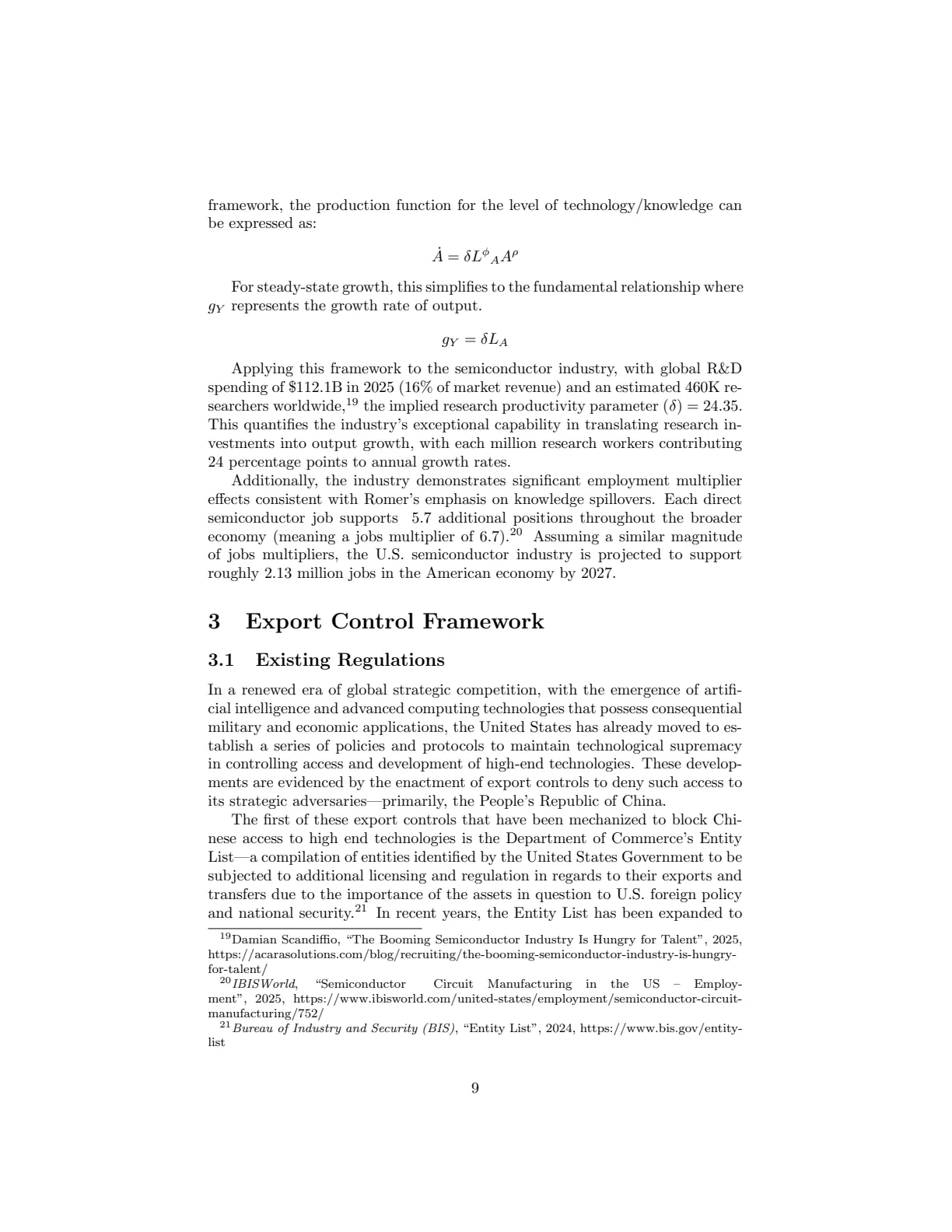
Perrin Institution Institution for Human-Centered A.I. & Institute for Youth in Policy. (2025, July 1). A.I. as a Strategic Trade Asset: Designing Export Controls for the Next Generation of Semiconductors. Perrin & Fidutam (Perrin Institution archive). https://perrininstitution.org/archive/research/ai-strategic-trade-asset