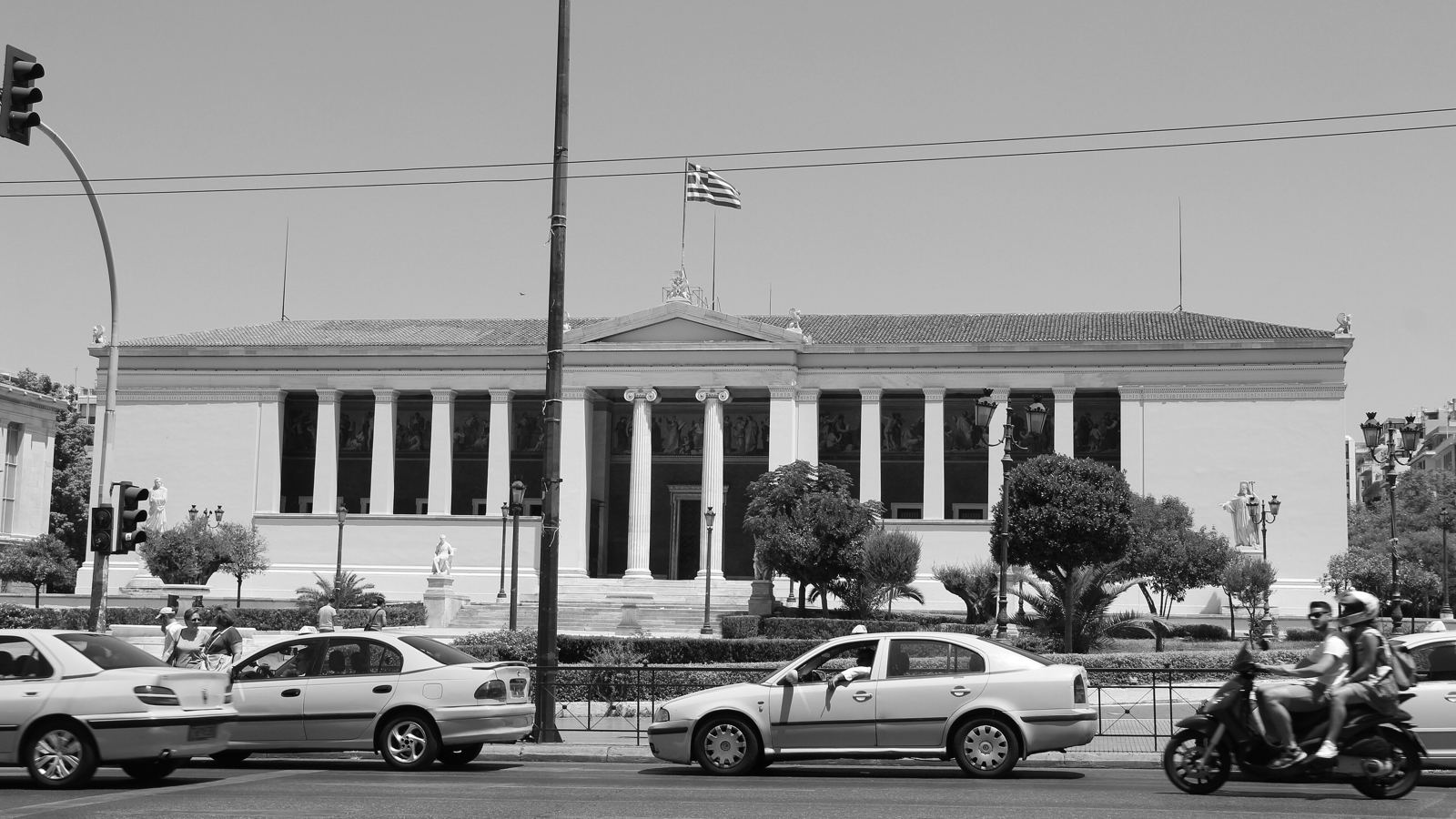
In August 2025 the Greek government completed the certification of operations for four international private universities to open subsidiaries in Greece. The topic of private universities has long been debated in Greek politics due to the legal framework concerning tertiary private educational institutions. The issuance of licences to non-public organizations, not only is prohibited by the Constitution but it has also been rejected countless times by the Greek supreme court. Yet as it seems, if the Greek Parliament is the motor that powers this legislation, then the current supreme court is the drunk driver at the wheel. This reckless driving car was able to crash and put the cornerstone of society, once again, to shame–a very common occurrence in the last dozen years. Despite the ethical challenges of ignoring the highest form of law, as well as the complementary circumstances that differentiates this case from other nations, public universities constitute a primary reason why Greece is one of the most economically failed nations. This article will examine the root of the economic issues associated with public post-secondary education, as well as analyze how even though this decision is beneficial in principle, it will prove to be catastrophic.
Ever since the post WWII era until today, Greek universities have been 100% publicly owned and operated. For the ordinary citizens of Greece, this legislation has proven to be crucial since it is simply impossible to finance both the living expenses associated with university attendance as well as pay tuition. In fact most Greek families are unable to sustain studies in regions away from their home, forcing students to either take up part time jobs or to attend local, often less prominent, schools. In and of itself, this fact is certainly not concerning. Yet the problem lies at the heart of Greek culture, which has inappropriately correlated higher education with social status. This social norm has been reinforced by the government’s attempts to prove to Europe that Greece is on par with Eurozone literacy standards, failing to consider the utility these universities provide to society. When combined, the peer pressure to attend university regardless of future employment opportunities, coupled with the plethora of choices provided by the taxpayers has led Greece among Europe’s top in educational attainment. Society has embraced the battle for an educated population celebrating those who achieve enrollment and indirectly shaming those who do not. Inadvertently, Greece is also a leader in youth unemployment among the EU, showcasing the unconsidered effects of such policies.
Economics are the pillar of modern societies. Every policy decision by public officials, every dollar spent by governments, every infrastructure project financed by the taxpayer, are all rooted in economic theory. Education is no exception. Nations invest in education, not only because it is a determinant of productivity which directly impacts long term economic growth, but also due to the conferment of positive externalities from education. In principle, more human capital–a fancy word for education and experience–translates to higher productivity and thus increased production capabilities. In economics however, there exists the idea of diminishing returns. Human capital alone is as useless as a surgeon with their hands tied behind their back. Productivity is a multivariable function of human capital, natural resources, physical capital and technological knowledge. With the other three factors stable, after a certain level, more education will prove to be economically unviable. Greece not only does not invest in the industrial and agriculture sectors, but it has also been selling domestic assets and natural reserves for pennies on the dollar. But why is the public education system to blame ?. Because at the core of economics lie incentives.
Incentives shape economies. Policies are solely a means to an end. Most legislative failures in the history of nations can be explained by a misinterpretation of the potentially created incentives. Education is an investment into human capital regardless of whether it is financed privately or publicly. It is foolish to make investments with negative returns. Of course private investments are evaluated on an implicit economic basis while public investments also take into account social benefit or harm. The big difference is exposure to risk. Public initiatives provide the incentive for moral hazard–unwanted behavior rooted in the lack of consequences associated with an action. If we apply these ideas to education it is very evident why public education is problematic, especially higher education. You see, without tuition expenses the only cost incurred from attending public university is the opportunity cost of the next best choice. Living expenses apply no matter how the studies are financed so considering them is not necessary. In contrast, associated with private education there is an additional explicit cost of tuition. Individuals will think twice before partaking in personally funded higher education, exploring the demand for professions and creating a sort of return on investment model, allowing for the market to adjust to changing conditions. Put it simply, public education creates incentives for bad choices, often resulting in market failure.
If theoretically, the introduction of private universities is strictly beneficial, then why is this article claiming that they will be disastrous for the Greek economy?. Well, all it takes to prove it is a simple supply-demand model. What has just been claimed is that the country’s economic problems are deeply rooted in the failure of its education system to cater to market conditions. This has led to a huge spike in skilled unemployment all while unskilled labor is suffering from supply shortages. Introducing private universities will only increase the supply of skilled labor, with many candidates left out of public university spots opting to go the private route. Many critics are concerned that what will arise is an opportunity to purchase a degree, undermining the efforts of hard working students. But nor is it correct to definitively assume that such events will take place, neither to use this as an argument against their certification. As already mentioned, modern policies are more economical rather than political. Instead of assessing the utility of private universities in Greek society by political terms, what should happen is genuine economic analysis on the benefits as well as disadvantages of such a detrimental decision in order to not end up in a market failure yet again.
Considering the case of the introduction of private higher education institutions in Greece, it is of vital importance to depart from political norms and ideology in order to properly evaluate the policy. Despite the theoretically positive impact private education has on economies, enabling the proper allocation of resources and shaping desirable incentives, this case is not applicable to the Greek economy. Due to the fact that Greece is already suffering from a highly skilled labor force that, however, is not on par with market demand, presenting alternative routes to specialization in the scientific fields will only exaggerate this issue. In conclusion, this policy might be a blessing in theory but due to the aforementioned evidence it will prove to be a curse for years to come.