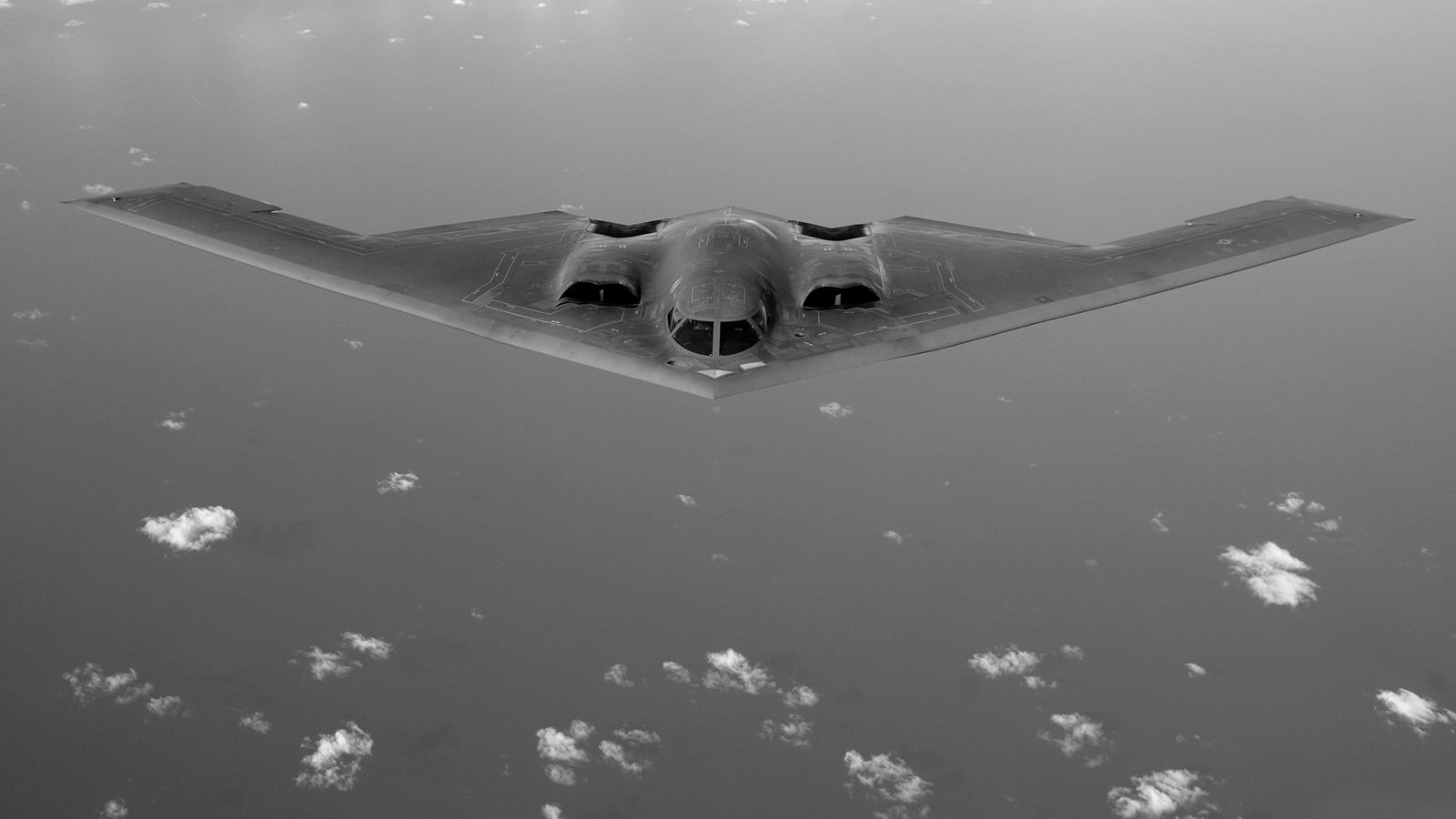
At 2:10 a.m. Tehran time, the lead B-2 Spirit Bomber banked silently over the mountains near Qom, its stealth profile hiding its presence from Iranian radars. From its bomb bay doors, two GBU-57 Massive Ordnance Penetrators (MOP) –the largest conventional explosive in the US arsenal– fell toward the hardened nuclear facility below, and with it, its first ever operational deployment.
Over the next 22 minutes, six more bombers released their payloads, delivering a total of 14 MOPs across multiple aim points at Fordo and Natanz. No anti-air missiles fired, no interceptors scrambled. By dawn, the strike package known as Operation Midnight Hammer slipped back into friendly airspace, taking with it the ambitions of the Iranian nuclear program.
How This Unfolded
While the U.S. strike sent shock waves around the world, there were clear signs of the attack in the days leading up to its execution— just a week before the strike, at least 30 U.S. aerial refueling tankers were redeployed from their bases in America into forward positions in Europe, satellite imagery of Diego Garcia (a airbase located in the indian ocean critical for middle eastern aerial operations) shows a build up of B-2 Spirit bombers, and reports from June 16th indicates that the USS Nimitz was rerouted from South China Sea operations to join the USS Carl Vinson under U.S. central command along with further reinforcements arriving in the coming weeks in the form of the USS Gerald R. Ford (the largest warship in the world) to the Mediterranean region.
The execution of Operation Midnight Hammer began late Friday night, June 21, 2025 EST, with the coordinated launch of U.S. strategic bombers from the continental United States. Part of this strike package proceeded to the West and into the Pacific as a decoy. The main package comprising 7 B-2 Spirit bombers headed east, where they underwent multiple aerial refueling maneuvers with minimal communication.
Once over land, the bombers rendezvous with escort and support air elements before proceeding towards their targets. At 5:00 p.m. EST, just before entering Iranian airspace, a U.S. submarine under Central Command launched over two dozen Tomahawk cruise missiles at key surface targets based in Isfahan to destroy critical infrastructure as well as suppress and destroy enemy air defense and early warning systems.
As the strike package closed in on Iranian airspace, escorts pushed forward to scan for enemy interceptors and potential surface-to-air threats. Currently, there is no indication that Iranian air defenses detected the inbound planes, nor did any Iranian fighters take off in response to the intrusion.
At precisely 2:10 a.m. Iran time, the lead B-2 dropped its payload of GBU-57s on Fordo. Over the next 22 minutes, the remaining bombers in the strike package executed their attacks on both Fordo and Natanz while Tomahawk strikes covered their retreat. In total, the U.S. strike deployed 14 MOPs and approximately 75 precision-guided munitions across all three nuclear targets in Fordo, Natanz, and Isfahan, 125 aircraft, and a missile submarine.
The entire operation was complete by 7:02 p.m. EST. All told, the mission was coordinated by U.S. Strategic Command, U.S. Transportation Command, U.S. Space Force, and U.S. European Command.
The Fallout
The U.S. strike marked a fundamental recalibration of American foreign policy. While past administrations have not been shy regarding military activities against Iranian proxies like the Houthis and Hezbollah, Operation Midnight Hammer marked the first direct U.S.-Iranian military confrontation since the mining of the USS Samuel B. Roberts in April of 1988 by Iranian vessels.
This particular operation serves two purposes: First, as a warning to the Iranian government as to the seriousness of U.S. intent in ceasing nuclear proliferation. Failure to respect American red lines will now be met with overwhelming military force rather than strongly worded condemnations at the UN.
Second, as a message to all U.S. adversaries, especially China, which is currently constructing a fortified joint command facility in Beijing. Even hundreds of feet of concrete will not shield you from the American military machine. The very nature of this strike package being delivered by bombers only possessed by the US, with bombs only possessed by the U.S, drives home this message. Not only was the strike devastating for Iranian nuclear infrastructure, but it was delivered in a manner no other country can replicate.
Strategically, Operation Midnight Hammer also reshuffled the regional power dynamics within the Middle East. For decades, Iran was seen as the rallying point for the anti-American, anti-Western axis in the Middle East. As such, it has been able to cultivate a wide-ranging network of Islamic extremists known as the Axis of Resistance.
Yet, as Israel began to diminish Iranian proxies following the Hamas attacks of October 7, 2023, and even struck into the heart of Iran itself in recent weeks, its position as the poster child of Islamic extremism has come under question. Increasingly, Iranian proxies have begun to prioritize their survival rather than becoming involved in Iranian wars.
Now, Operation Midnight Hammer, paired with the Israeli Operation Rising Lion, has brought Iran’s vulnerabilities into full view and made them seem helpless. Iran itself has a difficult decision to make: retaliate against U.S. assets in the region and risk further strikes from Washington, or give in and lose its legitimacy and relevance in regional politics.
In the end, Tehran has nothing to gain by drawing out this conflict. Iran has no effective weapons at scale to counter American warships and bases in the region. Before Midnight Hammer, American force protection was elevated across the region, especially in Iraq, Syria, and the Gulf. Even if Iranian weapons managed to slip through the multi-layered American air-defense networks, U.S. personnel casualties would likely prompt harsher retaliations, which Iran is in no position to defend (Operation Midnight Hammer and Rising Lion should be an indication).
A protracted conflict in the region would have consequences for the U.S. as well. The absence of the USS Nimitz from its operations in the South China Sea will certainly be sorely felt in places like Taipei and Manila, which are regular victims of Chinese military posturing in the region. The concentration of U.S. naval assets in the Middle East has left gaps in its armor elsewhere.
Yet, reactions in Beijing and Moscow are likely to lean towards cool caution rather than eager opportunism. The strike package demonstrated more than just American weaponry; it also showcased its unmatched cohesion. The tight coordination of elements across multiple chains of command and domains is something adversary nations like Russia and China have yet to fully achieve.
While technological advancements may allow Moscow and Beijing to match Washington in terms of equipment, they still lack the global reach and tight cohesion that the American military has put on display in Operation Midnight Hammer.