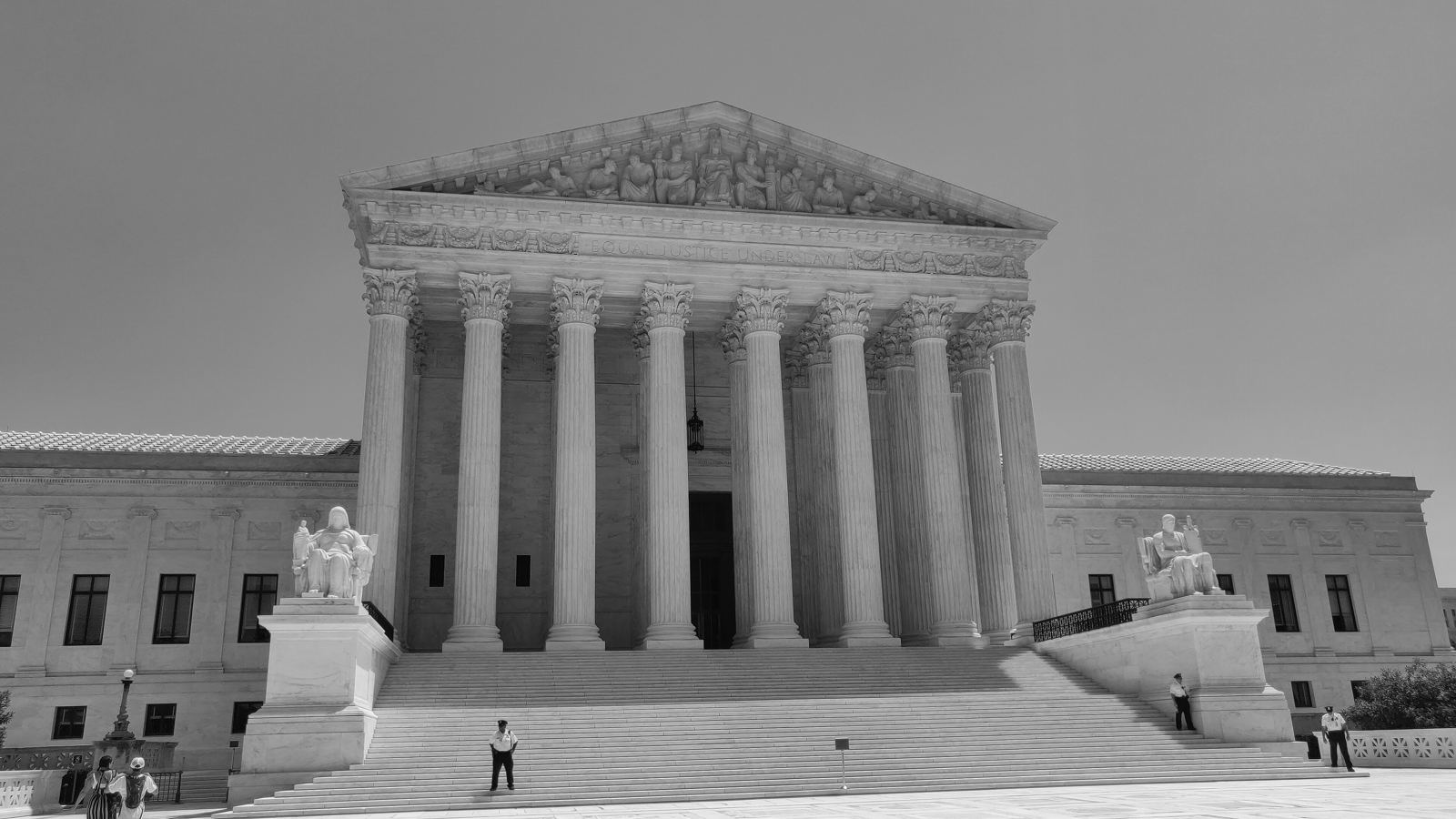
The Supreme Court of the United States (SCOTUS) recently announced that in a 6-3 majority, they had made the decision to approve President Trump’s immigration policy of deporting detained immigrants to nations they do not originate from. The decision was the result of a multi-month legal battle between the administration and judicial system over the legality of the decision. Even the SCOTUS case itself saw heated debate, with the liberal Justices of the court strongly opposing Trump’s policy.
The issue itself first arose in February, earlier this year, when the Department of Homeland Security (DHS) issued internal guidance that immigrants could be deported to countries to which they had no previous ties if they feared persecution or torture in their home countries. This policy, commonly referred to as seeking a “safe third country,” has been American immigration policy in the past, but only with Canada. In other words, asylum seekers who had entered the U.S. could only be returned back to Canada, if applicable. However, under the new administration, the U.S. has reportedly been seeking deals with over 30 countries to accept detained immigrants, including both standard immigrants and asylum seekers.
One of the most well-known examples of such a country is El Salvador. In March, the U.S. deported 238 Venezuelan men to be incarcerated at a Salvadoran maximum security prison known as the Terrorism Confinement Center, or CECOT. The administration claimed that the men were deported due to affiliations with gangs, such as MS-13, although the decision was widely critized because the overwhelming majority of the deportees had no criminal record in the U.S., and several even had active asylum cases. For example, according to Lindsay Toczylowski, an attorney for one of the deportees named Andry Romero, Romero had no criminal record, and had fled his home country of Venezuela over fears of persecution over his homosexuality and political views.
This policy was challenged in April through an injunction by U.S. District Judge Brian Murphy, who argued that the deportations, as in the case of the immigrants deported to CECOT, were conducted without due process. Specifically, Murphy required the administration to provide 10 days and a “meaningful opportunity” to express their opposition to deportation, and a further 15 days to reopen immigration proceedings if they felt their safety in the proposed third country hadn’t been sufficiently guaranteed.
However, this ruling was arguably violated by the Trump administration when it deported eight migrants to South Sudan, only one of whom was actually a South Sudanese citizen. The administration claimed the men were criminals, and that it had confirmed that the countries of origin of the seven migrants not from South Sudan had refused to accept them. However, the notice given to the migrants was criticized by District Judge Murphy as “hurried and confused.” Murphy followed up by urging the administration to observe due process, for example, by providing the migrants with a 72-hour notice prior to any interviews, by providing them with a lawyer and interpreter during said interviews, and by adhering to the guidelines he set in his initial injunction. Others have pointed out the fact that South Sudan is currently in a state of civil war, which contradicts the principle of conducting deportations to “safe third countries,” and calls into question the level of safety the administration can guarantee for the migrants.
However, the Supreme Court recently ruled on Monday, June 23rd, that the Trump administration could resume swift deportations to third countries, overruling Murphy’s decision. In other words, the administration is no longer required to provide migrants with adequate time to contest their deportation orders, and can conduct the deportations on their own schedule. While the court did not provide a formal explanation for the emergency ruling, the three liberal Justices on the court wrote their dissent. For instance, Justice Sonia Sotomayor wrote in her 19-page dissent that the decision was an “abuse” of power that was “rewarding lawlessness” and making migrants “vulnerable to torture or death” in dangerous countries. She also went on to slam the administration's prior defiance of Murphy’s injunction, claiming that “the government’s misconduct threatens [the rule of law] to its core.”
Meanwhile, the administration quickly voiced its support for the decision, with DHS Assistant Secretary Tricia McLaughlin saying that the decision means the government “can now execute its lawful authority and remove illegal aliens to a country willing to accept them.” She further commented, “Fire up the deportation planes.” The administration also began to retroactively apply the ruling to its South Sudan deportation. However, Murphy upheld his earlier ruling in this specific case, which Solicitor General John D. Sauer referred to as “unprecedented defiance.” In the context of this disagreement between Murphy’s court and the administration, it is still unclear whether or not the migrants, who are currently being held at a U.S. military base in Djibouti, will be deported.
Only the coming weeks and months will be able to tell exactly to what extent the administration plans to utilize third-country deportations, as well as the level of legal legitimacy it can expect. However, the policy is undoubtedly a representation of the administration’s approach to immigration and emblematic of the legal troubles that have come about as a result.